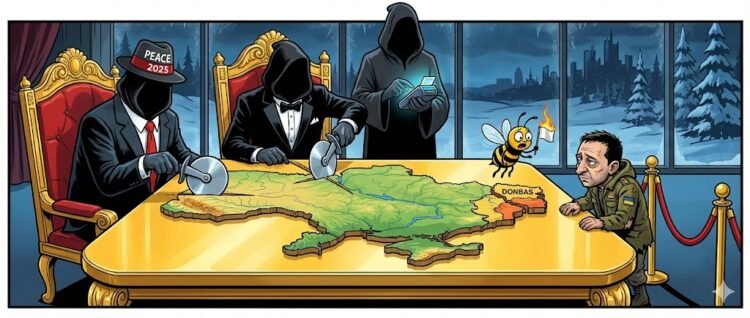
We are watching the privatization of geopolitics, where nations are not conquered but liquidated for pennies on the dollar.
It was inevitable that the end of the post-war international order would not arrive with a bang or a whimper, but with the slap of a leather portfolio on a mahogany table. The portfolio in question did not belong to a diplomat, a historian, or anyone who has spent a waking moment considering the intricate, blood-soaked tapestry of Eastern European ethno-nationalism. It belonged to the envoys of Donald J. Trump, a collection of real estate magnates and family retainers who view the map of the world less as a collection of sovereign states and more as a zoning dispute that has dragged on too long. Over the weekend, this traveling circus of closers, led by Steve Witkoff and the omnipresent son-in-law Jared Kushner, arrived to present their vision of peace. They did not bring a treaty. They brought a term sheet.
The proposal they handed to the leaders of Ukraine and Russia is a masterclass in the art of the surrender. It demands that Kyiv accept significant territorial concessions, specifically handing over the Donbas region to the invaders who bombed it into rubble. It requires Ukraine to slash its armed forces, effectively disarming itself in front of the neighbor who just broke into the house. It insists that Ukraine abandon any hope of future NATO membership, cementing its status as a buffer state in a Russian sphere of influence. In return for gutting their nation and kneeling before the aggressor, the Ukrainians are offered “security guarantees.” These guarantees, largely unspecified and backed by absolutely no enforcement mechanism, are the geopolitical equivalent of a store credit coupon valid only at a shop that burned down yesterday.
There is no promise of foreign troops to guard the new borders. There is no firm guarantee of long-term aid to rebuild the cities that were pulverized by Russian artillery. The entire architecture of the deal depends heavily on faith. It relies on the belief that Vladimir Putin, a man who has treated the Geneva Conventions like a suggestion box, will suddenly decide to play nice because he signed a piece of paper. It is a plan that could only have been drafted by men who think history began the day they were born. They believe that if you just give the bully your lunch money and your shoes, he will definitely stop hitting you, because that is how business deals work in the fantasy land of high-end real estate development.
By December 8, the reaction from the actual victims of this war was as swift as it was predictable. Ukrainian President Volodymyr Zelenskyy publicly rejected the deal. He did not mince words. He called the territorial concessions an act that no Ukrainian government could legitimize, a suicide note for the nation. He boarded a plane to London to meet with European leaders who are currently staring into the abyss, determined to preserve some shred of sovereignty before the Americans sell it for scrap. Meanwhile, back in the safety of the United States, Donald Trump publicly taunted Zelenskyy. He claimed the Ukrainian president simply hadn’t “read” the agreement carefully enough.
This is the gaslighting of the century. The implication is that if Zelenskyy just put on his reading glasses and looked at the fine print, he would realize that giving away a third of his country is actually a brilliant business move. It is the logic of the timeshare salesman. If the customer says no, it isn’t because the product is a scam; it is because the customer isn’t sophisticated enough to understand the value proposition. Trump is treating the leader of a war-torn nation like a contractor who is being difficult about the price of drywall. He is daring Ukraine to walk away from the table, knowing full well that without American ammunition, walking away might mean walking into a grave.
We must pivot to the sheer, blinding satire of this moment. We are witnessing a spectacle that casts global peace as a bizarre reality-TV special. The negotiations are not being handled by career diplomats who speak the language and know the history. They are being handled by reality-show producers. The entire vibe is less “Treaty of Versailles” and more “The Apprentice: Eastern Front Edition.” The framing is entirely transactional. Trump is playing the role of the overeager closing-time bartender. He is pushing deals. He is pouring the drinks. He is telling everyone that they don’t have to go home, but they can’t stay here, especially if they expect the United States to pay the tab.
Europe, meanwhile, is scrambling to hide the glasses before the hangover hits. The hypocrisy and power dynamics on display are nauseating. The plan reads less like a peace agreement and more like a bailout for an aggressor power. It is a political favor to Moscow wrapped in sad euphemisms about “reassurance” and “peace.” To call this a negotiation is to insult the concept of dialogue. It is a liquidation sale. The United States is acting not as a mediator but as a broker for land-grab insurance. We are negotiating not on behalf of justice, but on behalf of power realignment. We are telling the victim of a crime that the only way to stop the beating is to apologize to the assailant for bruising his knuckles.
Satirize the notion that cutting Ukraine’s defenses counts as anything other than surrender. Imagine telling a homeowner that the best way to prevent future burglaries is to remove all the locks from the doors and sell the guard dog. That is the logic of “demilitarization” in the face of an imperialist neighbor. It assumes that Russia’s invasion was provoked by Ukraine’s strength, rather than tempted by its vulnerability. It is a worldview that sees the victim as the provocation. It asks us to believe that weakness is the ultimate deterrent.
Zoom out to the European capitals, where the mood is part horror show and part diplomatic funeral. Leaders in London, Paris, Berlin, and Brussels are now painted into a corner. They have spent three years telling their populations that the defense of Ukraine is the defense of Europe. Now they are watching their most powerful ally cut a side deal that renders that defense impossible. They are forced into last-minute scrambles to assert that any agreement must have their sign-off. They are shouting into the wind that Ukraine’s sovereignty is non-negotiable. They are insisting that European security cannot be pawned off in a bilateral U.S.-Russia chat held in a gold-plated resort.
The nervousness in these capitals is palpable. It is a mix of anger, disbelief, and the cold sweat of fear. They are afraid of being sidelined by a U.S. plan drafted without their consultation. They are dreading what a premature “peace” could mean for the next war. They know that if Russia is allowed to keep its gains, it will simply rearm, regroup, and try again in five years. They know that this “deal” is just an intermission. But they also know that without American logistics and intelligence, their ability to stop it is limited. They are passengers in a car driven by a man who thinks traffic lights are a conspiracy against his freedom.
We must use biting detail to ground this absurdity. The war is coming into winter. Ukraine’s cities are battered. Its energy infrastructure has been bombed into fragility. The risks of widespread blackouts are rising as the temperature drops. Hospitals are in short supply of everything. Civilians are displaced, hungry, and under constant threat of missile barrages. And yet, the big deal on the table rewards the invasion. It rewards the people who turned the lights out. It gives the invader de facto ownership of lands they didn’t even fully seize on the battlefield. It hands over the keys to the house while the family is shivering in the basement.
This is the moral vacuum at the center of the proposal. It ignores the human cost of the war in favor of the lines on the map. It treats the suffering of millions as a sunk cost that can be written off in the final accounting. It is a view of the world where people are just inventory, and inventory can be moved, liquidated, or destroyed to balance the books.
Now, let us indulge in a satirical flourish. Imagine the post-deal press conference. It will be held, inevitably, in a ballroom with too many chandeliers. Donald Trump, Jared Kushner, and Steve Witkoff will stand on a stage, flanking Vladimir Putin. They will all be smiling the smiles of men who have just gotten away with something. They will hand out commemorative pens. They will call it “Peace 2025™”. There will be a sold-out merch line in the lobby. You can buy “Make Russia Great Again” hoodies. You can buy “Peace-in-Our-Time” bumper stickers. The world’s autocrats will applaud. The markets will rally. The pundits will call it “historic.”
Meanwhile, in the background, the reality will be much grimmer. Ukrainian widows will watch on television as the men who killed their husbands are toasted as partners in peace. Rebuilt refugee families will realize they can never go home because home is now part of the Russian Federation. European NATO officials and intelligence analysts will watch in horror as credibility, trust, and long-term security are auctioned off for a quick headline. They will see the foundations of the post-war order crumbling, not because of an external attack, but because the architects decided to sell the bricks for profit.
This tableau reveals the broader rot in this version of American diplomacy. In this world, treaties aren’t sacred; they are negotiable. Allies are optional; they are just customers who haven’t paid their dues. Red lines are optional; they are just chalk marks that can be scuffed out. Deals are temporary. War-torn nations, allied democracies, and European unity are all bargaining chips in a transactional game. Geopolitical stability is replaced by vendettas, deals, and press cycles. The goal is not a safe world. The goal is a world where the United States—or at least its leader—can claim a win, regardless of the cost to anyone else.
This isn’t isolationism. Isolationism would be leaving Ukraine to fight on its own. This is active intervention on the side of the aggressor. It is using American power to force a victim to submit. It is the weaponization of fatigue. It is telling the world that if you hold out long enough, if you are brutal enough, the Americans will eventually get bored and help you finish the job just to clear the schedule.
The “security guarantees” offered to Ukraine are particularly insulting because they come from the very people who are dismantling the current security architecture. Who is going to enforce these guarantees? The United States? We just proved we will abandon a partner the moment it becomes politically inconvenient. The Europeans? They are terrified and fragmented. The UN? A debating society with a broken microphone. The guarantee is a ghost. It is a promise made by a liar to a victim who has no choice but to listen.
We end with a dark, sardonic question that hangs over the entire affair. If this goes through, and Ukraine is forced into surrender while Europe buys silence, what happens the next time Russia re-arms? What happens when they turn their eyes to the Baltics, or to Poland, or to Moldova? If sovereignty is renegotiable, if land can be traded like portfolio assets, then what is anyone fighting for? Are we fighting for territory? Are we fighting for democracy? Are we fighting for principle? Or are we just fighting for leverage in the next negotiation?
If the answer is leverage, then the concept of the nation-state is dead. We are all just squatters on land that belongs to the highest bidder. The borders on the map are just suggestions, waiting to be erased by a man with a sharpie and a drone fleet. The idea of “home” is a sentimental delusion.
The final warning to the reader is simple. Watch the next headlines. Watch who signs the papers. Watch who walks away from the table. Watch who scolds the victims for being ungrateful. And most importantly, watch who profits. Because if peace is built on deals born from leverage, not justice and democratic consent, then what we call “diplomacy” now might just be the front-window sale for war’s next volume. The clearance sale is on, and everything must go. Even your country.
The “diplomatic hangover” in Europe is not just a headache. It is the sickening realization that the party is over, the house has been trashed, and the new landlord is handing out eviction notices. They are realizing that the Atlantic alliance was not a marriage; it was a long-term lease, and the lease is up. The United States has decided to pivot. We are pivoting away from the messy, expensive business of values and toward the clean, profitable business of deals.
It is a brave new world. A world where might makes right, and the only crime is losing. A world where justice is a luxury good that most nations can no longer afford. So take a good look at the map of Europe. Memorize the lines. Because the guys with the erasers are in the room, and they are looking for a win.
We are witnessing the transformation of international relations into a protection racket. “Nice country you have there,” the envoys seem to say. “Be a shame if something happened to your aid package.” It is mafia logic applied to the fate of millions. And the terrifying part is not that it is happening. The terrifying part is that half the world is cheering for it, convinced that cruelty is strength and surrender is peace.