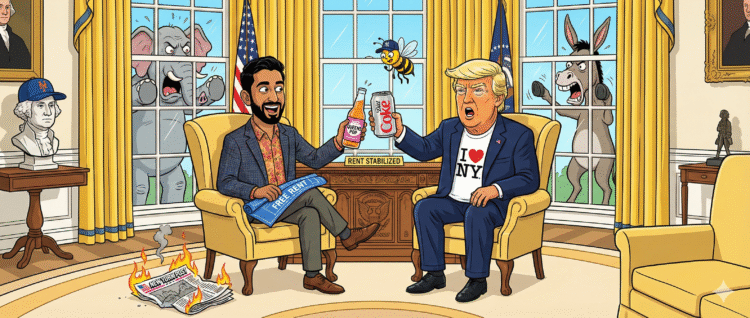
The simulation didn’t just glitch on November 21, 2025; it blue-screened, rebooted, and loaded a corrupted file from a different timeline. In the Oval Office, beneath the stern, oil-painted gaze of George Washington, the President of the United States sat next to the Mayor-elect of New York City. On paper, this should have been a cage match. In the blue corner, Zohran Mamdani: a 34-year-old democratic socialist, supporter of the BDS movement, and a man Trump had spent the last six months diagnosing as a “100% Communist Lunatic” and a “total nut job.” In the red corner, Donald Trump: the architect of the deportation force, the bane of the “radical left,” and a man Mamdani had recently diagnosed as a “fascist” and a “despot.”
The press pool was salivating. Fox News had the “Marxist Mayor” chyrons loaded. Elise Stefanik was reportedly watching from a secure location, popcorn in hand, waiting for the moment Trump would eviscerate the “jihadist” interloper and banish him from federal funding forever.
Instead, they watched Donald Trump turn into a doting Queens uncle who just discovered his nephew got into a good college.
The pivot was so violent it likely caused whiplash in the Fox control room. “We agreed a lot more than I would have thought,” Trump beamed, patting Mamdani on the arm with the affection usually reserved for a golfer who lets him win. The man who once threatened to send tanks to New York to restore order was suddenly offering to personally beat up ConEd over electricity rates. It was the most confusing display of “horseshoe populism” in American history—a moment where the far-left and the far-right looped all the way around the political spectrum, met in the back of a Queens diner, and decided that the real enemy is the rent.
The spectacle began with the kind of questions designed to draw blood. A reporter from the conservative media ecosystem, practically vibrating with anticipation, asked Mamdani if he stood by his characterization of the President as a “fascist.” In a normal political universe, this is the trap door. If Mamdani says yes, the meeting explodes. If he says no, his base revolts.
But Donald Trump, in a display of magnanimity that can only be described as “bored emperor energy,” stepped in to save him. “That’s okay,” Trump interrupted, waving his hand dismissively. “You can just say yes. Okay? It’s easier than explaining it. I don’t mind.”
There it was. Permission to call the Commander-in-Chief a fascist, granted by the man himself, largely because he couldn’t be bothered to listen to a nuanced critique of authoritarianism and preferred to get back to talking about zoning laws. It was a moment of transactional nihilism so pure it was almost beautiful. Trump essentially signaled that he doesn’t care what you call him in the New York Times, as long as you sit nicely on his couch and complain about the price of eggs.
The bond that formed over the next forty-five minutes was built not on shared values, but on shared grievances. Mamdani, sticking relentlessly to his script, talked about the “crushing cost of living.” He talked about rent stabilization. He talked about the fact that a bag of groceries in Astoria now costs as much as a used Honda Civic. And Trump, the billionaire who lives in a golden tower, nodded along like a man who personally coupon-clips at Key Food.
“The new word is affordability,” Trump declared, as if he had just invented the concept of being broke. “Another word is just groceries. You know, it’s sort of an old-fashioned word, but it’s very accurate.”
For the Republican establishment, this was a nightmare. They had spent months building a very specific scare narrative. Mamdani was supposed to be the boogeyman. He was the “Hamas-loving,” “police-defunding,” “radical extremist” who would turn New York into a Soviet satellite state. Elise Stefanik, the upstate Congresswoman running for Governor, had staked her entire preliminary campaign on being the shield against Mamdani’s “jihadist” agenda. She had practically pre-written the fundraising emails: Help me stop the Socialist takeover sanctioned by the White House!
And then Trump blew it all up. When asked about Stefanik’s “jihadist” label for Mamdani, Trump didn’t just disagree; he dismantled her. “No, I don’t,” he said, dismissing the slur with a shrug. “I met with a man who’s a very rational person. I met with a man who really wants to see New York be great again.”
somewhere in New York, a Stefanik campaign aide quietly closed their laptop and walked into the sea.
The President went further. He vowed to “stick up for” Mamdani. He promised to be “a big help.” And in the ultimate rebuke to the “Escape from New York” narrative peddled by the New York Post, he declared that he would “absolutely” live in the city under Mamdani’s leadership. “I always feel very, very comfortable being in New York,” Trump said. “And I think much more so after the meeting.”
The New York Post editorial board is currently trying to figure out how to run a cover calling the Mayor a danger to civilization while their hero is offering to be his roommate.
What we witnessed was the final death of ideology in Washington. In 2025, labels like “socialist” and “conservative” are just stage direction. They are costumes you wear to get booked on cable news. The only thing that matters—the only thing—is whether you can flatter the man in the Oval Office. Mamdani, to his credit (or cynical brilliance), understood the assignment. He didn’t walk in with a copy of Das Kapital. He didn’t lecture Trump on the intersectional dynamics of late-stage capitalism. He walked in and said, “Mr. President, the rent is too damn high, and you’re the only one strong enough to fix it.”
He played to Trump’s vanity, yes, but he also played to Trump’s lingering, lizard-brain identity as a New York builder. Trump loves to talk about construction. He loves to talk about “deals.” When Mamdani talked about building social housing, Trump didn’t hear “socialism.” He heard “real estate development.” He heard concrete, steel, and ribbon cuttings. He heard “jobs.” The fact that the housing would be government-owned was a detail too boring to disrupt the vibe.
This is the “Horseshoe Theory” of American politics in action. The democratic socialist from Queens and the right-wing nationalist from Queens found that they have more in common with each other than they do with the squishy, technocratic middle. They both hate the “swamp.” They both hate the “establishment.” They both think the system is rigged (though they disagree on who rigged it). And they both understand that the average voter doesn’t care about the dialectic; they care that their ConEd bill just doubled.
By focusing entirely on “affordability,” Mamdani gave Trump an out. He allowed the President to pivot from “culture warrior” to “economic populist” without having to actually change any policies. Trump gets to look benevolent, a magnanimous leader reaching across the aisle to help his hometown. He gets to stick a thumb in the eye of the Republican establishment that secretly loathes him. He gets to show that he is the “King of New York,” holding court with the new Prince.
For Mamdani, the gamble was massive. He risked alienating his own base, the young progressives who view Trump as an existential threat. Normalizing a “fascist” by chatting about utility rates is a dangerous game. But Mamdani walked away with the ultimate prize: protection. By getting Trump to say “I’ll stick up for you” on camera, he inoculated himself against the worst of the federal retaliation. It will be much harder for the Department of Justice to sue New York into oblivion when the President is on TV calling the Mayor a “rational guy.”
The losers in this scenario are the partisans who rely on conflict to pay their mortgages. The Fox News hosts who had their “Mamdani Meltdown” segments ready to go were left scrambling to explain why the President was hugging the Marxist. The Democratic consultants who planned to run against “Trump’s Extremism” now have to explain why their own rising star is high-fiving him. The clarity of the “Good vs. Evil” narrative has been replaced by the murky, transactional reality of “Queens vs. Everybody.”
As the press conference wound down, Trump offered one final, perfect encapsulation of the moment. “I think he is going to surprise some conservative people, actually,” he said, smiling at the cameras. It was a warning shot to his own party: I decide who the enemy is. Today, the enemy isn’t the socialist mayor. The enemy is the landlord raising the rent, the utility company raising the rates, and the boring politician trying to tell Donald Trump who he can be friends with.
In the end, the meeting wasn’t about policy. It was about vibes. It was about two guys from the outer boroughs looking at the mess of Washington and deciding that, actually, they’d rather just complain about the price of a slice. And in the broken, bizarre landscape of 2025, that might be the most stable coalition we have left.
The Fine Print for Grownups
The danger of this “bromance,” of course, is that it obscures the very real, very dangerous authoritarian impulses that Trump has not abandoned. While he plays nice with Mamdani, his administration is still detaining thousands of immigrants, dismantling the Department of Education, and threatening to execute his political enemies. The Mamdani meeting is the sugar that makes the medicine go down. It allows low-information voters to look at the screen and say, “See? He’s not a dictator; he’s working with the other side!” It is a PR coup that softens the edges of a hard regime. Mamdani got his rent freeze, perhaps. But Trump got something far more valuable: normalcy.