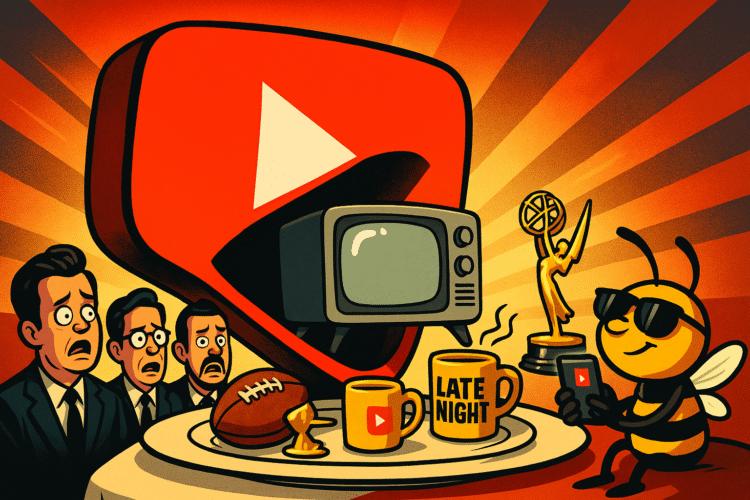
There’s a poetic cruelty in watching television networks—once smug arbiters of American attention—now refreshing their own YouTube analytics like anxious creators in ring lights. For decades, they owned the living room. Now, they’re tenants, and the landlord’s name is YouTube. The deep dive is no longer theoretical: YouTube has eaten TV’s lunch, commandeered its dinner plate, and is currently licking the frosting off its Emmy.
Once upon a time, television was the cathedral of culture. It had anchors, time slots, and a moral high ground. But sometime between the third reboot of The Bachelor and the seventeenth Marvel tie-in, Google’s video arm stopped being an afterthought for clips and cat videos—and became television’s central nervous system. It’s not “new media” anymore. It’s the media.
The Turning Point: From Clippings to Kingdom
When YouTube first arrived, it was the highlight reel after the main event—the digital afterparty for network moments. Late-night hosts uploaded their best bits; sports leagues dropped teasers; viewers grazed. But the platform did what television never could: it personalized addiction.
Now, YouTube isn’t supplementing television—it’s supplanting it. The proof is statistical and spiritual. The company’s first exclusive NFL Sunday Ticket broadcast drew more than 17 million global average viewers, surpassing the reach of entire cable networks. Sports, television’s last unbroken fortress, has been breached by a content algorithm.
The same week, Fox’s sports ratings jumped double digits once streaming was folded into the metrics. Google’s distribution muscle inked a fresh NBCUniversal carriage deal, effectively turning its on-demand pipeline into a broadcast syndicate. Traditional TV chiefs have stopped calling YouTube a “partner.” They’ve started calling it “our oxygen.”
The Late-Night Humbling
Nowhere is this shift more visible—or humiliating—than in late night. Once the province of Letterman’s monologues and Leno’s chin jokes, the 11:35 p.m. slot has been cannibalized by the algorithm. The “show” still airs, technically, but the real audience arrives the next morning on YouTube, where the clips go viral before most Americans have brushed their teeth.
Jimmy Kimmel, ever the accidental truth-teller, put it bluntly: “ABC pays for the show. YouTube pays for the audience.” He’s not wrong. Every late-night team now has a bespoke sketch unit—writers, editors, thumbnail designers—whose only job is to manufacture virality. The real rivalry isn’t Colbert vs. Fallon. It’s Colbert vs. Hot Ones.
Hot Ones, hosted by Sean Evans, isn’t a talk show—it’s a ritual of suffering disguised as branding. Celebrities confess, sweat, and break under the pressure of poultry. It’s cheap, ingenious, and infinitely replayable. Each episode racks up tens of millions of views, a number that would make a CBS executive weep into their Nielsen charts.
Meanwhile, independent podcasters like Theo Von and Andrew Schulz now command bigger audiences than entire networks—without corporate overhead, censorship delay, or a thirty-second cue card shuffle. They own their IP, their channels, and their ad inventory. Network talent owns… debt.
The Algorithm Is the New Executive
Television executives used to brag about their “gut instincts.” YouTube replaced guts with code. The algorithm doesn’t sleep, doesn’t hedge, and doesn’t care about prestige. It rewards consistency, novelty, and retention. To the modern entertainment economy, that’s divinity.
Every late-night producer now prays at the altar of “watch time.” Interviews are reverse-engineered for thumbnails. Guest bookings come with SEO decks. Even the biggest celebrities—actors, athletes, politicians—now require custom sketches designed specifically to succeed on YouTube’s front page.
It’s a bizarre inversion of power: networks pay millions to stage interviews, only to surrender the final cut to an algorithm trained to prioritize chaos. The “moment”—once the province of marketing strategy—is now a variable in a formula.
Sports: The Last Domino Falls
For years, sports leagues swore allegiance to cable contracts and their sacred rights deals. But YouTube’s entry into live sports streaming—via NFL Sunday Ticket and platform-exclusive games—has detonated that logic. The company didn’t just buy games; it bought the audience’s habits.
Watch Parties, Shorts, and “Watch With” streams have turned sports from appointment television into a continuous feedback loop of reaction, replay, and engagement. Instead of waiting for halftime commentary, fans dissect plays in real time with creators who monetize their fandom faster than ESPN can break for commercials.
The result? A sports ecosystem that feeds itself through YouTube’s arteries. Every touchdown spawns 400 Shorts, every blooper a thousand memes. Television was the cathedral; YouTube is the bazaar.
The Ratings Mirage
Network chiefs insist that they’re not panicking. They’re just “pivoting to platform diversity.” That’s executive code for “we’re uploading our souls.”
Consider this: YouTube’s global average viewership now outpaces every U.S. cable network combined. The median age of a YouTube viewer is 27. The median age of a broadcast TV viewer is dead.
Advertising dollars are migrating accordingly. Big brands no longer ask about prime-time slots—they ask about engagement rates. They don’t want viewers; they want view-through conversions. For the first time, a TikTok-style ad buy can outperform a network campaign. The only metric television still dominates is nostalgia.
And nostalgia doesn’t monetize.
The New Deal: Creators as Studios
What used to be a talent pipeline has become a talent exodus. Creators who once dreamed of “making it to TV” now treat the networks like retirement homes. The economics are too lopsided: on YouTube, creators keep up to 55% of ad revenue, control their release schedule, and retain IP rights. On network TV, you get residuals, if the lawyers remember.
In the past, a showrunner’s dream was syndication. Now it’s monetization velocity—how fast you can move from upload to profit. The Hot Ones empire, the MrBeast industrial complex, the Dude Perfect merchandising juggernaut—all point to a future where creators aren’t employees but mini-studios.
The YouTube Partner Program is now the de facto guild. Its bylaws are algorithmic; its union meetings happen in Discord.
Commerce Becomes Content
The real sorcery of YouTube’s rise isn’t just viewership—it’s conversion. Every clip is a potential storefront. The “shop” button under a viral video is now a revenue gateway for creators and advertisers alike.
Television spent decades pretending the audience didn’t exist between ad breaks. YouTube collapsed that distance. You don’t just watch an ad—you comment on it, remix it, or buy the product before the clip ends. It’s attention capitalism perfected: one tab open, one click away from transaction.
When you combine that with YouTube’s global reach—available in over 100 countries—the traditional ad model starts to look like a rotary phone.
Jimmy Kimmel’s Existential Crisis
Kimmel’s confession that “ABC pays for the show, but YouTube pays for the audience” wasn’t a joke. It was the summary of a dying medium. Every late-night host now owes their cultural relevance to clips, not broadcasts.
The irony is suffocating: the networks fund production, talent, and distribution, but YouTube owns the relationship. If a Fallon monologue goes viral, it’s credited to Fallon, not NBC. The platform eats the metadata, the traffic, and the future.
Meanwhile, digital-native talk shows—like Chicken Shop Date or Between Two Ferns—run circles around legacy formats. They’re lean, absurd, and infinitely replayable. What’s a ten-minute segment on ABC compared to a four-minute existential meltdown over spicy wings?
Google’s Quiet Coup
Google’s latest NBCUniversal carriage pact isn’t just business—it’s declaration. By securing distribution rights across both legacy and digital systems, YouTube positioned itself as the default television provider for the 21st century.
You don’t flip channels anymore; you refresh feeds. And unlike the old TV guide, this one learns you. It knows your insomnia pattern, your guilty pleasures, your political lean. It can predict which late-night sketch you’ll watch before you do.
Television was an appointment. YouTube is a mirror.
Hybrid Futures: The Next Genre War
The next frontier isn’t who owns content—it’s who controls context. YouTube’s experiments with hybrid release models—clips leading to longform storytelling—hint at a future where scripted entertainment plays by creator rules. Imagine a serialized drama where each episode premieres in chunks, and viewers choose whether to binge or drip-feed.
Traditional studios scoffed at that once. Now they’re quietly testing it. Because audience behavior has already shifted: people watch, discuss, and remix shows on YouTube whether or not networks allow it. The question is no longer how to keep them watching live—it’s how to keep them watching you.
Legacy TV’s False Choices
The big networks are facing their most unromantic decision yet:
- Rebuild around YouTube distribution and creator collaborations.
- Keep pretending “live TV events” can outdraw a billion personalized screens.
There’s no third option.
For now, they’re trying both—partnering with creators while still scheduling pilot seasons like it’s 2007. But creators don’t wait for greenlights. They upload. They iterate. They build audiences faster than executives can form committees.
The television era was built on scarcity. The YouTube era thrives on surplus. Every minute, five hundred hours of new content go up. Television was a monoculture; YouTube is an ecosystem. And ecosystems don’t have finales.
THE END CREDITS (STREAMED LIVE)
The real tragedy isn’t that TV is dying—it’s that it refuses to die gracefully. The medium that once defined mass connection now survives as algorithmic content fodder. The audience didn’t disappear; it migrated. The living room became the comment section.
YouTube didn’t just eat television’s lunch—it learned how to cook. And as sports, comedy, talk, and scripted genres collapse into its gravitational pull, the future looks less like prime time and more like perpetual time.
The next Johnny Carson won’t sit behind a desk. They’ll sit behind a ring light, armed with editing software, and a revenue split.
Television once taught us to gather. YouTube taught us to perform. The rest of culture is just trying to keep up.