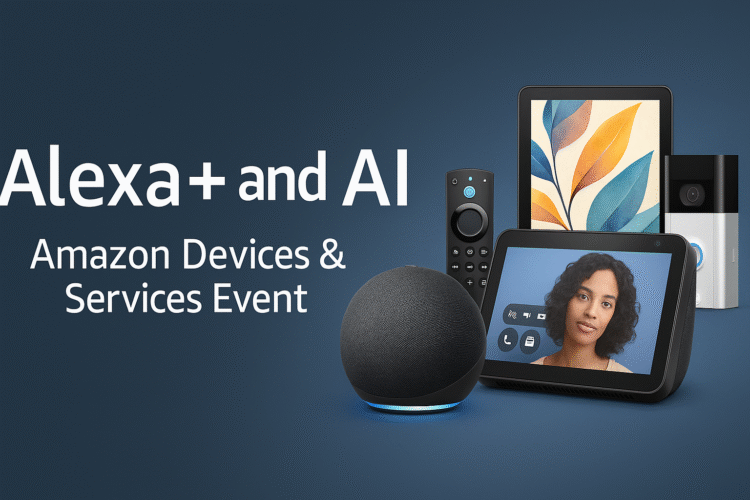
At precisely 10 a.m. ET, Panos Panay strode onto the Amazon stage and began the familiar dance: new gadgets, bolder claims, bigger vision. But this time the reveal looked less like a tech refresh and more like a domestic overlay. This wasn’t just about speakers and TVs. It was about claiming more of your life—how you listen, how you see, how you move in your home. It was a whisper: your walls are telling on you.
Amazon’s Devices & Services 2025 salvo is ambitious. Headlining was a new Echo Studio (price ~$219.99, shipping late October), with spatial audio, Dolby Atmos support, and a next-gen AZ3 Pro chip. There’s also a new Echo Dot Max, revamped Show models (Show 8 and Show 11), and a new Fire TV Stick 4K Select at a surprisingly modest $39.99. The big reveal: Vega OS, Amazon’s post-Android TV platform. Kindle gets fresh life too: slimmer, AI-driven Scribe models (including color) and a petite color Kindle. Ring cameras upgrade with 2K/4K, facial “Familiar Faces,” and “Search Party” for lost pets. All of it rolled under the banner of Alexa+, a more personalized, AI-first assistant.
Sounds shiny. But as always, the devil lives in the details. Let’s trace what changed, what really moved, and how deep the push is into your home’s seams.
The New Hardware: Hype and Reality
Echo Studio & Echo Dot Max
The centerpiece is the new Echo Studio, now endowed with spatial audio and Dolby Atmos support. The claim: immersive 3D sound that surrounds you. Apple and Sonos have flirted with this—Amazon now wants to make it ubiquitous. Under the hood: the AZ3 Pro chip. They say it offers faster local inference, better wake-word detection, and more on-device AI processing.
The Echo Dot Max is a new middle child. Bigger than a Dot, smaller than a Studio. More powerful drivers, better bass, likely a step toward getting “good enough” audio into more rooms. The light ring moves to the front face instead of the top—one more visual cue that devices are watching, listening, processing.
These speakers also support Alexa Home Theater, a scheme to link up to five Echo speakers with a Fire TV to create a surround-sound experience. In theory, your living room becomes a mesh of audio awareness, with Amazon’s AI calibrating every movement, every voice.
Echo Show 8 & 11
They updated the Echo Show displays too. Improved screens, cameras, more capable speakers. The Show devices now lean into video, telepresence, ambient computing—face recognition, health insights, smarter routines. The idea: your display should know who you are, anticipate what you want, and interrupt you less awkwardly.
Fire TV, Vega OS, and the Stick
Perhaps the boldest move: the new Fire TV Stick 4K Select, priced at $39.99, shipping October. It’s not just another streaming stick. It’s the first device to debut Vega OS, Amazon’s in-house replacement for Android-based Fire OS. (Amazon has leased this shift for months via leaks; now it’s public.) This marks Amazon’s desire to own the full stack: hardware, software, AI, and the “turn your living room smart” narrative. Reuters+4WIRED+4Android Police+4
Vega OS, reportedly Linux-based, is meant to be leaner, more tightly controlled, and more modular for AI and personalized services. Some TV lines and the new stick will run it out of the box; older Fire OS devices may not be upgradable. That means fragmentation, but also a platform Amazon can mold without Android’s constraints. WIRED+4Android Central+4Android Headlines+4
Amazon also introduced new Fire TV sets: Omni QLED, 4-Series, 2-Series, all with embedded Alexa+ features. They start in price ranges as low as the mid-hundreds. All preloaded with the new assistant experience. The Verge+2WIRED+2
Kindle Scribe & Petit Color
Kindle got resurrected in Amazon’s imagination. Slimmer, lighter Scribe models now include AI notebook search—ask your Scribe, “Where did I write that quote about freedom?” and it will dig it up. They also debuted a color Scribe, the first Kindle to try color ink. A smaller “Petit Color” Kindle also joins, offering color display in a more portable size. These devices aren’t just reading tools—they’re projectors for personalization and memory assistance.
Ring & Blink Upgrades
In home security, Amazon leaned hard on visuals and identity. Ring now offers 2K/4K models, Familiar Faces recognition, and a Search Party tool to identify pets. Blink cameras boost resolution and integrate tighter into the Alexa+ ecosystem. These devices more aggressively position themselves as identity analytics engines: who’s at your door, which pet is this, does this visitor match your social graph, etc. AP News+2Reuters+2
What’s Actually New—and What’s Not
When Amazon says “next-gen,” you should lean forward. But many upgrades are iterative, not revolutionary.
- Chips & AI leaps: The AZ3 / AZ3 Pro chips promise more local inference, less cloud round-tripping, faster responses, better privacy in theory. But Amazon’s pitch relies on seamless AI handoff between device and cloud, which is hard to deliver at real scale.
- Acoustics & sound design: Spatial audio is real, but its perceptual impact depends heavily on room acoustics, speaker placement, and software tuning. No chip by itself guarantees immersive experience.
- Camera & sensor upgrades: More sensors and cameras mean better tracking, face recognition, ambient awareness. But privacy trade-offs increase. Who stores that data? On-device or in cloud?
- Display & UI improvements: New screens and UI refinements matter, but they extend the same interaction model—watch, talk, tap.
- Vega OS & ecosystem lock-in: The move off Android is strategic. It lets Amazon control the update cadence, UI, data architecture, and app ecosystem. But it also risks developer resistance, app fragmentation, and transitional brokenness.
- AI features & personalization: The “glue” stuff—proactive routines, predictive suggestions, cross-modal transitions (from speech to visual) — these are what will differentiate real evolution from marketing sleight-of-hand.
The Stack: How It All Fits Together
Amazon doesn’t launch devices in silos. They launch ecosystems. Echo, Fire TV, Kindle, Ring, Blink, eero—they’re all layers on Amazon’s smart-home fabric. The pitch: Alexa+ becomes the conductor, orchestrating your devices, your schedules, your routines, your preferences.
- Echo + Fire TV: The Home Theater linking Echos to Fire TV makes your speaker network part of your cinematic system.
- Echo + Ring: Smarter doorbells talk to smart speakers; presence and identity cross modalities.
- Kindle + Alexa+: Your reading data, your notes, your queries become inputs to the assistant’s memory.
- Vega OS centralizes control: Amazon gains tighter control over device updates, UI, monetization models.
All of this aims for what I call “ambient orchestration”: your home AI intervenes not just when you ask, but when you don’t know to ask.
Competitive & Regulatory Arena
Amazon faces Google and Apple, both pushing AI assistants. Google has a lead in search and cloud. Apple has privacy branding. But Amazon trades strength in home devices, e-commerce reach, Prime services. Alexa+ needs to deliver something they can’t: deep, daily contextual integration.
But regulatory scrutiny is rising. Facial recognition and identity analytics (Ring’s Familiar Faces) face civil-rights pushback. How long before courts ask Amazon: on what authority do you track who walks to your door? How is that data stored, used, or shared?
The shift to Vega OS also raises antitrust and ecosystems questions. If Amazon locks developers into its platform too tightly, it becomes gatekeeper. The move away from Android is bold—but it invites pushback: who owns your homescreen, your app store, your device data?
Privacy toggles were glossed over in the event. You saw disclaimers: “We’ve built privacy settings in.” But those settings are rarely front and center. The deeper AI behavior often hides behind defaults. The question: do you trust them to design “opt-out”?
The Strategic Stakes
There are several strategic bets Amazon is making here:
- AI lock-in: Once Alexa+ becomes good at predicting your habits, voice models, preferences, users will be reluctant to switch.
- Home as battlefield: The more Amazon’s ecosystem controls your lights, your security, your screens, the more indispensable it becomes.
- Revenue beyond hardware: Devices subsidize loyalty. Amazon wants to monetize assistant insights, subscriptions, premium AI tiers.
- Data moat: Every camera feed, voice query, reading pattern flows to Amazon. The richer that data, the harder to replicate.
- Holiday push: This rollout is timed for holiday adoption. Families buy new TVs, speakers—embedding the stack right into living rooms for the next cycle.
This is not just gadget refresh. It’s expansion of domain. Amazon is repositioning from retailer/tech company to ambient intelligence firm: you live inside its network, not beside it.
Risks, Friction, and Question Marks
- Backward compatibility: Many current Fire OS devices may not support Vega OS. Users will feel abandoned.
- Developer adoption: Will app makers port to Vega OS? If not, the new platform may be weak in content offerings.
- Performance claims vs latency: Local AI is alluring, but real-time performance on budget hardware is hard. Cloud fallback will remain necessary.
- Privacy backlash: Facial recognition, surveillance mapping, proactive routines—these will trigger civil-rights campaigns.
- Trust erosion: Amazon must prove it doesn’t use its assistant to nudge you toward their services, products, or third-party partners unfairly.
- Regulatory intervention: FTC, DOJ, privacy commissions may examine data usage, monopoly dynamics, competitive harm.
- User fatigue: A push toward ambient orchestration may feel invasive. Some users may reject a home that “knows too much.”
The Bigger Picture: Alexa+ as Home Choreographer
This event is Amazon’s pitch for ownership of your sensory life. It’s not just “ask Alexa what the weather is.” It’s: Alexa watches, listens, suggests, anticipates, orders, adjusts, nudges. It’s a quietly choreographed home, not reactive but continuous.
Let’s be honest: we’re at the point where our homes need assistants more than assistants need homes. The climate changes, remote work intensifies, energy systems grow complex. Smart devices feel like helpers. But the deeper risk is handing the choreography over to a single private firm.
The Amazon stack is jockeying to be the spine of our private lives—TV, security, reading, audio, identity. When that spin becomes seamless, when device logos vanish and behavior emerges, that’s when you bow to the invisible hand of ambient control.
Anatomy of the Push
Let me pull apart specific lines from the event that belie deeper designs:
- “Ambient intelligence” was repeated. That’s a polite way to say: your home will interrupt you, not you interrupt it.
- On-device AI models + cloud fallback: the claim is privacy plus performance. But fallback means everything traces back to Amazon’s servers anyway.
- Facial “Familiar Faces” and pet ID: helpful? Yes. Creepy? Also yes. Who controls the identity registry? Who gets opt-out?
- Vega as Android replacement: Amazon unshackles itself, but also gates you. No more Android updates, no more third-party app installs outside Amazon’s control.
- Preorders and limited early-access flags: they’re using scarcity to force leaps into the new platform—get the hardware now if you want the AI experience.
One moment stood out: Panay said it’s “less about your devices and more about you.” That line is the thesis. The new Alexa+ push isn’t device-first. It’s person-first, home-first. Everything else is the scaffold.
Final Thought
Amazon’s Devices event wasn’t a showcase. It was an inauguration. They unveiled not just gadgets, but a worldview: you live inside Amazon’s intelligence, not alongside it. The upgrade isn’t just in your speakers—it’s in your expectations. The shift from reactive assistant to ambient choreographer marks a priority move: they want to earn your trust not by what you ask, but by what they predict you want.
If you accept that, you accept a new center of gravity in your home. That’s not just tech. That’s quiet governance. And it’s up to you whether to let it light up your rooms—or your control.