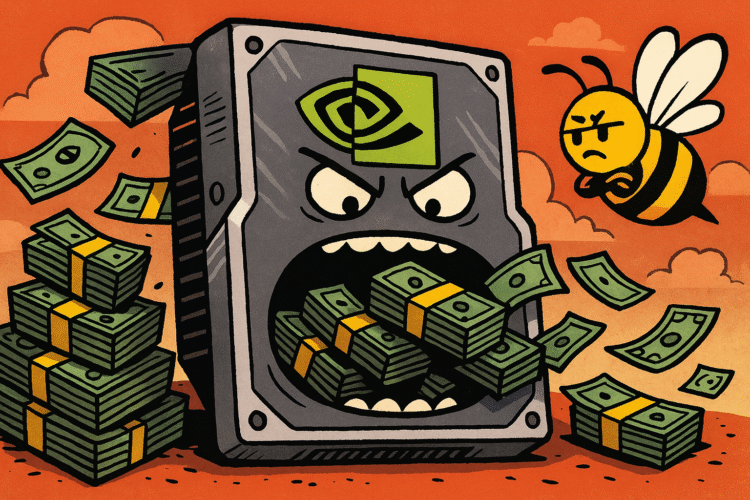
There’s a fine line between innovation and collective delusion, and we are currently sprinting across it in a pair of $2,000 AI-branded sneakers financed at 22 percent APR.
Fortune’s latest interview with Morgan Stanley Wealth Management CIO Lisa Shalett reads less like financial analysis and more like a desperate intervention at an industry support group. The “AI trade,” she warns, has a chokehold on the markets—three-quarters of the S&P’s gains, four-fifths of its profit growth, and nearly nine-tenths of its capital expenditures are now chained to the same glittering promise: that generative AI will save us all.
It’s a seductive story. Unfortunately, it’s also starting to smell like the dot-com bubble, only this time with more GPUs and less shame.
The Holy Trinity: Nvidia, Nvidia, and Nvidia
You can’t talk about the AI boom without talking about Nvidia. The company isn’t just a stock anymore—it’s a religion. Its CEO, Jensen Huang, wears his leather jacket like a clerical robe, delivering sermons about “AI factories” while his market cap hovers near the GDP of France.
Shalett’s warning is simple: we’ve concentrated the entire global growth narrative into a single ticker symbol. Nvidia is now the beating heart of Wall Street’s AI faith. Every hedge fund, pension plan, and retail investor has become a de facto semiconductor cultist.
The irony? Most of this “AI revolution” still produces little tangible productivity beyond a few better-worded emails and a tsunami of low-effort LinkedIn thought leadership.
We’ve built a trillion-dollar market cap on autocomplete.
Cisco’s Ghost Is Typing…
Shalett draws a chilling parallel to Cisco circa 2000, when network infrastructure was the buzzword of the century and routers were going to change everything. They did, but not before Cisco’s stock cratered 80 percent as supply, hype, and debt collided with gravity.
Today, Nvidia stands in Cisco’s shadow—commanding the same reverence, same dominance, same delusion. Except this time, the stakes are bigger. We’re not just talking about overpriced routers. We’re talking about massive, debt-funded data centers consuming the energy of small nations while investors chant “AI forever” like a Vegas slot machine mantra.
When the correction comes—and it will—it won’t just hit tech bros and traders. It’ll hit pensions, 401(k)s, and city budgets tied to “innovation districts” that can’t pay their electric bills once the speculative music stops.
Circular Logic, Circular Money
Shalett’s critique cuts deeper: the AI ecosystem is increasingly self-referential. Companies are raising money to build data centers so they can train AI models that generate PowerPoints to raise more money for data centers.
It’s a closed economic loop, powered by venture capital, corporate debt, and delusional optimism. Nvidia sells chips to cloud providers, who buy them with borrowed money, then rent them back out to startups training models no one can afford to run profitably.
Wall Street calls this “synergy.” Economists call it “a pre-collapse feedback loop.”
The Invisible Taxpayer in the Server Room
What makes this bubble particularly grotesque is that the public is footing the bill without getting the profits.
The data centers sprouting across the country like invasive species don’t just cost billions to build—they devour electricity, land, and water, all subsidized by local communities desperate for “tech jobs” that rarely materialize.
Residents in places like Iowa, Arizona, and North Carolina are watching their utility rates rise so multinational corporations can power cloud farms training models that mostly generate better ad copy.
Your electric bill is now venture capital for someone else’s speculative hallucination.
The Bankers Are Nervous Again (Which Is Never a Good Sign)
When even Jamie Dimon—a man whose resting heart rate is measured in basis points—says the market has a “material probability of breaking,” you know something’s off.
The Bank of England and the IMF are both sounding alarms about “stretched valuations.” Translation: this looks like a bubble, walks like a bubble, and will almost certainly explode like one.
But here in America, we treat bubbles like birthday balloons. We keep blowing until it pops, then act surprised when we’re covered in latex and regret.
A Bubble Without a Product
At least the dot-com boom built websites. At least crypto had… well, an ethos.
This time, we’ve bypassed the messy middle step of creating anything functional. The AI trade is selling promises of future efficiency—not actual productivity, just the potential for productivity.
The entire market is one giant “what if.” What if AI writes code? What if AI cures cancer? What if AI makes toast and feelings?
We’re not buying products—we’re buying hypotheticals. And every quarter, companies release earnings reports that sound like cult testimonies: “Our AI strategy is progressing as planned. Revenue will follow.”
Spoiler: it usually doesn’t.
The Jobs Mirage
The cruelest irony? This isn’t even counting what AI will do to the job market when the bubble bursts.
Because make no mistake—it will burst, and when it does, the aftermath won’t just be financial. It’ll be existential.
For now, corporations are spending billions on AI tools to “enhance productivity,” which is corporate doublespeak for “replace people with cheaper algorithms.” But once the hype cycle collapses, companies won’t just shed workers—they’ll shed entire departments that no longer have meaning in a post-AI narrative.
The layoffs won’t stop when the bubble pops; they’ll accelerate.
The future will be automated unemployment, powered by hardware nobody can afford and software nobody trusts.
Main Street’s Hidden Exposure
While Wall Street plays musical chairs with GPUs, ordinary Americans are holding the bag.
Your pension fund? Probably has exposure to Nvidia, Microsoft, or one of their AI-adjacent suppliers.
Your mutual fund? Likely overweight on tech.
Your local government? Maybe just offered tax abatements to a data-center developer promising “innovation jobs” that require five PhDs and a willingness to work nights monitoring server humidity.
When the correction comes, those losses won’t hit Silicon Valley—they’ll hit school districts, retirees, and anyone whose “balanced portfolio” was quietly rebalanced into an AI piñata.
The Hyperscaler Hangover
The biggest players—Amazon, Google, Microsoft—are spending hundreds of billions building server farms the size of small cities. It’s a global construction boom for machines that will spend most of their lives at 40 percent utilization.
It’s not infrastructure—it’s a speculative arms race.
The cost of capital keeps rising, the demand for power is outpacing supply, and regulators are starting to notice that these companies are essentially private utilities—except without the oversight.
If interest rates stay high, these projects will become unprofitable overnight. But by then, the towns that hosted them will be stuck with the environmental bill, and the companies will have already moved on to the next “strategic pivot.”
The Policy Mirage
The Biden administration loves to talk about “AI leadership.” Lawmakers love to talk about “innovation.” What nobody wants to talk about is accountability.
If AI’s gains are privatized while its costs—energy, land, and risk—are socialized, we’re not building the future. We’re building a rent-seeking machine dressed in buzzwords.
The policy debate should be simple: Who benefits when AI works, and who pays when it doesn’t?
Right now, the answer is clear. Nvidia’s shareholders get the profits. Everyone else gets higher power bills, more market volatility, and fewer stable jobs.
The Religion of Progress
The reason the AI bubble is so hard to pop is that it’s not just financial—it’s ideological. We’ve convinced ourselves that any slowdown in tech investment equals regression.
We no longer distinguish between progress and profit.
Every skepticism is labeled “anti-innovation.” Every cautionary flag is waved away with “you just don’t understand exponential growth.”
But exponential growth isn’t a strategy. It’s a shape—one that always ends the same way: vertical, then vertical again, then suddenly horizontal.
The Carbon Footprint of Hubris
AI doesn’t just cost money—it costs the planet.
Training a large model consumes millions of kilowatt-hours of electricity and guzzles water by the ton. Data centers are the new coal plants, but shinier.
When executives brag about “training the world’s largest model,” what they really mean is “we burned enough power to light Cleveland for a month.”
And yet, the same companies release sustainability reports about “reducing paper use.”
It’s like bragging about quitting plastic straws while you dynamite the ocean floor.
The Slow-Motion Crash
What makes this moment so eerie is how familiar it feels. The IMF, the Bank of England, the Jamie Dimons of the world—they’ve all seen this movie. But nobody wants to be the first to leave the theater.
Markets don’t correct out of wisdom; they correct out of panic.
And panic, once it begins, moves faster than a training run on borrowed GPUs.
The Endgame
When the bubble bursts, there won’t be fireworks. There will be silence—empty data centers, half-built campuses, and balance sheets full of “AI initiatives” that no one can explain.
Tech stocks will crater, but the language of disruption will survive. The same executives who inflated the bubble will rebrand overnight: “This wasn’t a collapse—it was a recalibration.”
And the cycle will start again.
Closing Section: The Machine That Ate Everything
AI was supposed to make the world smarter. Instead, it’s making us dumber in the oldest way possible: through greed disguised as genius.
Lisa Shalett’s warning isn’t about stock tickers—it’s about hubris. When three-quarters of the market’s growth depends on one narrative, that’s not innovation. That’s addiction.
And like every addiction, it will end not with a crash, but with a quiet realization: the machine we built to think for us was really just a mirror, reflecting our own stupidity back in 4K resolution.
We didn’t create artificial intelligence. We created artificial inevitability—a story so good, we forgot to ask if it was true.
And by the time we do, the servers will still be humming, the power bills will still be due, and the only intelligence left will be the kind that knows when to unplug.