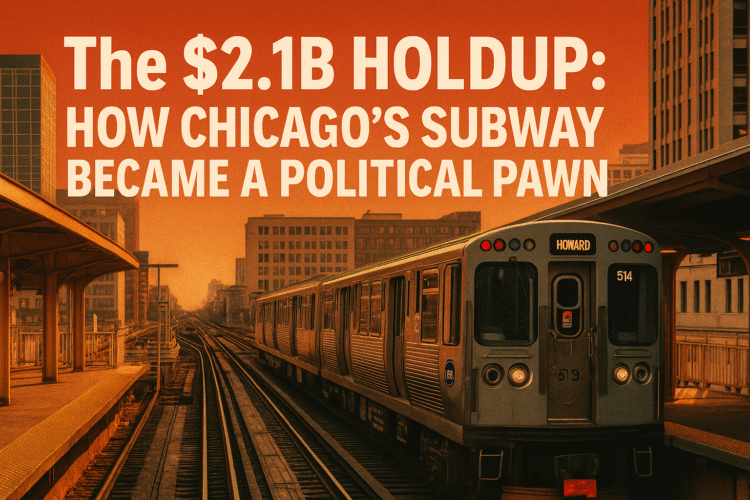
When the federal government freezes $2.1 billion meant for Chicago’s transit infrastructure, it does more than delay train cars. It broadcasts a message: your city’s progress must pass Washington’s purity test. On October 3, the White House announced that funds earmarked for the Red Line Extension and Red & Purple Modernization were “put on hold to ensure funding is not flowing via race-based contracting.” In effect, the subway becomes a battlefield for culture wars, equity policing, and partisan leverage.
Let’s reconstruct how this came to pass, parse the logic (and illogic), and position the absurdity: that a city’s mobility now hinges on whether a bureaucrat in D.C. finds your contracting practices ideologically acceptable.
The Promise & the Pause
The Red Line Extension, long championed in Chicago, aimed to push the “L” farther south, into underinvested neighborhoods. The Red & Purple Modernization project sought to upgrade century-old tracks, eliminate bottlenecks, and modernize stations on the north side. Combined, they formed a transit lifeline for thousands of riders and prospective jobs. In the final days of the prior administration, a nearly $2 billion award had been confirmed to help realize those ambitions.
But with the federal government shutdown underway, Office of Management and Budget Director Russ Vought stepped into the breach and froze the funds. He said he did so to ensure that no portion of that money flows through race-based contracting. He cited a new interim rule the U.S. Department of Transportation had issued, barring race- or sex-based preferences in federal grants and instructing further administrative review of transit projects. The administration also withheld a $300 million reimbursement for the subway program pending review.
Vought explicitly tied this freeze to race-based contracting concerns, and framed it as enforcing constitutional and statutory limits. In a press release, USDOT said letters went to the Chicago Transit Authority informing CTA that those two projects—the Red Line Extension and Red & Purple Modernization—would undergo review. Meanwhile, local transit officials, alderpersons, and commuters watched progress come to a hard stop.
The Political Logic & Punishment Play
To fully grasp the freeze, you must see it as a maneuver in the shutdown’s leverage war. Chicago is a Democratic stronghold. The White House had already frozen $18 billion in New York transit funds under the same justification. Now Chicago became the next bruise in a partisan bruising. Progress becomes conditional on ideological compliance.
The messaging is multitiered. On the surface: race-based contracting is unconstitutional or unfair. Below the surface: Democratic cities that built diversity initiatives must now justify them. Below that: if your local leadership is unwilling to dismantle what Washington deems “preference,” your infrastructure becomes hostage.
The freeze is thus not benign scrutiny—it’s a wound. A city already grappling with budget stress, transit deficits, and development inequality must now face the moral judgment of D.C. bureaucrats.
The Absurd Hypocrisy
Consider the irony. A city that has long argued for transit equity, access for underserved communities, and neighborhood investment is now penalized for doing precisely what federal policy claims to support. Projects meant to bring mobility, jobs, connectivity and economic justice are construed as suspicious conduits for racial preference.
Meanwhile, no one in the freeze announcement demanded evidence of misconduct. No one asked whether local DBE (Disadvantaged Business Enterprise) programs had misbehaved. The freeze is blunt and anticipatory. It assumes guilt—or at least questionable virtue—until local officials prove their purity.
The effect is structural intimidation: cities rethink diversity policies, contractors second-guess bidding criteria, officials delay new inclusive programs. The freeze doesn’t just pause trains—it chills innovation.
Consequences & Real-World Harm
This isn’t just bureaucratic theater. The freeze has acute consequences:
Job losses: Contractors, subcontractors, laborers counting on the Red Line project now face layoffs or delays. Transit delays & capacity shortfall: Riders who expected reduced commute times, better service, fewer transfers now face extended timelines or cancelled plans. Economic opportunity lost: Businesses planned near new stations lose investment; neighborhoods expecting development stall. Credibility damage: Chicago’s reputation as a reliable partner with the federal government suffers.
Behind these lies the human cost: workers laid off, transit-desert neighborhoods waiting longer for relief, grids of inequality staying inscribed in steel and concrete.
The Legal & Constitutional War
Legally, this freeze raises thorny questions:
Does Washington have authority to withhold funds conditionally based on contracting criteria not rooted in statute but in ideology? Is “race-based contracting” an actionable violation when diverse participation programs already exist under federal DBE rules? Can a city seek injunctive relief forcing release of funds pending review? Does the freeze violate separation of powers—Congress appropriated money for transit, and now the executive withholds it based on ideological review?
Chicago and Illinois officials could sue, arguing the freeze is arbitrary and capricious, represents unconstitutional shadow policy, or violates federal obligations. In court, they could demand audit of the freeze criteria, release of withheld reimbursements, and restoration of funds pending litigation.
Satirical Interlude
Imagine a city planning board presenting renderings of gleaming new stations—floors, ceilings, digital displays, elevators—for four new stops along the South Side. But they hold off until the federal ideological police OK the artwork, confirm the painter’s racial mix, and audit whether the subcontractors have “enough diversity blah blah.” Meanwhile, residents stare down the tracks and say: can we just ride a train?
Or picture a debate: “We can’t build this train until we prove to Russ Vought we’re not promoting race.” And someone responds: “Wait till they audit milk crates, graffiti crews—they’ll find race-based contracting in bathroom stalls.”
That’s not dystopian fiction; that’s today’s freeze.
The Strategic Stakes
If the freeze succeeds in chilling race-based contracting, it becomes a template. Seattle, Detroit, Los Angeles—all could face paused transit funding if their diversity criteria do not pass D.C.’s purity test. It shifts federal infrastructure from a tool of equity to a sword of ideological enforcement.
If Biden’s or future administrations restore the funds, the freeze is a wound to be healed—but the precedent stays. Local leaders will budget around the threat, redline dissent. If courts push back, it becomes a constitutional test of whether Washington may judge city contracting on political grounds.
Chicago’s transit future is now a test case: which matters more, speed of trains or speed of ideology?