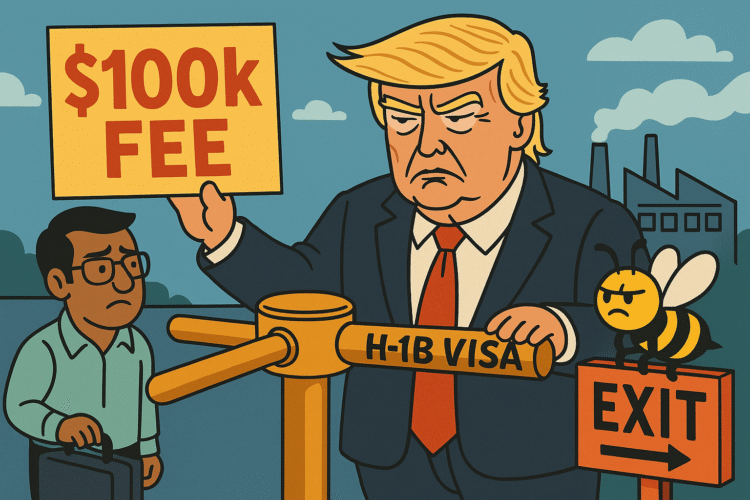
Picture this: the United States is a giant manufacturing plant filled with idle machinery, blinking warning lights and rusting gears. Somewhere, leadership is walking the floor with a cheery sign that says TALENT SHORTAGE. Meanwhile they close the door, raise the price for key workers, and then scratch their heads when the machines don’t run. That is roughly what is unfolding in the H-1B whiplash saga. The administration tells us we don’t have enough “talented people” to fill factory lines, defense jobs, complex systems. Then they impose a fee that makes the visas a cost wall. The message is clear: we need the brains, but we’re going to charge them like parking at a Fifth Avenue garage.
Here’s how it goes. In September of 2025 the White House issues a proclamation that new H-1B petitions filed after September 21 will carry a $100 000 application fee. That is sixty times the prior roughly $1 500 cost. The program the U.S. has used for decades to fill high-skilled jobs suddenly becomes reserved for the very richest or the largest firms willing to absorb the toll. Firms like Walmart and other employers dependent on H-1B sponsorship start freezing offers to candidates who rely on H-1B status. The Wall Street-type wage schemes cannot move fast enough. The economy depends on talent. The same leadership admits it on air. The same leadership built the toll.
From a timeline perspective: in mid-September the fee is proclaimed. Within days tech firms and defense contractors begin internal freezes and advisories. By late September the White House appears on Fox saying “we don’t have enough talented people so we must bring them here” even though the fee wall is erected. Within weeks business groups warn of project delays, offshoring risk, lost productivity. Lawsuits begin. The U.S. Chamber of Commerce sues to block the fee as exceeding the executive branch’s authority. Meanwhile thousands of skilled candidates sit in limbo, employers cancel or pause contracts, universities ask students to reconsider staying in the U.S. Because you cannot import talent if you block access and then act surprised when the line dries up.
The legal plumbing matters. Congress sets immigration laws. The H-1B cap remains at 85 000 “regular” visas plus exemptions for universities and nonprofits. But the executive branch claims fee authority under DHS and USCIS rulemaking. The proclamation treats the fee as a one-time payment for new petitions. Employers must pay the fee before filing. USCIS puts out guidance later. Critics argue the fee exceeds the Immigration and Nationality Act and violates the Administrative Procedure Act because it was implemented without rulemaking. Meanwhile the fee wall collides with labor market needs. You need firmware engineers, you need chip plant specialists, you need biotech researchers, you need defense technicians. But the toll means many candidates simply won’t get through. The cost is too high for startups, mid-sized firms, for faculty job switches. Who wins? Big conglomerates that already have worldwide payrolls and can absorb the fee as overhead. Who loses? Start-ups trying to hire promising candidates, universities trying to recruit international scholars, defense contractors who relied on global talent, and the underlying economy that needs innovation.
Start with industries. Chips, defense, auto manufacturing, energy systems and health systems are heavily exposed. A chip fab may require dozens of H-1B-s in design and process engineering. If each petition now carries six figures, either the cost moves to the buyer (higher prices, delayed rollout) or the project moves abroad. Defense contractors looking for H-1B scientists will count the fee as risk. Offshoring becomes cheaper. Firms like Walmart pause offers to H-1B candidates as they question whether the program remains viable. Meanwhile foreign governments such as India protest. One newspaper reports Indian IT firms and Government officials are scrambling to offer alternatives because their skilled workers are blocked or delayed. The irony is thick: we declare a domestic talent shortage and then tax the visa that fills it.
Let’s stack receipts. On September 19 the proclamation is signed. On September 20 the White House clarifies fee applies only to new applicants, not renewals. On September 21 the fee goes into effect for petitions filed after that date. USCIS issues guidance in October. The U.S. Chamber of Commerce files lawsuit on October 16 challenging the fee’s legality. Firms advise current H-1B workers to stay in the U.S. rather than travel abroad. Economists issue warnings: the fee could reduce U.S. growth from 2 % to 1.5 % due to talent drain and slower innovation. Business groups publicly say brain drain is real. The administration runs headlines about “talent shortage.” Software firms pause H-1B recruiting. Universities warn of recruitment freezes. Job candidates hold offers in limbo, waiting for clarification on fee floor. Economic press reports risk of “exporting jobs to whoever takes talent.”
Who wins? Clearly the government in the rhetorical sense: they can say they raised the wall while still claiming they need talent; they can say they are protecting American workers from “abuse” of H-1B; they can channel support from restrictionists who applaud the toll. They control the narrative that immigration reform equals barrier. Who loses? The economy, the projects, the employers, the international students and skilled workers, the innovation pipeline, and ultimately the country’s global competitiveness. The law itself is under strain; the statutory authority of the executive branch is being tested. This is policy by surcharge, not by congressional debate.
What are the reactions? Restrictionist voices cheer the fee wall and talk about “merit-based migration” and “hire Americans first.” Business groups warn of brain drain and delayed R & D. The Indian government protests. Immigration lawyers scramble for carve-outs and exemptions. Families sit in limbo: promising engineers invited to come to the U.S. now told “pay the six-figure fee or we will deny your petition.” Start-ups say they will move to Canada or Germany where visa access remains smoother. Universities fear the U.S. may no longer be the best destination for foreign PhD candidates. Chip plants worry. Defense contracts stall. The rhetoric of talent meets the wall of dollars. The contradiction is not subtle.
Let’s talk macro shell-game. The supply-side of talent is being taxed while demand-side investment remains desperate. When you raise the toll on visas, you shrink demand from foreign talent or push firms to go abroad. That worsens price to income ratios in tech and innovation. It crowds out renters and graduates who now opt for countries where they can launch careers. It raises the chance of delayed factories, slower productivity, higher prices. It shifts emphasis away from supply reform (training Americans) to demand suppression (taxing foreign workers). It is not building talent. It is taxing it. Intergenerational equity tilts when a promising engineer accepts a job abroad because U.S. entry is blocked. The U.S. pays for it years later in fewer startups, fewer patents, fewer high-pay jobs.
Now the checklist for the next few weeks: watch whether the White House narrows the fee by guidance—if it says it is “one-time only” rather than recurring making the burden worse. Watch whether lawsuits land over the fee wall under APA and immigration statute challengers argue the executive exceeded authority. Watch whether STEM employers publish hiring cuts or shift teams overseas: if you see publicly announced freezes at major car or chip makers that linked to H-1B timelines, you know the cost hit is real. Watch whether Congress reacts: whether a lawmaker introduces a prohibition on executive fee walls via appropriation riders or authorization language. And watch whether the press plainly states the contradiction: you cannot declare a talent shortage and then tax the visas that fill it without paying a price in delayed factories, slower research, and quieter jobs.
Because here is the bottom line: imposing a six-figure fee on the visa you say you need is not reform. It is a wall covered in rhetoric that says “we need you” on one side and “you must pay us first” on the other. When talent meets toll booths, the conveyor belt moves somewhere else. And when the world’s brightest minds look at the U.S. and say “we can go to Canada or Germany instead,” the talent shortage becomes real—and not because of training Americans or having fewer STEM pipelines—but because you built a cost gate and walked away.
When the next chip plant remains delayed, when the next defense contract says “overseas sister facility,” when the next startup opts for Singapore, we will know the cost. And it will not be measured merely in dollars. It will be measured in lost innovation, in slower growth, in jobs that could have been here. The equation is simple: if you raise the cost on entry the supply shrinks. If you claim you need entry you cannot tax it at the same time. The talent shortage you admit exists becomes the consequence of the policy you enacted.
If this were marketing it would pass the smell test: we’re coming to you, talent, we just ask you pay a premium. That is not patriotism. That is policy by toll.
And so we watch. Because we are not just talking about visas. We are talking about the architecture of global talent, the velocity of innovation, the capacity of a country to lead, not follow. We are talking about whether you build a pipeline or erect a bar. If you want talent you build access, you train. If you erect fees you erect barriers. Any other message is marketing.
So yes, we acknowledge the skill shortage. But creating a fee that turns the program into a luxury tower is not solving the problem. It is redefining the problem in your favor: “We need talent—but only if it pays us first.” That is not reform. That is revenue extraction. That is economic hypocrisy.
Let’s track the results. Let’s read the lawsuits, the hiring freezes, the project delays. Because the machines on the floor are not waiting for a policy memo. They are waiting for talent to plug them in. And if the U.S. walks away while telling the world it cannot find its builders, we will have the shame of a rusting plant and the excuse of a policy that looks like virtue but works like toll.
If you are an employer, a candidate, or an economy depending on both, watch this closely. Because the fee is not just a number. It is a signal of trade-offs. Your next job, your next factory, your next breakthrough may depend on whether we build systems or barriers. Because in a global race for talent we are building speed-bumps. And we are doing it with a smile.