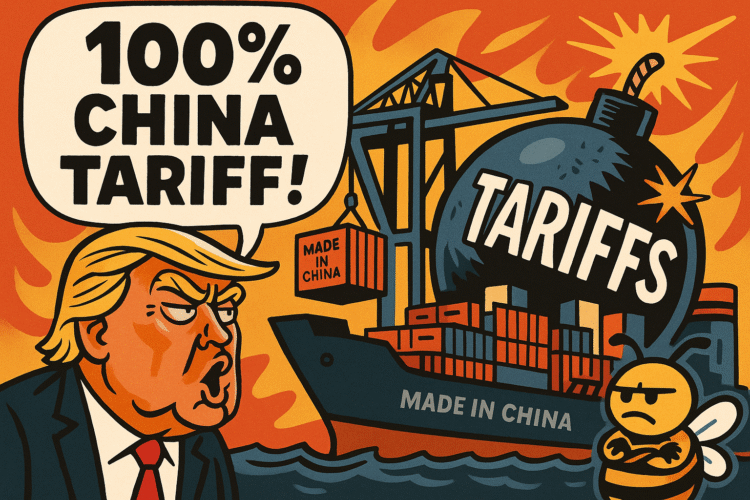
If you ever wondered how quickly a global economy can go from “steady simmer” to “rolling boil,” welcome to the October 2025 edition. Beijing quietly dropped new export controls on rare earths. Trump responded by threatening a blanket 100 percent tariff on all Chinese imports beginning Nov. 1 (or “sooner,” depending on China’s mood). He also floated export curbs on critical American software and cast doubt—then backpedaled—on whether he would even meet Xi Jinping at APEC in South Korea. Markets quaked. Manufacturers who rely on Chinese magnetics, battery metals, and semiconductor inputs scrambled. And behind all this, the too-familiar specter of full-blown trade war metastasized once more.
Let’s dance through this tariff tango step by step, peeling back the spectacle to see the strategic stack behind it—and the real risks hiding underneath.
The Day the Tariff Wolf Howled
Beijing’s move: new export controls on rare earth elements and their associated processing technologies—metals and alloys so essential to everything from EV batteries to jet engines and military-grade electronics. These controls tighten the screws on any foreign firm using Chinese-sourced rare earth content above a hairline threshold, requiring government permission and licensing in strategic categories.
Trump’s reaction was operatic. He announced an impending 100 percent tariff on all Chinese goods starting November 1 (or earlier, if China double-dares). He also threatened to slap export controls on “any and all critical software” emanating from U.S. firms—a digital counterpunch in a high-stakes global fight.
Markets did not listen politely. The Dow sagged by nearly 900 points. The S&P 500 plunged close to 3 percent. Caught in the crossfire are chip makers, electric-vehicle firms, defense contractors—all dependent on Chinese magnets, rare-earth powered motors, battery precursors, and supply chains that stretch across East Asia and inland Chinese factories.
Then came the diplomatic whiplash. Trump said there was “no reason” to meet Xi in Korea. Hours later he clarified he hadn’t canceled the meeting—just didn’t want to “appear weak.” That’s the same playbook as every negotiation man who needs both the carrot and the bone.
Why This Is More Than a Tariff Headline
This isn’t just another threat in a long line of tariff escalations. This is escalation where diplomacy, supply chains, and national security all converge. The rare earths market is nearly monopsonic: China dominates much of the processing and upgrading capacity. That gives them leverage. If China refuses, the U.S. may find itself unable to build next-generation motors, sensors, or defense components—because no equivalent supply chains exist domestically yet.
Now layer on U.S. export controls on software or key components. That shifts the fight from trade to technology war. Suddenly, foreign access to AI chips, advanced firmware, and encryption tools becomes a bargaining chip.
Congressional hawks cheer this kind of escalation—finally using “trade weaponization” as policy rather than punch line. Business groups call it insane, warning of supply-chain collapse, price shocks, regulatory whiplash, and “decoupling by fiat.”
Meanwhile, diplomacy gets squeezed. A tentative TikTok compromise and soft signals that U.S.–China could settle tensions now wobble. If Trump really cancels or downgrades the Xi meeting, the entire thawing track collapses and the confrontation becomes official.
Who’s Moving the Pieces Behind the Scenes
- White House & Trade Office: They’re drafting the tariff proclamation, toggling options on “sooner if China insists,” and lining up companion export controls on software and semiconductors.
- China’s countermeasures: Beijing responded with port-fee hikes on U.S.-flagged vessels, stricter licensing for battery materials, and probes into American chip firms to signal asymmetrical pressure.
- Congressional hawks: Senators like Rubio, Cotton, and Graham now have their preferred headline. They argue that weak trade policy is how you lose great-power competition.
- Industry coalitions & think tanks: Already pushing contingency plans: stockpiling, supply chain redesign, tariff pass-through maps, and lobbying for carve-outs or relief.
- Allies watching nervously: Countries in the Indo-Pacific and Europe must now hedge—do they side with U.S. decoupling or risk access to Chinese economics?
The signaling is dual: “We will hit you so hard you can’t ignore us”—and “we remain open to deal, so bring your better posture.”
The Now-or-Never Timing
The tariff threat is timed exquisitely. Existing U.S.–China tariff truce relief is scheduled to expire November. So Trump’s escalation arrives just before that expiration. If supply-chain disruptions begin early, his threat becomes active leverage rather than posturing.
Also, APEC and leaders’ summits loom later in October/November. By setting a hard line first, he forces Xi to decide: back down, send softened responses, or escalate in kind. If Xi refuses to meet—or insists the meeting requires China-first concessions—Trump’s narrative is strengthened.
Markets and manufacturers must guess: Is this a brief power play to reset negotiation? Or the first salvo in a new, savage trade war?
The Risks That Could Rip the Playbook
- Supply-chain backlash: U.S. firms built lean, just-in-time operations. Sudden 100 percent tariffs break those quietly over nights.
- Inflation shock: Import costs, from appliances to EVs to electronics, jump. American households bear it.
- Export retaliation: China could blacklist U.S. manufacturers, deny licensing, or block commodity inputs.
- Regulatory paralysis: Export controls on software will layer compliance burdens, licensing windows, and byzantine restrictions.
- Diplomatic damage: Allies will question U.S. reliability if every negotiation becomes threat over diplomacy.
- Decoupling cascade: China may force partners to choose blocks. The world fractures into spheres.
- Performance gap: If the U.S. can’t deliver alternatives in rare-earth processing, demand outruns supply, and national security projects stall.
The Watchlist: What Comes Next and What It Means
- Will Trump publish a formal 100 percent tariff schedule before Nov. 1?
- Will the export controls on software and components roll out just as tariffs hit, or be tethered?
- Will Xi refuse to meet? Or use the summit battlefield to demand preconditions first?
- Will Chinese countermeasures scale quickly—trade bans, export licensing denials, embargoes?
- How many U.S. industries will apply for exemptions or carve-outs if critical component lines run red?
- Will bilateral trade pacts shift—other nations picking sides in economic blocs?
- Will Congress seize control—or will executive authority reign unchecked?
Closing: When Tariffs Become Declarations of War
This is not about punishing China. That trope always works best for speeches. It’s about projecting strength, resetting norms, and showing voters that the President can pivot from shutdowns and theater to global steel.
But there’s a dangerous arithmetic here: the tariff threat is a weapon. It cuts to the bone of global interdependence. If Beijing responds with full retaliation, we exit the realm of trade standoff and enter the realm of national fracture.
When the world charts its supply chains, the first map they redraw is where they rely on you—rare earths, batteries, chips. Trump’s ramp is not just tariff escalation. It is a bet that the U.S. can reshape dependencies in a flash. If that bet fails, U.S. industry bleeds, allies doubt, and the global economic order fractures.
Markets react with drops and trembling. CEOs stare at cargo manifests. Defense planners sweat over magnet supply. Farmers worry supply chain collapse. The chessboard is set.
Tariffs are the most visible move, but the real fight is for leverage, posture, and global precedence. If Trump’s 100 percent tariff becomes real, it is not a trade policy. It’s a national pivot.
Closing Section: “WHEN ECONOMICS BECOMES EXILE”
Once trade is battleground, every factory is at risk of exile. Companies will relocate, alliances will realign, and the map of supply will no longer follow cost—but loyalty. If your nation becomes your supplier, your supplier becomes your master.
When a tariff becomes a declaration of war, the only question left is who the casualties will be. For now, the world watches whether Nov. 1 is the starting gun—or the beginning of capitulation.