WASHINGTON —
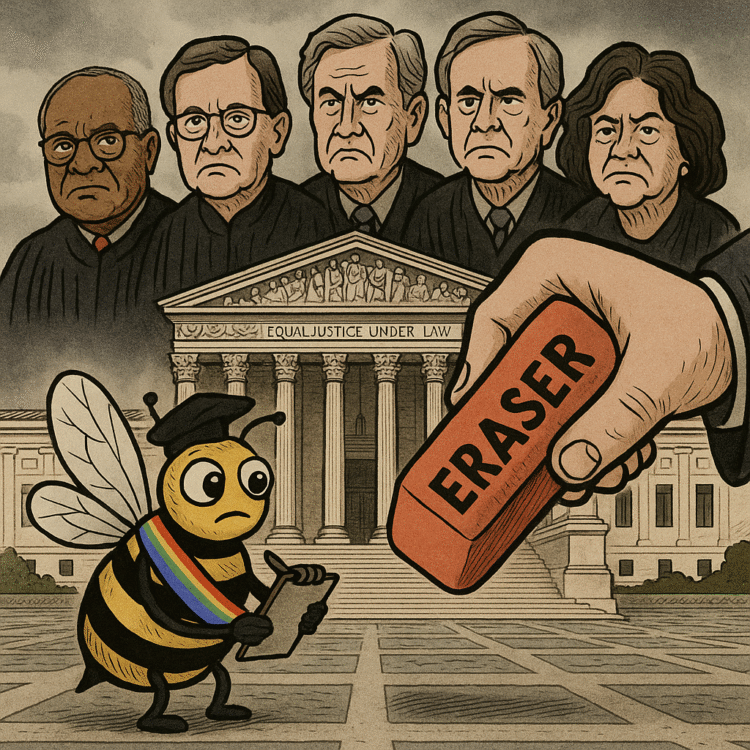
It’s autumn in America again, that magical time when leaves fall, pumpkin spice lattes proliferate, and the Supreme Court quietly considers whether to snatch a fundamental right from millions of people while insisting it’s all just a polite “revisit” of precedent.
This year’s seasonal constitutional Jenga comes courtesy of one Kim Davis — yes, that Kim Davis — the former Kentucky county clerk who decided in 2015 that the Supreme Court’s landmark decision in Obergefell v. Hodges didn’t apply to her personally because she had Jesus on speed dial. When two men approached her for a marriage license, Davis made history by doing absolutely nothing — and then defending that nothing with the ferocity of a mall security guard convinced they’re in a Jason Bourne film.
The Case that Time Should Have Forgotten
The case the Court may take up this fall is not about whether marriage equality is popular (it is, wildly), or whether it has functioned without the societal collapse certain pundits swore was coming (it has, unless you count the Real Housewives of New Jersey reboot). No, this is about Davis’s continued insistence that her refusal to issue a marriage license was not a bureaucratic hissy fit, but a sacred act of religious devotion, protected under the First Amendment.
Davis has been ordered to pay $100,000 in emotional damages and $260,000 in attorney’s fees to the couple she refused. Lesser mortals might see this as a costly consequence of turning your government job into a personal theology seminar. Davis, however, sees it as martyrdom — the Joan of Arc of office supplies. She believes Obergefell was “egregiously wrong,” and that her religious convictions should have functioned as a legal force field against the Constitution she swore to uphold.
The Lower Courts Roll Their Eyes
To their credit, the lower courts have not been swayed by this argument. They’ve ruled, repeatedly, that Davis was acting in her capacity as a state official, which means her actions were state actions. And state actions are bound by the Constitution — not by the personal devotional playlist of the official in question.
But in the same way some horror movie villains never stay dead, Davis’s legal crusade has shambled forward, one appeal at a time. The Supreme Court declined to hear her case in 2019, but like a televangelist who just discovered NFTs, she’s back, and this time she’s aiming higher.
The Stakes: The “Roe Treatment”
The stakes are not small here. If the Court agrees to hear her case, it will be the first time since 2015 that the justices explicitly consider overturning Obergefell v. Hodges. Even legal experts who doubt it will happen acknowledge that this is not a casual coffee date with precedent — it’s more like the Court sending Obergefell a late-night “u up?” text.
Conservative Justices Clarence Thomas and Samuel Alito have both previously signaled an openness to revisiting the decision, with Thomas famously describing Obergefell as part of a “demonstrably erroneous” line of cases. When Thomas uses the word “erroneous,” it tends to mean “I’d like to replace this with my personal moral code.”
The “Don’t Worry, Your Marriage is Still Valid” Consolation Prize
If Obergefell were overturned, existing marriages would still be recognized thanks to the 2022 Respect for Marriage Act. This means that, unlike the total erasure of rights we saw when Roe v. Wade was overturned, there would be a federal obligation to honor marriages already performed. The catch? Future couples in states hostile to LGBTQ+ rights could find themselves in legal limbo, needing to cross state lines for a wedding license the way people now cross them for medical care.
In other words: the right to marry the person you love would still exist — you’d just need gas money and a hotel reservation to get to it.
Why This Feels Familiar
The parallels to the dismantling of Roe are almost too on-the-nose. A precedent that conservatives never accepted as legitimate. A high-profile plaintiff turned folk hero in certain circles. A Supreme Court stacked with ideologues who claim to respect precedent while circling it like vultures. And a broader political climate in which the rollback of rights is not a bug, but a feature.
We’ve seen this playbook before:
- Elevate a “wronged” individual who stood against “liberal tyranny.”
- Frame the case not as an attack on rights, but as a defense of “religious liberty” or “states’ rights.”
- Wait for the Court to look the other way while precedent erodes into “suggestion” status.
The Myth of the Harmless Revisit
Supporters of Davis’s cause like to suggest that the Court merely “revisiting” Obergefell is harmless — just a legal palate cleanser. But this is how rights are lost: not in a single dramatic act, but through a series of increasingly bold hypotheticals floated from the bench. Remember when Justice Alito asked during Dobbs v. Jackson whether Roe might be “distinguished” rather than overturned? We all know how that ended.
The Religious Liberty Shuffle
At the heart of Davis’s argument is the idea that her personal religious beliefs should allow her to withhold a legal right from others while holding public office. It’s an argument as old as America’s first debates over church and state, but with a modern twist: today’s version comes with merch, speaking tours, and podcasts.
The religious liberty defense is seductive because it frames the person denying rights as the real victim. It’s not about the couple who were humiliated and delayed in exercising their constitutional rights — it’s about poor Kim Davis, forced to choose between her paycheck and her piety. It recasts public service as a kind of hostage situation, where the only escape is to rewrite the law in the employee’s favor.
Why Now?
There’s a certain timing to these cultural skirmishes. As public opinion solidifies in favor of LGBTQ+ rights — with support for same-sex marriage hovering around 70% — the most extreme opponents understand that their best shot at rolling back progress is through the courts, not the ballot box. Courts don’t care about poll numbers. They care about arguments that sound lofty enough to justify dismantling precedent while pretending not to.
And let’s be honest: the current Court has shown no hesitation in reshaping the legal landscape in ways the public didn’t ask for. If Obergefell lands on their docket, it won’t be because America was clamoring for a “reevaluation” of marriage equality. It will be because a small, determined faction has learned that the quickest path to cultural dominance runs straight through the marble columns of One First Street.
The Imagined Future
Picture it:
Two women in Tennessee walk into their county clerk’s office. They’ve been together for ten years, they own a home, they pay taxes, they bake casseroles for their neighbors. They ask for a marriage license. The clerk, citing her “deeply held beliefs,” declines. The couple is told they can drive six hours to Virginia for the paperwork. They spend the next year embroiled in legal battles, their relationship reduced to a test case.
It’s not the apocalypse. It’s not the Handmaid’s Tale. It’s the slow bleed of equality — the erosion of dignity one county office at a time. And it’s exactly the kind of future Davis’s legal crusade invites.
Final Thought: Love on the Precipice
Rights rarely vanish in a thunderclap. They dissolve in a drizzle of exceptions, carve-outs, and “reasonable accommodations” that turn the bold promise of equality into something conditional. Marriage equality is not under attack because it has failed — it’s under attack because it has succeeded, because it proved that queer love could be ordinary, visible, and woven into the fabric of daily American life.
If the Court takes up Davis’s case this fall, the justices will have a choice: to affirm that equality means what it says, or to carve it into a patchwork that depends on your ZIP code and your clerk’s personal theology. And if they choose the latter, the loss won’t be loud. It will be quiet, bureaucratic, and devastating — the kind of loss you only notice when it’s your turn at the counter.