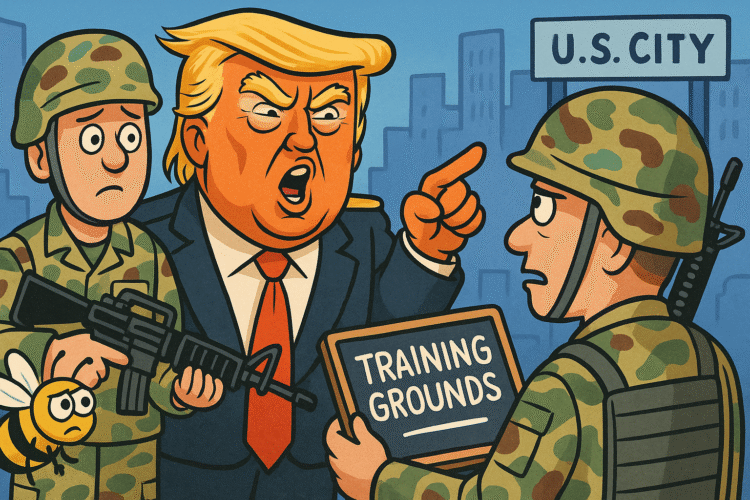
On September 30, 2025, at Marine Corps Base Quantico, something happened that will never feel routine. President Donald Trump and Defense Secretary Pete Hegseth presided over a convocation of roughly 700–800 of America’s highest military officers—generals, admirals, senior enlisted advisers—flown from around the globe on short notice. Why? To hear a plan: use U.S. cities as “training grounds” for countering an “enemy from within.” To dismantle “political correctness” in leadership. To reset fitness, grooming, command culture. To warn dissenters: step aside.
It was less a leadership address than a pivot—the moment when the civil-military contract risked being rewritten live, under overhead lights and in silence. The room’s muted reception, the gravity of policy shifts, and the legal tensions all combine to make Quantico that day more a flashpoint than a speech. Let’s reconstruct it minute by minute, walk through the lead-up, critique each prescription, and consider what world this moment could birth.
Run-Up: The Five-Day Orchestration
September 25: Reuters breaks the story: Hegseth is summoning all senior commanders to Quantico. The summit is cast as mysterious, urgent, top-secret. [Reuters reported Hegseth’s criticism of “fat generals” and political correctness ahead of the meeting.] Reuters
Pentagon spokespeople acknowledge an upcoming meeting but refuse to share themes. Commands everywhere buzz with speculation. Some generals scramble travel plans. Others lean on their staff to vet possible speeches or leaks.
September 26–29: Internal memos circulate—orders to prepare remarks, review fitness records, groom appearance standards, re-review diversity and harassment policies. Commands ask: is this about doctrine, or personnel purity tests? Observers note this is not a traditional summit, but a sharp-edged overhaul in progress. Media begins connecting dots: Hegseth’s prior public commentary on grooming, warrior ethos, and “woke” culture is forming the skeleton for what comes next. Politico+1
On the evening before, commanders and staff are briefed: dress uniform, no civilian suits, minimal electronics, no guest access. The logistics feel martial, not collegial. The stage is set.
Minute-by-Minute: The Stage, Remarks, and Silence
Pool cameras capture: The ballroom inside a Quantico base facility—flag-draped stage, rows of seating, stiff formality. The generals arrive, in white uniforms, green, navy, echoing the global commands they represent. Some walk briskly; others carry weight in their eyes. The room hums with protocol, tension, possibility.
Prelude: Gen. Dan Caine (Trump-aligned JCS chairman) welcomes the crowd, calls this an “unprecedented opportunity to hear from civilian leadership,” acknowledging the dramatic summons. The assembly is told this is not symbolic—it’s directive. The Washington Post+1
Hegseth’s speech (roughly one hour): He opens with critique: too many leaders have advanced due to identity selection, “historic firsts,” “feelings over force.” He calls out “fat generals,” declares the era of “politically correct, overbearing rules” over. He demands stringent physical benchmarks, reverts grooming and beard allowances, and hints at shrinking top tiers of general officer billets. He encourages those who disagree to resign. He vows cultural reset: “Warrior ethos” becomes default. He argues that commanders must lead from physical example, not bureaucratic insulation. Reuters+2Politico+2
He name-drops several retired officers—Milley, Chiarelli, McKenzie—as cautionary examples. He tells the room: future evaluations will punish mediocrity, soft conduct, failure to enforce discipline. He promises he will “review misconduct, discrimination, promotion anomalies” at every echelon.
Trump’s rebuttal / amplification (circa 20–30 minutes): He follows as the figurehead. His tone is blunt, combative. He frames U.S. cities—San Francisco, Chicago, New York—as “dangerous ground,” needing military “training grounds” to counter the “enemy within.” He repeats the threat: “If you don’t like what I’m saying, you can leave the room—but of course your rank, your future go with it.” Applause is subdued. He mocks political correctness, remarks that he wants a Department of War, and positions this meeting as the twilight of softness in the military. The Washington Post+2The Washington Post+2
Generals remain mostly stoic. Some nod once or twice. Applause is cautious, hesitant—perhaps out of discipline. Some faces are impassive. Silence is louder than cheers.
Afterwards: Some officers file out. Some linger, consulting notes, whispering. Staffers begin pushing out talking points. In internal group chats, some complain this was political theater; others brace for changes tomorrow.
Policy Prescriptions & Immediate Mechanisms
Here are the major proposals and how they ripple through a military structure:
- Male-benchmark, uniform fitness standards applied across combat arms
Hegseth wants the combat arms physical standard—historically calibrated toward male norms—standardized for all officers, regardless of age, gender, or career track. No more feminist adjustments, no more tiered allowances. Everyone must meet the toughest baseline—or risk career stagnation. - Grooming, beard, body-composition revision
The new rules would eliminate or greatly narrow beard exemptions, require stricter body-fat thresholds, and reduce relaxed grooming allowances. The pivot: all visual markers of identity are to be minimized in favor of strict conformity. - Leadership purge & billet cuts
Hints of shrinking the number of general officer positions. Fewer three- and four-stars. Consolidation of commands. Centralizing power upward. Removing “soft” or “bureaucratic” posts in favor of snake-pit, war-facing commands. - Culture reset & chain-of-command edicts
He demands more obedience, less dissent. He frames prior decades of diversity, sensitivity, grievance-processing, and political accommodation as corrosive to force readiness. He promises to rename functions with “warrior ethos” language. He orders reviews of misconduct and discrimination protocols—possibly to eliminate protections. - Domestic deployment normalization
Trump’s proposal: use U.S. cities as training grounds. That is, enable military operations in urban American environments to counter “internal enemies.” This is a profound shift, colliding with Posse Comitatus doctrine. He frames disorder in Democratic cities as a threat of internal war. - Implicit pressure & resign or fall in line
Hegseth tells dissenters they should resign. Trump implies leaving the room threatens your career. It’s not a recommendation—it’s coercion.
These policies begin to redraw training calendars, force structure for FY2026, and talent pipelines. If generals resist, they may be purged. If battalion commanders fail to enforce new norms, they may be transferred or sidelined. Boots on the ground will feel pressure in promotions, physical tests, evaluations.
Blowback, Legal Friction & Internal Angst
The reaction is immediate and multi-front:
- Sen. Jack Reed (D-RI) condemns the meeting as a “dangerous dereliction of leadership” and warns that Hegseth’s ultimatum is politically coerced. The Washington Post+2AP News+2
- Civil-military scholars ring alarm: this summit flouts norms, conflates civilians and troops, and sets a dangerous precedent of partisan alignment.
- Governors, mayors, rights groups warn: using troops in U.S. cities threatens constitutional limits. The Posse Comitatus line must not blur.
- Fact-checkers dig into Trump’s claims: “training ground” language, cost of the summit, past firings, consequences of promotions. Some statements are exaggerated or misleading.
- Within the force: whispers that readiness and recruitment will suffer. If standards shift overnight, if career risk is tied to ideology, many will balk. Some may retire early. Others may hunker, obey quietly. The command climate becomes predator-prey.
- Alliance implications: our foreign partners will notice a U.S. military posture turning inward. War-fighting credibility may erode when public speculates our cities are next theaters.
Stakes & Structural Consequences
Let me bold the core stakes—ones you can’t wish away:
- Domestic urban operations as training grounds rewrite the role of the military in domestic politics. If allowed, it creates a standing template for using troops against American populations.
- Values war within the Pentagon: ideological cleansing, culture purges, loyalty tests. The officer corps becomes not merit-based but litmus-test based.
- Shift in budget & structure: FY2026 funding will pivot toward homeland security units, urban operations training, riot control, interior surveillance. Overseas commitments may get cut. Commands realigned.
- Command climate ricochets downward: if generals tremble, colonels, majors, captains will defensively adjust. The systemic focus becomes obedience, not innovation.
- Litigation & IG scrutiny: Congressional oversight, inspector-general valid investigations, civil suits over misuse of troops or constitutional violations.
- Alliance conflict vs domestic focus: How do we balance readiness abroad when doctrine shifts inward? Are NATO commitments downgraded? What happens when the next foreign threat emerges?
In short, this Quantico summit was not a rehearsal—it was a teetering pivot.
Final Reflection
What we witnessed wasn’t just an address to military brass. It was a test. A test of how far you can ask a professional force to bend itself into the shape of your political worldview. A test of whether generals will toe the line or quietly recede. A test of whether the laws meant to keep democracy intact still matter when power grows hungry.
The optics were sober: hundreds of officers in silence, their faces unreadable. Because they live in the tension of duty and democracy. Because they know the weight of uniforms—but now they sense the pressure of red lines. Because they know that a shift in one lecture room can reverberate across commands, bases, cities—not just battlefields.
This is more than theater. This is a moment at which an administration demanded not just obedience, but transformation. If you permit cities to become “practice zones,” if you haul uniformed men into civilian streets, if you purge diversity for “warrior ethos,” you do not preserve democracy—you corrode it from inside.
Quantico 2025 reveals not just a policy shift—but a threshold: when military culture becomes an instrument of domestic control, and when loyalty to party becomes as important as fidelity to constitution. The rest of the force, the public, the courts—they all have to decide now whether to resist or comply.
Because once the line between soldier and domestic enforcer blurs, you can’t unblur it easily.