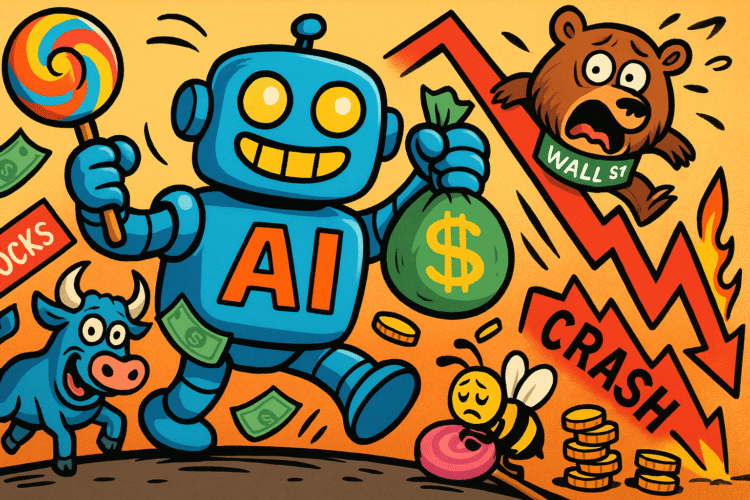
You knew it would happen: someone on 60 Minutes lifting it all up, peering into the neon smog of 2025, and muttering, “I think it’s a bubble.” That someone was Andrew Ross Sorkin. As markets wobble after tariff threats, Sorkin told Lesley Stahl that today’s economy is being propped up by an AI sugar rush—hundreds of billions are flooding into chips, data centers, startups—while the guardrails come off, transparency fades, and ordinary Americans become collateral in the next speculative swing. In his telling: we’re either on the cusp of a gold rush that enriches a lot of us, or headed for a sugar hangover that bankrupts many.
He didn’t sugarcoat the stakes. He warned that skyrocketing debt, weak oversight, “democratization” of risk, and the normalization of meme coins could hollow nest eggs before most people even realize they’re skidding. The coming months are his test: will regulators act like lifeguards or bystanders?
The Great AI Gold Rush … or Candy Store?
Sorkin frames today’s market surge as a gamble cloaked in innovation. Everywhere you look—chip fabs, data centers, AI startups—you see money rushing in. Institutional capital, retail hype, and venture funds scramble to “get in early” on whatever can be branded “AI-enabled.”
That flurry looks exhilarating. The problem is: if your base is built on hype and credit, you have the makings of a sugar rush, not sustainable fuel. When the music stops, someone’s stuck holding the “Sorkin coin” — an absurd meme example Sorkin offered: it was launched after a passing joke in a TV appearance, pumped to millions in trading volume, then crashed until it now trades for nominal daily volume again. That example isn’t a joke—it’s a parable: when exposure is frictionless and disclosures optional, the market will treat your name like ticker tape and your earnings like rumor.
Sorkin didn’t pretend to know when or how hard the crash will land. He said: “We will have a crash. I just can’t tell you when, and I can’t tell you how deep.” But he warned that when confidence evaporates, markets move fast—like liquid evaporating under a torch.
Guardrails Are Melting
Remember guardrails? That was when agencies regulated, rescued, and revealed. Now, many rules are being dismantled. Sorkin warns:
- SEC oversight is loosening. Rules on disclosure, fair dealing, and filings are under pressure.
- Consumer protection is evaporating. The agency charged with policing predatory financial practices is “practically gone,” per Sorkin.
- The push to allow ordinary 401(k) holders to steer retirement funds into opaque private markets is accelerating. It sounds democratic—until you realize the risk comes without the transparency.
- Meanwhile, crypto and meme tokens have become normalized—tools for hyper-speculation with zero accountability.
Sorkin’s message: when you expand access to risk but shrink the requirements for accountability, losses don’t fall on elites. They fall on workers, retirees, and those least able to absorb them.
He points out that disclosures exist for a reason: so that ordinary investors know what they’re buying. Remove that, and you privatize upside—letting the big money win—and socialize downside, letting everyone else clean up the wreckage.
The Silence of CEOs
One of Sorkin’s more haunting observations: CEOs today are afraid to speak honestly. When earnings are political landmines, when regulatory whims can tank mergers, and when federal attention zeroes in on dissenters, silence becomes survival. That means crucial warnings—about supply constraints, debt levels, geopolitical risk—go unspoken, because no executive wants to get crosswise with power.
That silence is complicit. It means we end up with echo chambers where things sound impressively rational until the air tunnels collapse.
The Real Victims of a Bubble Crash
Let’s bring this down to human scale. The people who lose hardest when a bubble bursts are rarely hedge-fund guys. They’re:
- Retirees with modest nest eggs, whose 401(k)s were lured into private-equity or tech allocations.
- Middle-class workers who saw AI investment as their ticket out of stagnation, only to find they bought illusions.
- Communities that banked on new factories or tech campuses shifting the economy—and now stand with empty lots.
- Healthcare workers, public employees, educators whose budgets are squeezed when tax receipts crash.
If this AI boom is real, fine: let it be shared, transparent, regulated. But if it’s sugar, then calories will be paid by people who expected to retire—not gamble.
Why 1929 Matters Again
That’s Sorkin’s framing: he’s working on a book called “1929” (fitting). He sees parallels. In the 1920s, speculation, debt, and margin bets ran wild. Public participation ballooned. Oversight lagged. When it crashed, it wiped out fortunes and bankrupted institutions.
Today, Sorkin argues, the “new roaring 20s” has its own remix: digital leverage, high-frequency trading, AI hype, private markets, algorithmic leverage. But the underlying pattern is eerily similar: a honeymoon with risk until reality insists on accrued interest.
He calls the current moment artificially propped, not naturally grown. Let the sugar analogy sink in: sugar gives you a rush—and then a crash. He fears this is the kind of boom whose hangover takes years to limp out from under.
Policy Is the Dopamine Regulator
This is where it gets explicitly political. Sorkin calls out policy shifts that treat speculation as virtue:
- Opening 401(k)s to private investments without requiring the same disclosures public markets demand.
- Deregulating oversight so platforms and funds can shade transparency.
- Allowing crypto and meme coins to proliferate as speculative toys with zero safeguards.
- Weakening consumer protections so people can be sold high-risk instruments without recourse.
He argues: democratizing risk is only fair if democratizing transparency and fiduciary accountability comes along. You can’t give someone access to a factory without giving them a safety manual.
In Sorkin’s framing, the choice is between a regulated tech boom—and a free-for-all bubble. The former raises the entire economy; the latter buries parts of it in debt and despair.
What The Public Needs to Demand
If there’s going to be a crash, the people least insulated should at least be protected legally and politically. Sorkin suggests:
- Plain-English disclosures for all investment vehicles—no exceptions.
- Stricter fiduciary duties for funds managing retirement money.
- Limits on leverage and margin in AI, crypto, and illiquid assets.
- Enforced truth in advertising for speculative products (no wild projections).
- Strengthening SEC and consumer protection agencies, not gutting them.
Because the key question is: who gets to privatize the upside and offload the downside? Today’s rhetoric suggests elites get the windfalls while everyone else absorbs the crash.
The Sugar High’s Deadline
If Sorkin is correct, this bubble’s expiration time is unknown—but proximity is real. As he says, in a market, confidence is oxygen. Remove that, and collapse can feel like a reflex, not a decision.
Fat tails. Ruptured correlated risk. Flash crashes. Margin calls. Systemic contagion. These are not abstractions—they are the real risks when speculative euphoria meets credit expansion and weak guards.
If we reach that tipping point, the question won’t be “Why didn’t regulators act?” but “How many allowed their 401(k)s to be sold fairy dust?”
Satirical Aside: The “Sorkin Coin” Mood Swings
Remember when Sorkin joked someone would make a “Sorkin coin”? Two hours later, someone minted exactly that and traded it heavily—peak to fade. That mini experiment is the perfect metaphor for how markets now treat personalities as tickers, and ideas as memes.
When your name can become a crypto asset—and crash by midnight—you can see how far we’ve drifted from substance. Today’s legend becomes tomorrow’s ghost token. That’s not capitalism, that’s performance art in a casino.
Final Thoughts: Reward or Ruin?
Right now, the prestige narrative is: “AI will save us, invest early, get on board—or be left behind.” That’s marketing, not math. As Sorkin points out, you can’t subsidize growth forever. The bubble doesn’t collapse gently—it implodes.
The coming months are a test. Do regulators tighten or yield? Do funds expose their books or bury disclosures? Will entrepreneurs and workers get real gains or be told they were collateral damage in someone else’s hype cycle?
If we do this right, a tech boom can become shared prosperity. Do it wrong—and we get crash burns, pension scars, and a broken contract between citizens and capitalism.
The sugar rush may feel delicious. But the hangover is coming. The only real question is who ends up paying the bill—and whether we learned the lesson before the check arrives.