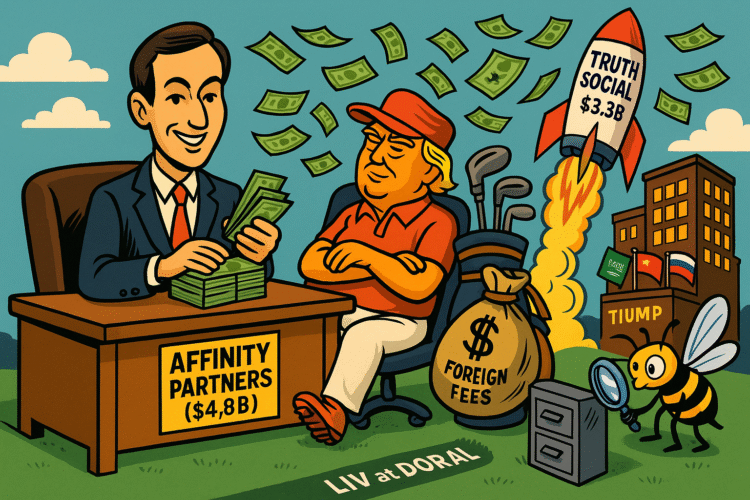
America loves a good family business story—until it involves the government, a few billion in Gulf money, and a golf tournament sponsored by a monarchy. For years, the public has been treated to breathless coverage of Hunter Biden’s laptop, that Rosetta Stone of speculation and projection. But while every congressional hearing and cable chyron has pored over email subject lines and unsent invoices, a far larger and better-documented web of Trump family enrichment has been quietly hiding in plain sight—on SEC filings, hotel ledgers, and Saudi term sheets.
Let’s call it what it is: a fusion of public office and private opportunity that makes the word “conflict” sound quaint.
The Saudi Starter Kit: Jared Kushner’s $2 Billion Friendship Fund
In early 2021, while the rest of America was reeling from an insurrection, Jared Kushner was doing what every out-of-work public servant does: starting a private equity firm with no track record and a $2 billion anchor investment from the Saudi Public Investment Fund (PIF).
The mechanics were straightforward. Kushner formed Affinity Partners, based in Miami, staffed it with a handful of former Trump officials, and pitched it as a cross-border bridge for “strategic investments.” The Saudis’ internal due diligence committee initially balked. Minutes later, Crown Prince Mohammed bin Salman overrode them personally, greenlighting the deal.
The fund didn’t stop at $2 billion. Over the next 18 months, it pulled in another $1.5 billion from Gulf investors, lifting its assets to roughly $4.8 billion—an astonishing feat for a first-time manager who, just months earlier, had been serving as the de facto U.S. envoy to the same Gulf monarchies now writing him checks.
Kushner insists this is all above board, that his post-government career is about “building peace through investment.” Ethics lawyers call it something else: cashing in on classified Rolodexes.
Meanwhile, he’s reappeared as a “Middle East whisperer”—a role that allows him to drift between private sector deals and public influence with no clear dividing line. The only thing louder than the conflict of interest is the silence around it.
Truth Social: The Billion-Dollar Meme
While Kushner was turning diplomacy into venture capital, his father-in-law was turning grievance into stock.
The Trump Media & Technology Group, parent of Truth Social, went public via a SPAC merger that instantly valued Trump’s personal stake at around $3.3 billion. The platform’s financials are a masterclass in magical realism—tens of millions in losses, minimal revenue, and an audience the size of a mid-tier newsletter—but the market treated it like a faith-based investment.
This wasn’t an IPO; it was a loyalty test with ticker symbols. Shares traded less on fundamentals than on proximity to power. Trump’s majority stake gave him the kind of liquidity most politicians only dream of, though his lockup period meant he couldn’t sell immediately. Still, the valuation became a campaign prop—a number that let him brag he’d made billions “the honest way,” through free speech and patriotism.
Financial analysts called it speculative. Ethics experts called it monetized influence. Supporters called it “owning the libs.”
LIV Golf: Greens Fees and Greenbacks
If Kushner built his fortune on Gulf capital, Trump kept it flowing through Gulf tourism.
The Saudi-backed LIV Golf tour, financed by the same Public Investment Fund that seeded Jared’s billions, began holding tournaments at Trump-owned courses—Bedminster, Doral, and beyond. The arrangement offered something for everyone:
- For Trump, steady revenue streams from hosting fees, hospitality, and brand burnishing.
- For the Saudis, soft power laundering—a way to normalize global business ties through sport and spectacle.
- For professional golfers, life-changing payouts subsidized by petrodollars and geopolitical amnesia.
By the time LIV merged with the PGA Tour under a “framework agreement,” Trump was already touting the events as proof of his worldliness. “They love me in Saudi Arabia,” he said, which, financially speaking, appears to be true.
Hotels, Delegations, and the Secret Service Tab
Then there’s the quieter, less photogenic enrichment: foreign government spending at Trump hotels during and after his presidency. Documents obtained by congressional committees show millions in bookings by delegations from Saudi Arabia, China, Qatar, Turkey, and Malaysia, often coinciding with high-level policy interactions.
Add to that the Secret Service invoices—nightly rates sometimes five times higher than federal per diems—paid to Trump properties for rooms used to protect Trump himself. The presidency became a kind of perpetual motion machine: taxpayers funding the protectees, who in turn paid themselves for protection.
The Organizational Flowchart of Nepotism
While Jared and Ivanka pursued the elegant art of influence arbitrage, Donald Trump Jr. and Eric Trump ran the Trump Organization, managing a network of hotels, golf clubs, and licensing deals that continued to market access to political patrons and foreign dignitaries.
After 2017, the company promised to avoid new foreign deals. In practice, it expanded branding and real estate projects through intermediaries and shell structures that blurred old promises. At times, the lines between politics, family, and business disappeared entirely.
The Trump Organization became a hybrid entity: part campaign headquarters, part lobby shop, part luxury travel brand for the MAGA elite.
The Legal Posture: Emoluments, Conflicts, and Convenient Loopholes
Here’s where it gets technical, and darkly comic. The Constitution’s Foreign and Domestic Emoluments Clauses prohibit federal officials from accepting gifts or payments from foreign states without congressional consent. But there’s a catch: they don’t explicitly bind the president.
Congress assumed the presidency would police itself, because the Founders never imagined a leader who’d see the government as a customer pipeline.
The result: Trump could legally receive money from foreign entities via his businesses so long as he didn’t formally acknowledge it as a “gift.” The Trump Organization could host foreign delegations, and the president could claim plausible deniability.
Other relevant statutes—federal bribery laws, honest services fraud, and conflict-of-interest rules—apply to cabinet officials and employees, but not the president or vice president. It’s the kind of loophole you’d expect to find in a banana republic’s constitution, not ours.
Post-employment restrictions were equally toothless. Kushner, as a senior White House adviser, was barred from lobbying U.S. agencies for a year—but not from doing billion-dollar deals with foreign sovereign funds he’d courted while in office.
In short, the Trump ecosystem didn’t break the law. It just discovered that the law was written for less imaginative grifters.
The Timeline of the Golden Grift
To understand how this ecosystem metastasized, follow the timeline:
- 2021: The Saudi PIF’s due diligence team flags “excessive risk” in Kushner’s new fund, noting lack of experience and conflicts. Mohammed bin Salman overrules them, approving the $2 billion investment.
- 2022: Jared opens Affinity Partners offices in Miami, attracting another $1.5 billion from Gulf investors.
- 2023: Truth Social merges with its SPAC partner, Digital World Acquisition Corp, sending the stock soaring and valuing Trump’s personal stake at roughly $3.3 billion.
- 2023–2025: LIV Golf expands its U.S. presence with tournaments at Trump’s Doral, Bedminster, and Los Angeles courses, generating multimillion-dollar hosting fees.
- 2024: The House Oversight Committee releases reports showing foreign governments spent hundreds of thousands at Trump properties during his first term. The matter stalls.
- 2025: As Trump’s second term begins, inspector general inquiries into these transactions are quietly shelved under “prior review.”
The throughline: influence in, money out, oversight optional.
The Hunter Biden Mirror Trick
Contrast that with the Hunter Biden narrative, and the asymmetry becomes a case study in selective outrage.
For years, the country has endured an investigative ouroboros of Hunter’s emails, laptop hard drives, and art sales, each treated as an existential threat to democracy. House Republicans convened hearing after hearing to parse the subtext of every invoice.
But when the Saudi Public Investment Fund wires $2 billion to the ex–White House adviser who brokered peace deals with the same regime, the coverage gets slotted under “business news.”
When Trump personally profits from foreign-funded golf tournaments, it’s described as “commercial diversification.” When foreign dignitaries book $10,000 hotel suites, it’s “economic diplomacy.”
Call it conflict laundering—the media’s polite term for what any other country would call corruption.
Markets Discover Political Proximity as an Asset Class
Wall Street has noticed, too. In the Trump era, political access has become a tradable commodity.
SPACs, defense contractors, and foreign investors now price proximity to power into their valuations. Hedge funds monitor Trump’s social calendar as closely as the Federal Reserve’s. When a LIV Golf event lands on a Trump course, hotel rates spike; when Kushner’s fund announces a “strategic partner,” sovereign wealth funds follow like seagulls chasing fries.
It’s not capitalism. It’s court economy—where fortunes rise and fall based on favor, not fundamentals.
Silence as Strategy
The reaction split is as predictable as it is revealing.
Republicans, who still froth at the mention of Hunter Biden, fall silent when the conversation turns to Saudi capital fueling a presidential son-in-law’s fund. They praise Trump’s “business acumen” and call any mention of ethics a partisan attack.
Democrats and ethics watchdogs sound alarms about a “normalization of pay-to-access politics,” warning that the line between influence and investment is gone. But their hearings die in committee, drowned by procedural fatigue and public apathy.
Newsrooms, desperate for neutrality, sanitize the story into euphemisms: “unusual arrangements,” “ethical gray zones,” “cross-border capital dynamics.” The phrase “self-enrichment” rarely appears outside op-eds, as though calling corruption by its name would violate decorum.
The Consequences: When the State Becomes a Brand
The cost of this normalization isn’t just moral; it’s structural. When power itself becomes a monetizable commodity, governance warps into marketing.
Foreign governments learn to treat the U.S. not as a partner, but as a vendor. Policy becomes transactional. Influence becomes subscription-based.
The Trump family model offers a preview of the post-democratic economy: one where national interest competes with personal portfolios, and the presidency is less an office than a franchise opportunity.
The Next Fork in the Grift Road
In the coming months, a few key decision points will determine whether the grift continues to masquerade as governance:
- Congressional Oversight: Will any committee compel full ledgers of foreign-derived revenue, or will subpoenas vanish into the swamp of “executive privilege”?
- Inspectors General: Will watchdogs at State, Treasury, and the General Services Administration re-open inquiries into foreign payments, or will “ongoing reviews” serve as bureaucratic burial grounds?
- Courts and Regulators: Will any court test the boundaries of emoluments, securities disclosures, or anti-corruption statutes? Or will judges continue to rule that presidential business interests exist in a separate universe of accountability?
- Media Integrity: Will major outlets print the numbers plainly—who paid what to whom in exchange for what access—or will euphemism remain the lingua franca of political journalism?
- Public Accountability: Will voters care enough to demand transparency, or will they shrug and accept that the republic is now a family-run enterprise with international investors?
Closing Argument: The Quiet Conversion of Democracy into a Customer Pipeline
If democracy dies in darkness, kleptocracy thrives in fluorescent light. None of this is secret. The filings, the payouts, the tournament schedules—they’re all public. What’s missing isn’t evidence. It’s outrage.
The Hunter Biden saga was a morality play; the Trump family business is an instruction manual. The difference is scale, and the price tag attached to silence.
The real question isn’t whether the law will catch up—it’s whether the public will. Because until Americans start treating self-dealing as disqualifying instead of entertaining, the world’s oldest democracy will remain the world’s most successful brand acquisition.
The state, in other words, has new owners. They just happen to share a last name.