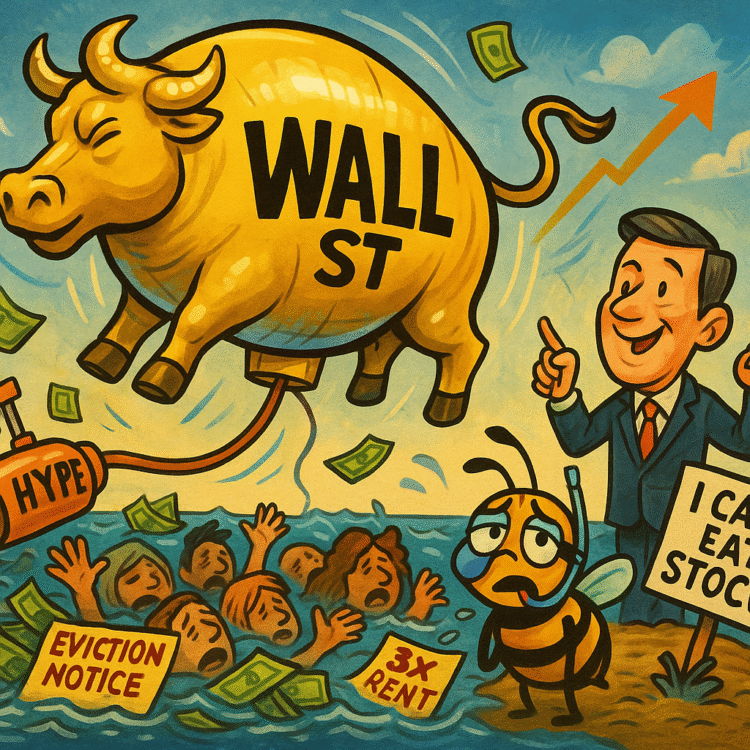
We need to retire the word “economy.” We need to take it out back, behind the woodshed of political discourse, and bury it next to “trickle-down” and “compassionate conservatism.” It has become a linguistic shield, a hollow propaganda term used by CNBC anchors and politicians to gaslight you into believing that your inability to buy groceries is a personal failure rather than a systemic feature. When they tell you the “economy” is doing great, they are not talking about your life. They are talking about a stock market that has been ballooned by an artificial intelligence bubble, where investors are currently throwing billions of dollars at companies that make nothing but PowerPoint decks promising to replace you.
The disconnect has never been louder. You can feel it in the checkout line, where a bag of chips now costs as much as a used car did in 1998. You can feel it in the rental market, where landlords are demanding you earn three times the monthly rent for a one-bedroom apartment that hasn’t been renovated since the Bush administration. Yet, turn on the television, and you will see a parade of well-dressed pundits pointing at the S&P 500 like it’s a divine scoreboard, insisting that because a few tech giants are trading at valuations detached from reality, you should be popping champagne. This is not an economy doing well. This is rich people doing well, billionaires doing spectacularly, and everyone else doing quite fucking terrible.
The AI Casino and the Bubble of Nothing
Let’s look at the engine of this so-called boom. The current stock market rally is not built on American manufacturing, infrastructure, or the growing purchasing power of the middle class. It is built on a casino bet called Generative AI. We are currently living through a dot-com style delusion where the entire financial class has decided that “Artificial Intelligence” is the magic word that justifies infinite valuation.
Investors are pouring liquidity into startups that have no revenue, no product, and no path to profitability, simply because they included the words “Large Language Model” in their pitch. They are praying that one out of a hundred of these bets pays off, effectively buying a lottery ticket with your 401(k). The other ninety-nine companies are destined to implode, vaporizing retirement funds and pension plans in the process, but that doesn’t matter to the people collecting the management fees. To them, the volatility is the point.
The result is a market that acts less like a reflection of national health and more like a mood ring for the Silicon Valley elite. When Nvidia sneezes, the entire “economy” catches a cold. This concentration of wealth in the hands of the “Magnificent Seven” tech companies masks the rot underneath. It allows the administration to point to a graph that goes up and say, “Look, we fixed it,” while ignoring the fact that the graph only tracks the fortunes of people who own capital, not the people who generate it.
This is the great trick of modern economic reporting. It substitutes the health of the casino for the health of the community. They tell you the market is “resilient” because speculative assets are soaring. They do not mention that this “resilience” is being subsidized by the erosion of your wages and the precariousness of your employment. They are celebrating the bubble while you are living in the blast zone.
The “Quiet” Time Gaslighting
Perhaps the most insulting pivot in this narrative has come from the Trump administration’s recent branding of the labor market. Faced with stalling job numbers and a hiring freeze that feels less like a pause and more like a permanent frost, they have decided to call this a “quiet” time. Kevin Hassett, a top economic advisor, recently went on television to assure us that this wasn’t a crisis of stagnation, but a peaceful interlude brought to you by the efficiency of AI.
He argued that companies don’t need to hire “the new kids out of college” because the algorithms are making everyone so productive. This is government-grade gaslighting. What they call “quiet,” you call “unemployed.” What they call “efficiency,” you call “fear.”
The reality of the job market in late 2025 is an anxious plateau. It is a state of suspended animation where companies are hoarding cash and refusing to hire because they are waiting to see if they can automate your job away before the next fiscal quarter. The “quiet” is the sound of thousands of resumes hitting the digital trash can, unread. It is the silence of a generation of graduates realizing that the entry-level jobs they were promised have been turned into subscription-based software services.
By framing this stagnation as a positive feature of technological progress, the administration is effectively washing its hands of the result. They are telling you that your unemployment is a sign of innovation. They are asking you to applaud the very machine that is being built to replace you. It is a cynical, cruel joke, delivered with the smile of a man who knows his own job is safe because he exists to spin the lie, not to do the work.
The Math That Doesn’t Math
While the pundits celebrate the “quiet” efficiency of the labor market, the cost of living has become a screaming crisis. The most brutal metric of this failure is the housing market. In cities across America, the standard requirement for renting an apartment has hardened into an iron law: you must prove a gross income of three times the monthly rent.
Let’s do the math that the CNBC anchors refuse to do. If the average rent for a decent apartment in a major metro area is hitting $2,500, you need to show proof of earning $90,000 a year just to get the keys. $90,000 is now the floor for renting—not buying, not owning, but borrowing a roof over your head. The median individual income in this country is nowhere near that number.
We have created a mathematical impossibility for the working class. We have a service economy that pays $40,000 a year and a housing market that demands $90,000. The gap between those two numbers is where the “economy” actually lives. It lives in the credit card debt you rack up to buy groceries. It lives in the “side hustles” you work just to keep the lights on. It lives in the quiet desperation of millions of people who are doing everything right and still falling behind.
And yet, we are told that inflation has “cooled.” This is another statistical sleight of hand. “Cooling” inflation just means prices are rising slower than they were before; it does not mean they are coming down. The damage is cumulative. The 30% spike in grocery prices over the last few years is permanent. That money is gone. You are permanently poorer, and the system is permanently more expensive. To call this “cooling” is like telling a burn victim that the fire has technically gone out while their house is still a pile of ash.
The Robot Fantasy and the Real Threat
The final insult in this “economic boom” narrative is the celebration of the very forces destroying labor power. The same elites pumping the AI hype cycle are openly building the automation designed to erase what is left of decent work. Elon Musk, the carnival barker of the oligarchy, continues to promise a robot army that will liberate us from the drudgery of employment.
We are treated to the spectacle of “Optimus” robots—clunky, uncanny valley nightmares—being paraded around as the future of the workforce. We are told that soon, “working will be optional,” a phrase that sounds utopian until you realize that in America, if you don’t work, you don’t eat. They are not building a post-scarcity paradise; they are building a post-employment favela.
This isn’t just about futuristic robots. It’s about the mundane, invisible automation happening right now. It’s the call center bots that trap you in a hell loop of “I didn’t quite catch that” so a corporation can fire a human mother in Ohio. It’s the warehouse drones that turn fulfillment centers into silent, terrifying hives of efficiency where the few remaining humans are treated like glitches in the software.
Every time a company announces they are “integrating AI” to “streamline operations,” what they are saying is that they found a way to transfer the salary of a hundred workers into the dividend check of one shareholder. This is not “growth.” This is looting. It is the systematic strip-mining of human utility for the benefit of capital. And they have the audacity to call it “progress.”
The Only Numbers That Matter
We need to stop letting them define the terms of the debate. We need to stop nodding along when they talk about “The Economy” as if it is a separate entity from our lives. There is no “Economy.” There are only people. There are only families trying to survive.
The only numbers that matter are these: What do people get paid? Can they afford to live?
Everything else—the S&P 500, the GDP, the Nasdaq, the valuation of Nvidia—is noise. It is irrelevant to the single mother trying to stretch a gallon of milk for three more days. It is meaningless to the college grad staring at a $2,000 rent requirement with a $0 income. It is a distraction designed to keep you looking at the scoreboard while they steal the game.
The Trump administration calls this a “quiet” time. They are right, but not in the way they think. It is the quiet of a population that is holding its breath, waiting for the other shoe to drop. It is the quiet of a people who have realized that the game is rigged, the boom is fake, and the “economy” is just a word rich people use to describe their winning streak.
Receipt Time
What happens next is not a mystery. The bubble will burst, as bubbles always do. The AI hype will collide with the reality that a chatbot cannot buy a house or eat a sandwich. The investors will flee, the stocks will crash, and the pundits will suddenly discover that “structural issues” exist.
But they will not be the ones who suffer. The golden parachutes are already packed. The billionaires have their bunkers and their islands. When the dust settles, it will be the rest of us standing in the wreckage, holding the bag, told once again that we just need to work a little harder to rebuild “The Economy.”
Do not listen to them. Do not let them hide behind the word. Force them to talk about the rent. Force them to talk about the wages. Force them to admit that an economy that only works for the top 1% is not an economy at all. It is a scam. And we are the marks.