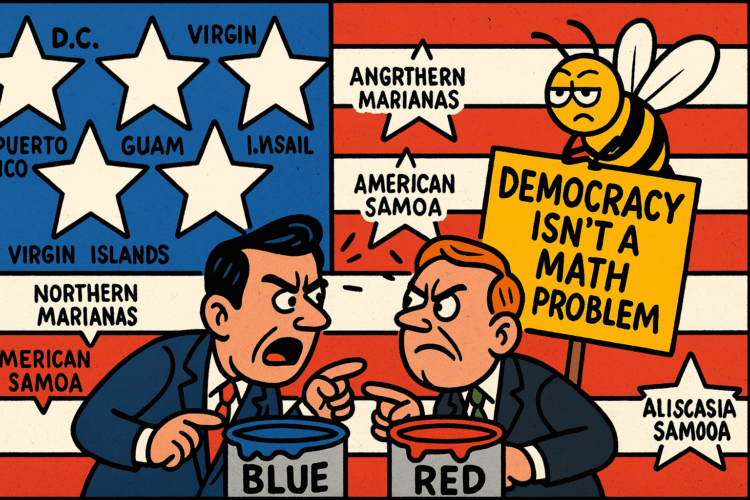
There’s a certain kind of American optimism that only emerges when we start talking about statehood, the same bright-eyed, civics-class sparkle that insists representation is a moral right and not a political chess move. But let’s be honest—if every U.S. territory and D.C. were granted statehood tomorrow, the fireworks wouldn’t be about democracy fulfilled. They’d be about which side of the political spectrum gets to put twelve more shiny stars on their banner of self-interest. The right would start clutching the Constitution like a rosary, and the left would start stitching blue into the flag like Betsy Ross at a DNC fundraiser.
For the first time in American history, places that have long been treated as vacation postcards or afterthoughts would suddenly matter in the national math problem. Puerto Rico, Guam, the Northern Mariana Islands, the Virgin Islands, American Samoa, and the District of Columbia—all suddenly with senators, governors, and actual leverage. And the question on every pundit’s trembling lips wouldn’t be “What does this mean for democracy?” It would be, “Are they blue?” Because in America, enfranchisement is always measured in electoral arithmetic, not morality.
The United States of Statistical Hypotheticals
Let’s start with the numbers, because nothing says “we care deeply about freedom” like treating human populations as polling data. The combined population of these territories hovers around 4.2 million—roughly equal to Oregon, a state famous for legal weed, rain, and voting entirely by mail without the republic collapsing. That’s about sixteen electoral votes’ worth of humanity currently stuck in political purgatory, unable to vote for the president whose face still appears on their money.
But here’s where it gets interesting: those sixteen votes would come wrapped in twelve new Senate seats. Twelve. That’s six times more representation than Texas would get for the same number of people, which is the kind of math that makes conservative pundits start hyperventilating into their “Don’t Tread on Me” mugs. If all twelve leaned blue, Democrats would only need 45 of the current seats to control the Senate—a structural advantage that could make Mitch McConnell’s neck retreat completely into his torso like a threatened turtle.
Republicans, of course, would call this a coup. They’d demand to see birth certificates from Guam, insist that D.C. isn’t a real place because it doesn’t have cornfields, and start tweeting that the Founding Fathers never envisioned representation for anyone who doesn’t own a ski lodge in Vermont. Tucker Carlson (or whatever holographic descendant he’s replaced by) would call it “the end of America as we know it.” Which is true, but only because for most of America’s history, we’ve been perfectly fine letting millions of people pay taxes and die in wars without having a single voting representative in Congress.
Democracy, but Make It Selective
The hypocrisy here is as old as the country itself. We love the idea of democracy, just not its logistical consequences. We’ll build monuments to representation while denying it to entire populations for centuries. D.C. residents have “Taxation Without Representation” printed on their license plates, which is both a moral protest and a flex—because nothing screams irony like commemorating your disenfranchisement in decorative typography.
Puerto Rico, with its 3.2 million residents, has more people than twenty U.S. states. Yet its most consistent form of representation has been hurricanes, austerity measures, and cable news reporters doing on-location segments in linen shirts. Guam and the Virgin Islands, meanwhile, are treated like America’s overseas Airbnb properties—great to visit, too inconvenient to include in the group chat about rights.
The truth is that statehood for these territories wouldn’t just alter the Senate. It would force the country to confront how arbitrary its moral geography really is. Because if democracy means every citizen deserves a voice, then the logical conclusion isn’t “fifty states forever.” It’s “maybe we should stop pretending that people in San Juan or Pago Pago are extras in the great American movie.”
The Red, The Blue, and The Gray Areas
Now, about that “safe blue state” assumption. It’s easy to assume that all these potential new states would be Democratic havens. D.C. is a lock—it’s been voting 90 percent blue since before Starbucks invented oat milk. Puerto Rico tends to lean progressive, though local politics there are less about donkeys and elephants and more about whether you want to stay a territory, become a state, or declare emotional independence. The Virgin Islands and Guam are historically aligned with liberal policies, especially on social and environmental issues, though Guam also has a strong military culture that could swing it purple.
So yes, if we’re talking hypotheticals, the territories would likely paint the Senate a rich cerulean. But politics is fluid. Once the money starts flowing, once lobbyists find the nearest tiki bar, and once Fox News opens a studio in San Juan with a correspondent named “Chase Liberty,” those certainties could shift. Nothing stays pure in Washington—not even the moral high ground.
The House That Gerrymandering Built
While the Senate would be a blue jackpot, the House of Representatives would be another story. Because congressional apportionment is a zero-sum game, new seats for the new states would likely come at the expense of existing ones, particularly from big blue states like New York and California. The irony is delicious: Democrats could win the Senate in a landslide but lose House seats to their own side’s population density. It’s like gaining twelve new senators while watching your majority leader pack up her office.
Of course, this assumes Congress would survive the process at all. The minute a bill granting statehood passes, you can expect half the country to declare it illegitimate and the other half to declare a federal holiday. Twitter (sorry, “X”) would explode into mutual accusations of treason, and the Supreme Court—now functionally an arm of the Heritage Foundation—would issue a 6-3 ruling that “territorial people are hypotheticals, not humans.”
The Fear of the New
The most revealing thing about the statehood debate is how it exposes the fragility of the existing power structure. For all the patriotic rhetoric about democracy, the American system has always been designed to protect hierarchy, not equality. Every expansion of voting rights—Black men, women, Native Americans, 18-year-olds, people without property—has been met with elite panic about who “deserves” representation.
The same will happen here. The right will warn that D.C. statehood is a plot to turn the Capitol into “San Francisco on the Potomac.” The left will wrap itself in moral superiority and forget to mention that it also just engineered a generational Senate majority. And somewhere in the middle, the people of American Samoa will keep wondering when they stopped being citizens and started being metaphors.
If democracy were a party, territories are the guests who’ve been standing outside the house for 125 years holding a bottle of wine, while the hosts keep yelling, “We’re not ready yet!”
The Math of Empire
It’s worth pausing to appreciate how wild this entire thought experiment is. The United States conquered, annexed, or purchased all these territories over a century ago, and we still haven’t decided what to do with them. They exist in a kind of geopolitical limbo—American enough to die in our wars, not American enough to have a say in starting them.
If statehood ever did happen, it wouldn’t just change the Senate tally. It would mark the first time in U.S. history that our colonial footprint got folded into the union instead of ignored. It would mean finally admitting that the empire isn’t “out there”—it’s right here, just without voting rights.
The moral math is damning: we’ve spent two hundred years preaching self-determination abroad while denying it at home. Maybe that’s why the idea of twelve new senators terrifies the establishment—it’s not the politics, it’s the precedent. If people in the territories get power, what’s next? Guam asking for infrastructure funding? Puerto Rico demanding a functioning electrical grid? The horror.
Imagine the Senate Roll Call
Picture it: Senator González of Puerto Rico rises to speak about debt restructuring, only to be interrupted by Senator Tuberville asking whether Puerto Ricans “believe in the Bible.” Senator Tago of American Samoa proposes expanding the Pacific climate-resilience budget while Marjorie Taylor Greene calls for an audit to confirm that Samoa exists. Meanwhile, Senator Blas of Guam gets cornered in a Fox News segment demanding to know if he plans to ban hamburgers to save the coral reefs.
It would be glorious chaos. But it would also be progress.
For once, the Senate floor would represent the actual geography of the country—not just the landlocked paranoia of 50 white men named “Chuck” and “John.” The new members would bring fresh urgency to issues like climate change, healthcare, and labor—issues that the continental elite treat as optional. They’d remind the mainland that democracy isn’t just a landmass—it’s a promise.
The Fear of Representation
What terrifies the political establishment isn’t that these states might be blue. It’s that they might be different. They might not worship at the altar of corporate PACs or measure success by GDP alone. They might talk about climate displacement instead of carbon credits, about healthcare as survival rather than an employer perk.
And they might remind everyone that America is not, and has never been, just fifty stars. It’s always been a patchwork of forgotten stories stitched together by exploitation and idealism in equal measure.
The territories would force us to reckon with our unfinished business—the parts of America we only remember when a hurricane hits or a Navy base needs expansion. Statehood would be less about partisanship and more about confession.
The Final Irony
Of course, the likelihood of this happening anytime soon is about the same as Congress passing a universal healthcare bill written by Bernie Sanders and edited by Elon Musk. But the thought experiment matters because it reveals how allergic we’ve become to fairness.
We call ourselves a democracy, yet every time a new population asks for representation, we reach for the rulebook, not the moral compass. We worry about “balance” when what we really mean is “control.”
If tomorrow, D.C., Puerto Rico, Guam, the Virgin Islands, American Samoa, and the Northern Marianas all joined the union, it wouldn’t destroy the republic. It would expose the myth that it’s ever been whole. It would show that democracy is still an aspiration, not an achievement.
Closing Section: The Math of Morality
So would they all be blue? Maybe. Would that tip the Senate? Probably. Would it make American politics fairer, messier, and more representative? Absolutely.
Because at the end of the day, the real scandal isn’t how many new senators a territory might send to Washington—it’s that millions of Americans don’t have any right to send one at all.
Every time we talk about “adding stars,” we’re really talking about subtracting excuses. And if democracy can’t survive twelve new senators from places it’s already colonized, maybe the problem isn’t math. It’s morality.
Until then, we’ll keep pretending that liberty fits neatly on a flag with fifty stars—and keep ignoring all the places where it still doesn’t shine.