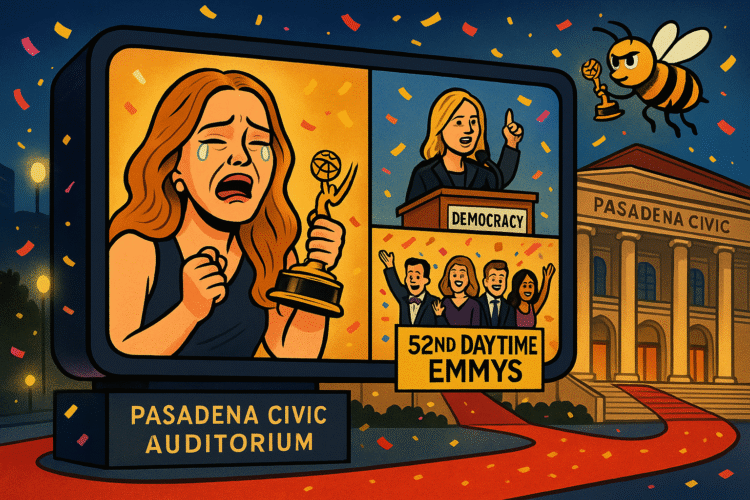
There’s a special kind of American optimism in handing out golden statues while the world burns. On October 17, the 52nd Daytime Emmy Awards beamed from the Pasadena Civic Auditorium, where a theater full of people in sequins and spray tans cheered for the institutions that have taught us to cry at noon, gossip at one, and heal through commercials for catheters. And somehow, in this fractured era of streaming chaos and federal melodrama, daytime television still feels like the most stable thing in America.
The night belonged, once again, to General Hospital, that ancient Corinthian column of chaos, which swept seven trophies including Outstanding Daytime Drama, solidifying its place as television’s most resilient hydra. Kill off one character, resurrect two. Split a twin, marry a cousin, bury a secret. It’s the closest thing to the federal government still functioning on schedule.
But beneath the applause, the teleprompters, and the cascade of sentimental montage packages, the ceremony revealed something deeper: the last bastion of shared culture isn’t prime time or prestige TV—it’s the flickering world of daytime, where democracy, melodrama, and middle-class fantasy still cling together like wet tissues in a soap opera funeral scene.
General Hospital: Democracy with Better Lighting
Nancy Lee Grahn, the night’s newly minted Lead Actress, accepted her award with the poise of a woman who’s both survived and delivered several fictional strokes. In her acceptance speech, she did what no one else dared: she turned the Emmys into a civics lesson. Between mascaraed tears, Grahn made a direct appeal to defend democracy, a move both radical and perfectly daytime.
Because daytime TV—unlike the internet—still believes in emotional continuity. You can’t fast-forward a soap opera and still understand it; you have to sit through the buildup, the bad decisions, the courtroom monologues. Democracy works the same way, or used to. Grahn’s speech wasn’t political posturing—it was nostalgic patriotism wrapped in network sincerity. She didn’t just thank her castmates; she thanked the concept of truth.
Meanwhile, Paul Telfer of Days of Our Lives won Lead Actor, proving that after 60 years, someone can still make adultery, kidnapping, and miraculous amnesia look heartfelt. His speech was simple: a humble nod to craft, a quick thank-you to his wife, and an indirect jab at AI-generated writing. If Days ever gets replaced by deepfake drama, it won’t be progress—it’ll be propaganda.
Supporting Roles, Eternal Archetypes
The supporting trophies went to Susan Walters and Jonathan Jackson, both emblematic of daytime’s spiritual core: actors who have aged gracefully while their characters age in dog years. Jackson thanked his writers for giving him “permission to feel,” which is either profound or a warning label for future therapy bills. Walters, meanwhile, reminded everyone that supporting actors are the gravitational force keeping the genre from floating into absurdity.
Their victories reinforced an eternal truth: no one cries like a soap star. No one delivers exposition while bleeding out from a poisoned martini quite like daytime royalty. If prime-time acting is realism, daytime acting is ritual—heightened, deliberate, endless. The same could be said for American politics.
Barrymore Ascends the Throne
The talk-show category delivered the night’s biggest full-circle moment: Drew Barrymore, forty years after her first Emmy nomination, finally took one home for Outstanding Daytime Talk Series Host. The woman once crowned Hollywood’s wild child is now America’s afternoon therapist. The Drew Barrymore Show also grabbed multiple trophies, cementing her as the new monarch of emotional sincerity.
Barrymore’s win wasn’t just career redemption—it was cultural course correction. In an era when late-night talk has turned into brand management, Barrymore’s unpolished authenticity feels revolutionary. She cries, she hugs, she occasionally interviews the furniture. But it works. Because daytime doesn’t need irony—it needs connection.
When she thanked her staff, Barrymore’s voice cracked on the line, “I just want to make people feel seen.” In a room full of performers, it was the first moment that didn’t feel performed. It was messy, awkward, real—the opposite of every political press conference in America.
The Talk Wars
Meanwhile, Live with Kelly and Mark snagged Best Daytime Talk Series, proving that marital banter is still a viable business model. The show has the easy rhythm of two people who have been bickering since dial-up. It’s breakfast television as emotional ASMR: the sound of safe domesticity in a country allergic to it.
But this new balance—Barrymore’s earnest therapy versus Kelly and Mark’s couple’s comedy—marks a quiet revolution. The daytime talk universe has splintered into empires: confession (Barrymore), conversation (Kelly and Mark), and chaos (The View). Each is a microclimate of American psychology. The genre has become our collective group chat—gossip, healing, and blame management, broadcast live.
The Soaps Remain the Republic
That General Hospital remains the undisputed powerhouse of daytime drama says something almost profound about national endurance. The show has survived network mergers, pandemics, and the death of every demographic it once targeted. Its victory lap—seven Emmys—isn’t just a tally. It’s a reminder that the soap opera, once dismissed as frivolous, now feels like a mirror of civic collapse: passionate, exhausting, and always one bad decision away from total implosion.
The night’s montage of GH clips looked eerily familiar to anyone following Congress. Secret plots. Double-crossed allies. Suspicious hospital paperwork. A cliffhanger that never resolves because the writers haven’t agreed on who the villain is yet.
The Nonfiction Frontier
The night’s nonfiction winners pointed to where daytime might actually be headed: into the microcosms. Programs like Secret Lives of Animals and Secret Lives of Orangutans took home specialty awards, proving that audiences now crave intimacy—whether with people, pets, or primates. The human ego, it turns out, finds comfort in watching creatures who don’t argue about polling data.
Cultural documentaries like Black Barbie also triumphed, expanding the genre’s conscience. In the world of daytime, where women once traded amnesia for infidelity, the conversation has widened to who gets to see themselves reflected at all. These wins suggest a hybrid future—where heart and history share the same timeslot.
Entertainment Tonight and the Myth of Perpetual Motion
Entertainment Tonight took home another Entertainment News Emmy, reaffirming that the only constant in television journalism is self-coverage. ET is the industry’s ouroboros—Hollywood gossip reporting on Hollywood gossip about gossip reporters. It’s the perfect daytime artifact: endlessly looping spectacle dressed as news.
But its endurance also reveals something strangely optimistic. Even in a fractured media world, millions still tune in for stories that begin with “exclusive.” Daytime TV may not shape reality anymore, but it still narrates it, one celebrity heartbreak at a time.
Beneath the Glitter: Economics, Power, and the Price of Comfort
Every trophy on that Pasadena stage represents not just artistry but survival. The daytime ecosystem—writers, producers, unions, local affiliates—depends on steady output and reliable ad slots. In an era of collapsing cable revenue, daytime is a rare pocket of equilibrium. General Hospital’s dominance isn’t just creative—it’s economic leverage. More Emmys mean more renewals, better syndication math, stronger bargaining power.
The networks understand something the tech disruptors forgot: emotion is sticky. Habit is monetizable. Millions still schedule their lives around fictional heartbreaks and celebrity confessions. Daytime is built not on innovation, but endurance. And endurance, in this country, wins.
The Weather Vanes in Sequence
Grahn’s speech about democracy, Barrymore’s ode to vulnerability, Walters’ nod to ensemble work—each was more than a thank-you list. They were temperature readings of the national psyche. In a year when government shutdowns and authoritarian vibes dominate headlines, the Daytime Emmys felt almost subversive in their civility. People hugged. They thanked unions. They pronounced words like “gratitude” without irony.
These ceremonies double as cultural diagnostics. The same way The Oscars measure aspiration and The Grammys measure chaos, the Daytime Emmys measure endurance—who’s still standing, still producing, still pretending that connection on camera might translate to community off-screen.
The Ceremony Itself: Earnestness as Resistance
The Pasadena Civic Auditorium looked like a glitter bomb of sincerity. Between commercial breaks, livestream hosts filled airtime with trivia about soap history and reminders to “vote” for audience-choice awards. The pacing was uneven, the lighting occasionally brutal, but the mood was curiously defiant.
This wasn’t a night for reinvention; it was a night for reassurance. The montages—those slow-motion collages of crying actors and heartfelt voiceovers—felt like national therapy. You could almost forget that the real world was burning just outside the auditorium doors.
In a culture obsessed with novelty, daytime television’s greatest rebellion is its refusal to change too much. It’s the same sets, the same lighting, the same melodramas—but somehow, that repetition becomes ritual. Stability disguised as spectacle.
The Paradox of Noon
At a time when media freedom feels fragile and truth is a partisan weapon, daytime TV remains the most democratic medium left. It’s free, unpretentious, and weirdly sincere. You don’t need a streaming password or algorithmic blessing—just an antenna and an afternoon.
When General Hospital wins for the 37th time, it’s not just industry inertia. It’s an acknowledgment that the soap opera is America’s shadow government: endless, emotional, and always debating the same five moral crises. And when Drew Barrymore cries into the camera, she’s channeling the last civic instinct we have left—our desperate desire to feel something, together, in real time.
THE LAST COMMERCIAL BREAK
So yes, the 52nd Daytime Emmys handed out golden angels. But the deeper story is survival: the persistence of communal feeling in a culture allergic to patience. General Hospital proved legacy still matters. Barrymore proved sincerity still sells. Black Barbie proved representation still shocks daytime’s glass ceiling.
For all its glamour, the night was strangely grounding. In a year when headlines look like satire and democracy resembles a cliffhanger, it’s oddly comforting to know that somewhere in Pasadena, Nancy Lee Grahn can still win an award, Paul Telfer can still deliver a soliloquy about redemption, and Drew Barrymore can still cry her way into America’s heart without irony.
Maybe that’s the moral buried in the glitz: that daytime television, against every forecast, still believes in the possibility of resolution.
Not happy endings—just continuity. The next scene. The next day. The next time slot.