On August 22, 2025, Mashable (via Bloomberg) confirmed what iPhone users have suspected since the first time Siri replied “I didn’t quite get that” to a basic request: Apple still doesn’t know what Siri should be. After years of delays, vaporware “Apple Intelligence” rollouts, and corporate reshuffles, the company is reportedly in talks with Google to power a revamped Siri with—wait for it—Gemini.
Yes. The trillion-dollar company that turned brushed aluminum into religion might outsource its voice assistant’s brain to a direct rival. The same Apple that spent a decade mocking Google for harvesting your soul through Gmail ads now wants to plug its flagship AI into Mountain View’s neural cortex.
From “Apple Intelligence” to “Apple Codependency”
Let’s rewind. Apple previewed Apple Intelligence features in iOS 18: Siri that could understand context, read your screen, and juggle apps. It was pitched as a revolution. By March 2025, Craig Federighi admitted those features weren’t shipping. Not “delayed.” Cancelled. A reboot was promised for 2026.
Now? Even that reboot may not be homegrown. Instead, Apple is reportedly kicking the tires on Gemini. Which means Siri—the assistant that launched in 2011—could celebrate its 15th birthday by borrowing its intelligence from the very company Apple treats like Voldemort.
The Brand Paradox
Apple’s whole brand pitch rests on privacy. “What happens on your iPhone stays on your iPhone.” They run smug billboards about not selling your data. If Siri suddenly gets Gemini under the hood, that story gets… complicated. Apple insists the model would run in Private Cloud Compute, with “guardrails.” But let’s be honest: outsourcing your brain to a competitor while claiming it’s still your brain is like buying McDonald’s fries, serving them in a white minimalist carton, and calling them “Apple Potatoes.”
Analysts: This Could Work
The analyst consensus: this might actually help Apple catch up quickly. Gemini is competent. It writes, it summarizes, it hallucinates less than Siri. A Gemini-powered Siri could leapfrog from “set a timer” to “draft me a cover letter and also summarize Eric’s email about synergy.”
But it’s also a strategy question: If Apple needs Google to make Siri usable, what exactly is Apple’s differentiator anymore? Sleek bezels? MagSafe accessories? The ghost of Jony Ive whispering “aluminum”?
The Eternal Build-vs-Buy Debate
Apple has been here before. Remember when they bought chip design in-house and made silicon their crown jewel? Or when they built their own maps and got roasted for routing drivers into lakes? Build vs. buy has always been Apple’s existential dilemma.
Now, with Siri, it’s existential squared. Build: risk more years of being a joke. Buy: hand your biggest rival the keys to your user experience. Neither option screams innovation. Both scream desperation.
Gemini in an Apple Skin
If this deal happens, here’s what to expect:
- Siri will act smarter. You’ll finally be able to ask: “Show me the file Eric sent” and actually get Eric’s file instead of Apple Music recommending Eric Clapton.
- Privacy marketing will go into overdrive. Every keynote will feature Federighi swishing his hair while reassuring you your Gemini queries are encrypted with pixie dust and stored in an iCloud bunker in Switzerland.
- Google will quietly laugh. Because even if Apple cloaks Gemini in Cupertino branding, everyone will know the brain behind Siri was rented from Mountain View.
Corporate Pride vs. User Reality
Apple hates depending on anyone. That’s why they built their own chips, their own modems, their own ad business. But pride has a cost: ten years of Siri being a national embarrassment. If outsourcing to Gemini means Siri finally functions, users may not care who built it. They just want it to stop being the punchline to every tech joke.
But Apple does care. Because Apple’s religion isn’t just product design. It’s control. Outsourcing Siri’s brain isn’t just a technical compromise. It’s a theological crisis.
The Bee’s-Eye View
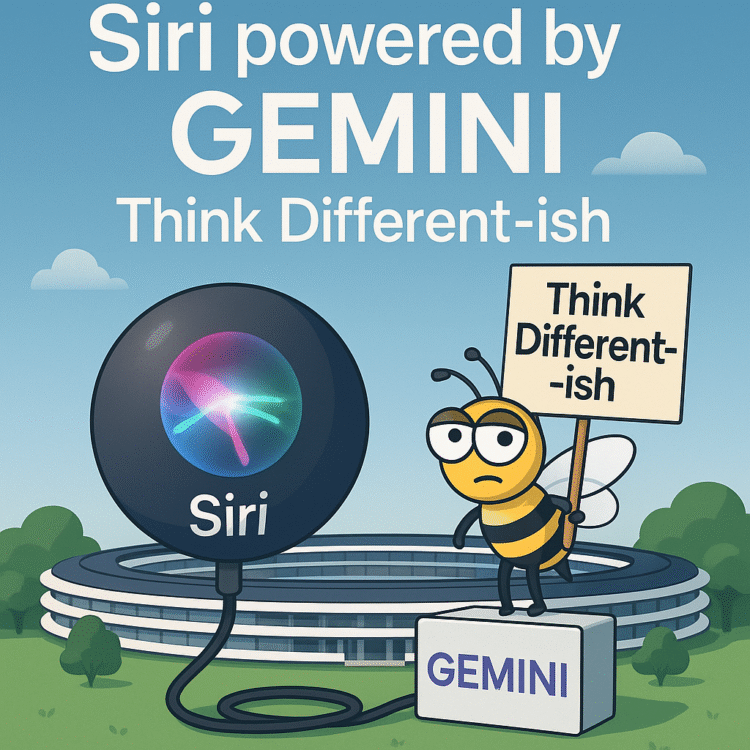
Picture it: Apple Park, spaceship campus gleaming. Inside, a giant Siri orb flickers, dim and sputtering. Engineers wheel in a glowing Gemini cube from Google. They duct-tape it to the Siri orb. Tim Cook nods solemnly: “It just works.”
In the corner, our cartoon bee buzzes, holding a sign: “So much for Think Different.”
The Closing Sting
This is the crossroads. Apple can build, and risk Siri being a joke until 2027. Or Apple can buy, and risk branding itself as a hardware shell wrapped around someone else’s intelligence. Either way, the illusion that Apple has a plan is over.
Siri’s existential crisis isn’t about AI. It’s about identity. Does Apple want to be the company that crafts every transistor in-house, or the company that rents brains from rivals? Because in 2026, when you whisper “Hey Siri” into your iPhone 17, you may be talking to Google in an Apple mask.
And that, my friends, is the most Apple thing of all: outsourcing genius, reselling it at a premium, and insisting it was theirs all along.