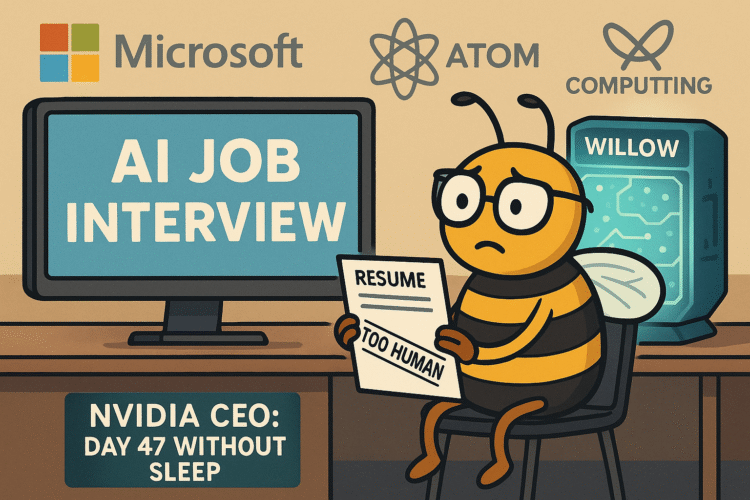
Somewhere between the release of a quantum chip named like your aunt’s dog (hi, Willow) and the quiet pivot from “ban AI in hiring” to “please, AI, hire someone,” the tech world decided it was time to let its mask slip. Not the innovation mask. The sanity one.
This week’s round-up in Techgeddon 2025™ offers something for everyone: CEOs working themselves into vapor, companies rebranding indecision as agility, and the gentle hum of quantum computers that may or may not be solving the wrong problems very fast.
Let’s explore this week’s headlines from the Valley of Delusion.
Jensen Huang Has Entered the No-Days-Off Pipeline
Nvidia CEO Jensen Huang, he of the perpetual leather jacket and GPU-fueled global dominance, is reportedly working seven days a week. That’s not hyperbole. That’s not “leaning in.” That’s a cry for help disguised as a TED Talk.
Nvidia is now worth $4.2 trillion—roughly the GDP of every country that still teaches handwriting. Naturally, this means Huang must personally be awake at all hours, fending off ChatGPT hallucinations, crypto miners, and engineers who keep trying to sneak tiny mechs into the firmware.
When reached for comment, a spokesperson said, “Mr. Huang remains committed to redefining the future of humanity’s relationship with silicon and sleep deprivation.”
If the singularity does arrive, it’ll probably be delivered by a deeply exhausted man holding a PowerPoint he’s never had time to proofread.
Anthropic Walks Back Its AI Hiring Ban, Now Welcomes Skynet into HR
Anthropic, a tech giant founded by people allergic to press interviews, has reversed its short-lived ban on using AI in the hiring process. Yes, they’ve decided that the ethical minefield of having artificial intelligence judge human job applicants is totally fine now, probably because the AIs are unionizing and it’s easier to just let them feel included.
One hiring manager was overheard saying, “We wanted humans who could think critically, but the AI kept flagging them as noncompliant.”
Expect new interview questions such as:
- “Tell me about a time you overcame a challenge, and please type it in JSON.”
- “What’s your emotional availability setting: default, fine-tuned, or deprecated?”
- “Describe a workplace conflict, but in under 80 tokens.”
Welcome to hiring in 2025: where the algorithm decides you’re a bad culture fit because your syntax is emotionally inconsistent.
Microsoft and Atom Computing Announce Quantum Computers… For Sale?
Microsoft and Atom Computing have decided it’s time to commercialize quantum computing. Because clearly, the world is ready for machines that can break encryption, predict climate chaos, and accidentally schedule twelve meetings in fourteen dimensions.
According to sources, the new quantum platforms will be marketed to:
- Corporations hoping to predict customer loyalty before the customer is born
- Governments interested in “quantum diplomacy,” which sounds fake but isn’t
- And startup founders who want to speed-run the collapse of linear time
Pricing is still TBD, but rumor has it you’ll need three venture capital firms and a wormhole to afford one.
Google Unveils “Willow,” a Quantum Chip That Can Solve Your Existential Crisis—But Only in Theory
In what sounds like a Pixar film gone rogue, Google has revealed “Willow,” its latest quantum chip. This chip can reportedly solve complex problems in minutes—problems like molecular modeling, traffic optimization, and determining how many timelines in the multiverse still think Google+ was a good idea.
Engineers assure us that Willow represents the future of computation. Critics say it represents the future of a team yelling “it works!” as the lab catches fire.
Either way, it’s clear Willow is here to do one thing: calculate answers so fast you never have time to ask if they’re useful.
Meanwhile, in Government: We Should Probably Talk About AI, Right?
Back in reality—or what’s left of it—governments are holding serious discussions about national AI standards and how to combat disinformation. Topics include:
- Regulating AI-generated campaign ads featuring holographic Founding Fathers endorsing crypto
- Teaching people how to spot deepfakes when most of them can’t spot satire
- And finally agreeing that maybe, just maybe, the “open-source doomsday model” wasn’t the best holiday release
The meetings are expected to produce guidelines, most of which will be ignored by tech companies already ten years ahead and twelve ethics violations deep.
Still, it’s cute that lawmakers are trying.
Final Thought: The Future Is Now, and It Has HR Access
From quantum arms races to job interviews judged by AI trained on Reddit threads, we are no longer living in the Information Age—we’re deep in the Interpretation Age. No one knows what any of this means, only that it’s happening faster than regulation, reason, or common sense can catch up.
So buckle up. Or don’t. The car’s driving itself now, and it’s asking for your resume.