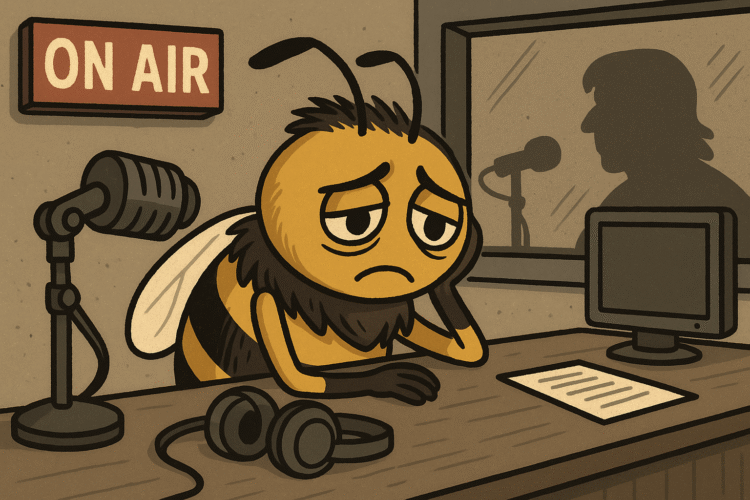
And just like that, the King of All Media may soon be the Ghost of All Middleware.
According to industry whispers muffled by the sound of rapidly disappearing subscribers, Howard Stern’s contract with SiriusXM is set to expire at the end of 2025—and the company, once a smitten bride throwing money at his throne, is reportedly preparing to not renew it.
No final show announced. No commemorative fart sound. Just a quiet click as the last boom mic powers down on a once-revolutionary format now held together with corporate nostalgia and stock photos of shock jocks in leather jackets.
Let’s be clear: Howard Stern is not just a radio host.
He’s a cultural artifact. A broadcast fossil with hair.
A man who turned FCC fines into a personality and somehow made “baba booey” both meaningless and eternal.
In the ‘90s, he was dangerous.
In the 2000s, he was defiant.
By the 2010s, he was rebranding as “introspective.”
And now, in the twilight of 2025, he’s… expensive.
Which is the one thing no man—no matter how many celebrity therapy sessions he hosts—can survive in satellite radio.
SiriusXM, the home he helped build, now finds itself asking the corporate version of a breakup question:
“What are we, really?”
And the answer appears to be:
“We are bleeding out in a content economy dominated by TikTokers whispering true crime into lavender microphones.”
Stern’s salary—rumored to hover around $100 million per year—once made sense.
He brought clout, subscribers, and an unfiltered chaos that helped satellite radio pretend it was still radio’s final frontier.
Now?
He brings increasingly intimate interviews with the third-tier cast of Succession, broadcast to a shrinking pool of long-haul truckers and Gen X dads too stubborn to cancel their subscription.
The irony is brutal.
Stern once was the disruption.
He took radio’s polite smiles and handed them a dildo and a lie detector test.
He fought the FCC with profanity and pivoted to Sirius like Moses storming out of terrestrial Egypt.
And now? He’s watching the platform he made famous drift off into obsolescence while a new generation listens to influencer wellness podcasts with names like Vibe Check and Emotional Hygiene.
You can almost hear the echo of old radio boards weeping into their sliders.
What’s next?
Does Stern retire?
Go independent?
Sell NFTs of his old interviews with lesbian porn stars and Quentin Tarantino?
The man already works three days a week, broadcasts from a home studio, and shows visible resentment any time someone asks him to try something new.
He’s become the exact kind of institution he used to mock: entrenched, protected, untouchable, and a little bored.
But there’s a dignity in boredom. Especially when it’s wrapped in nine figures and the slow drip of legacy praise.
SiriusXM, for its part, is facing the inevitable:
- Declining subscriptions
- Rising costs
- A media landscape that no longer centers on audio personalities, but on whether your podcast has a visualizer and an Instagram account with animated quotes.
And they can’t afford Stern’s legacy anymore.
Because legacy doesn’t trend.
They’ll cite “changing consumption habits,”
and “content diversification,”
and “strategic realignment of audience verticals.”
What they mean is:
We can’t justify paying Howard Stern more than the GDP of Belize so he can ask Hillary Clinton about her childhood.
The fans, of course, are divided.
Some are devastated.
They remember the glory days—when Howard felt dangerous, when morning commutes were ritualistic, when terrestrial radio cowered like a Victorian widow under a fainting couch.
Others—secretly—are relieved.
Because it’s hard to watch a rebel try to age gracefully on a platform that was built to break rules and now issues HR-mandated apology statements for tone.
Stern mellowed.
The world sped up.
And the gap in between was filled with quiet sighs and “best of” reruns.
Let’s also acknowledge the absurdity of trying to measure Stern’s current relevance in an age where the most powerful radio is…not radio.
It’s algorithmic chaos.
It’s TikTok girls explaining the Cuban Missile Crisis in a sing-song voice.
It’s Spotify exclusives hosted by men named Ryker who’ve never seen a cassette tape.
The idea of “shock jock” doesn’t even land anymore.
We are permanently shocked.
The jock part is optional.
So what happens now?
Stern might walk.
Or negotiate a scaled-back deal.
Or partner with someone new and immediately hate it.
Or maybe—just maybe—he vanishes.
Quietly.
Without a final prank.
Without a topless guest.
Just a mic that goes cold while someone in corporate signs a press release about “next-generation user experiences.”
Final Thought:
If SiriusXM lets Howard Stern go, it won’t just mark the end of a contract.
It’ll mark the quiet collapse of a certain kind of rebellion—one that once mattered, once scared people, once felt like radio on fire.
Now?
It’s static.
Expensive static.
But static, nonetheless.