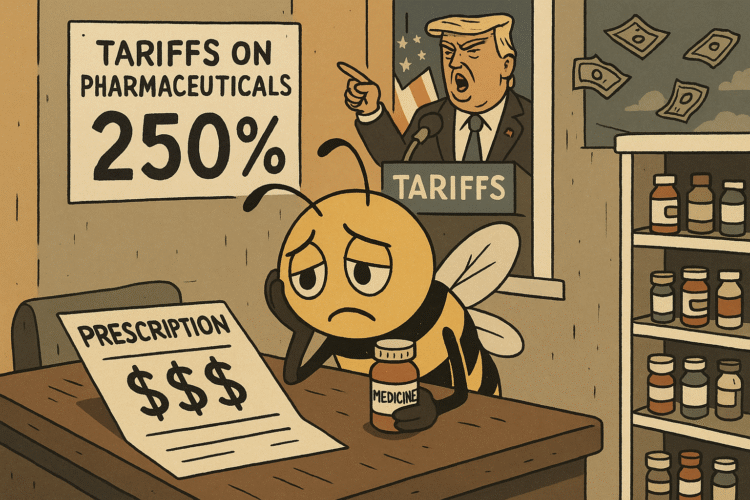
In the latest episode of The Price is Wrong, President Donald J. Trump—America’s most medically curious non-doctor—has threatened to impose up to 250% tariffs on pharmaceuticals imported from countries that, in his words, are “ripping us off,” prompting a new era of health care diplomacy where the treatment comes after the financial stroke.
This all began after Pfizer’s CEO allegedly called Trump regarding “most favored nation” pricing. That phrase, by the way, is not an honorary friendship bracelet between countries—it’s a clause that lets America demand the best available global price. Think: Costco, but with more diplomatic tension and less free samples.
Trump’s response? Classic.
If we’re not the favorite, everyone gets punished.
With tariffs so steep they need an EpiPen just to survive.
For context, the U.S. already pays more for prescription drugs than any other developed country, because… freedom. We believe in the right to bear arms and bankrupt ourselves over insulin. So when Trump hears that other countries are getting a better deal on meds, he does what any deeply rational leader would do: threaten to make American patients pay even more out of spite.
You know—for leverage.
Because when you’re playing economic chicken with the global pharmaceutical supply chain, the best move is clearly to drive your own citizens into financial ruin and then blame Big Pharma for swerving first.
Let’s talk numbers.
A 250% tariff means that if your meds cost $100 from a manufacturer in Germany, they now cost $350.
Which is great news if you’ve been wondering what it would feel like to choose between breathing and rent.
In this version of American exceptionalism, the only people getting high are the price tags.
Life-saving cancer drugs? Triple the cost.
Antibiotics for your kid? Time to crowdsource penicillin from someone’s moldy sourdough starter.
SSRIs? Better hope that yoga and positive affirmations can treat generational trauma.
But let’s be fair. This isn’t just policy. It’s performance.
Because the pharmaceutical tariffs are not about lowering drug costs.
They’re about weaponizing them.
About punishing other nations for negotiating better, then repackaging that failure as nationalism.
“We will not be taken advantage of,” Trump says—while his voters Google how to take a half dose of Lipitor every other day to save money.
It’s not health care. It’s hostage diplomacy with a co-pay.
Meanwhile, Trump’s base is left to untangle the moral math:
- Do you support tariffs if they make America look strong,
- but also make Grandpa’s heart pills cost more than the used Ford he drives to the pharmacy?
Tough call. But don’t worry—he’s promised exceptions. You know, for “essential” drugs.
No clear definition provided, but I’m sure Viagra will be exempt.
We wouldn’t want to risk the rise of a flaccid nation.
And let’s not forget the “most favored nation” clause at the center of this melodrama.
A policy concept rooted in fairness, twisted into a game of economic chicken by a man who thinks you can negotiate with Type 1 diabetes.
Trump doesn’t want a better deal for Americans. He wants a public feud with pharma execs that makes him look like a populist champion while quietly triggering the largest price spike since Martin Shkreli discovered Twitter.
But what’s truly poetic is that the people who’ll be hit hardest by these tariffs are the same ones who were promised cheaper meds in the first place.
The working-class voters in rural states where insurance is a luxury and prescription discount cards are passed around like coupons for bottled oxygen.
They’ll be the ones at the pharmacy counter next month, swallowing sticker shock instead of tablets.
They’ll ration blood pressure meds, crowdsource insulin, and delay chemo until payday.
All while the man who caused it tells them to be proud—because at least China didn’t get a discount.
The truth is, pharmaceutical tariffs won’t bring manufacturing home.
They won’t improve access.
They won’t punish Big Pharma.
They’ll just redistribute the cost onto the backs of the sick, the poor, and the desperate—
a patriotic price hike, brought to you by pride.
And if you die waiting?
At least you died as a favored nation.
Final Thought:
Trump’s pharmaceutical tariff plan is less a policy than a threat with a price tag. It’s what happens when ego becomes economic strategy—when the man with the marker board decides to draw borders around the pharmacy counter.
Because nothing says “America First” like paying three times more to die just a little bit faster.