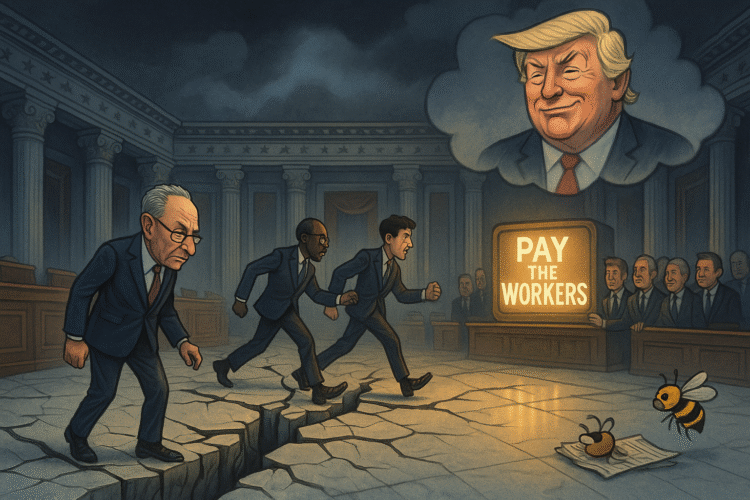
For three weeks, Chuck Schumer has performed the Senate equivalent of yoga on hot coals—keeping forty-nine Democrats in the lotus position while the government burns around them. It worked, until it didn’t.
Axios dropped the news like a leaky ceiling tile: Georgia senators Jon Ossoff and Raphael Warnock quietly crossed the aisle on a Republican motion—nothing binding, technically symbolic, politically radioactive. One vote doesn’t break a wall. Two makes it creak. And in a shutdown this deep, creaking is how collapse begins.
It’s the first real crack in Schumer’s “hold the line” strategy, that ironclad caucus discipline that’s been his calling card since October 1, when Democrats decided they’d rather starve the bureaucracy than feed Trump’s ego. For a while, it worked. Democrats had a story to tell: protecting healthcare, defending workers, resisting executive overreach. But stories age faster than groceries when the SNAP cards stop working.
Now, the unity is fraying—not because anyone’s ideology changed, but because people’s patience did.
The Day the Line Bent
It wasn’t a dramatic mutiny. No late-night floor speech, no torchlit walkout. Just two Georgia Democrats voting “aye” on a GOP motion that Schumer’s shop had already written off as a stunt.
The vote was procedural—a motion that didn’t reopen the government or appropriate a dime. But symbolically, it was the Senate equivalent of a sigh.
Ossoff and Warnock didn’t defect out of love for Trump’s budget math. They defected because Georgia is purple, airports are loud, and TSA agents are not subtle when they haven’t been paid in three weeks. Atlanta is home to Hartsfield-Jackson, the busiest airport in the country, and nothing tanks local approval faster than watching security lines stretch into next week while CNN broadcasts the chaos in split screen with your nameplate.
Call it the “Pay the TSA” paradox: Democrats say they’re standing for principle; voters say they’re standing in line.
Schumer’s War Room: The Memos That Aged Like Milk
Three weeks ago, Schumer’s office sent out a memo—leaked, of course—titled “Hold the Line.” It read like a campaign pep talk written by someone who still believes message discipline can beat hunger. The strategy: keep every Democrat voting “no” until Trump’s numbers tank or his allies blink.
And for a while, it seemed to work. Trump’s “shutdown for leverage” stunt began as a reality show stunt and quickly turned into an episode of Survivor: Washington. Democrats looked unified. Republicans looked unhinged.
Then the polls flipped.
The White House started circulating internal numbers showing the blame game was shifting. Voters, it turns out, don’t track procedural purity—they track rent payments. Trump world crowed that “the tide has turned.” Schumer’s team privately scoffed, then publicly tightened the leash.
The problem is, the leash now looks like a garrote.
The Georgia Problem
Ossoff and Warnock were always the canaries in Schumer’s coal mine—two ambitious freshmen from a state that still flirts with conservatism between elections. Their victories were miracles of turnout, not mandates for masochism.
Every day the shutdown drags on, more Georgians start to notice what Washington calls “tactical patience.” SNAP benefits are on the cliff. Federal employees are skipping paydays. Small contractors are watching projects evaporate.
When the choice is between explaining fiscal philosophy and explaining why your constituents can’t afford chicken, “aye” starts to sound like the pragmatic syllable.
Warnock, ever the preacher, framed his vote as “a moral stand for working people.” Ossoff called it “a gesture of good faith.” Schumer called it “unhelpful.”
Translation: the dam is sweating.
Republicans Smell Blood (and Ratings)
The GOP knows a wedge issue when it sees one. Within hours of the Georgia defection, Senate Republicans blasted out press releases praising Ossoff and Warnock for “bipartisan leadership.” They might as well have mailed them halos and “Welcome to the Team” fruit baskets.
The real play, though, isn’t flattery. It’s fragmentation.
Republicans have already begun floating a series of “partial pay” bills—fund the Coast Guard here, pay the air-traffic controllers there—each one a Trojan horse designed to force Democrats into looking like obstructionists for opposing them.
Schumer’s caucus knows the trap: every carve-out dilutes leverage, and once you start feeding select agencies, you lose the urgency to reopen the rest. But the optics are brutal. “Why won’t you pay the troops?” makes a better headline than “Because of separation-of-powers concerns in Section 301(b)(4).”
So the Republicans keep dropping bills like breadcrumbs, daring Democrats to keep saying no while the clock ticks louder.
The White House: Chaos with Charts
Meanwhile, inside the Trump administration, Treasury Secretary Scott Bessent—now moonlighting as the world’s least convincing fiscal hostage negotiator—held a press conference waving spreadsheets like surrender flags. “We can fund priorities immediately if Congress sends the right bill,” he said, which roughly translates to “We’re the arsonists offering hoses, but only for the parts of the house we like.”
The message is simple and cynical: Democrats are now the ones “holding America hostage.” And while that’s false, it’s also potent.
Especially because the shutdown optics are starting to rot. Grocery prices are climbing. SNAP funding is on fumes. Families that rely on federal paychecks—military, transportation, agriculture, corrections—are staring down missed rent.
When abstractions like “negotiating leverage” meet realities like “no groceries,” abstractions lose.
The Freshman Fracture
Axios also reports that several freshman Democrats—mostly from swing or purple states—have begun holding quiet huddles about “off-ramps.” The term is Beltway code for surrender that sounds responsible.
These meetings are less rebellion than existential panic. The question isn’t whether Democrats can win the standoff; it’s whether there will be anything left to win. Every day of unity buys them principle. Every week costs them empathy.
Even Schumer’s allies admit privately that the Georgia vote could be the start of a slow bleed—Montana, Nevada, Arizona, maybe even Pennsylvania. None of those senators want to spend Thanksgiving explaining the ethics of a shutdown to voters who just want to know why their benefits didn’t load.
The line “We’re fighting for the people” starts to sound absurd when the people are fighting for lunch.
The PR Problem
Shutdown politics used to be simple: Republicans caused them, Democrats condemned them, everyone agreed it was bad. But Trump has turned the shutdown into a branding exercise. He wears it like a crown, declares it proof of “strength,” and insists Democrats “want chaos.”
By holding out, Democrats thought they were showing resolve. Instead, they’ve handed him the script for his next Truth Social video: a montage of unpaid soldiers, grounded flights, and grim supermarket interviews, overlaid with his favorite voiceover—“Biden’s America, except now it’s Schumer’s.”
Trump’s strategy is pure optics warfare: force Democrats into explaining nuance to an exhausted country.
And so far, it’s working.
The Economics of Exhaustion
Shutdowns aren’t like storms—they don’t hit all at once. They creep. First federal workers miss a paycheck. Then contractors get furloughed. Then SNAP funds evaporate. Then retailers notice the quiet panic. By week four, the national mood curdles into resentment.
Schumer knows this. His staff knows it. The problem is that principle doesn’t pay rent.
Democrats entered October united behind healthcare funding and anti-corruption riders. Three weeks later, the conversation isn’t about ideals—it’s about inertia. The public stops distinguishing between sides. “They’re all to blame” is the default position of a hungry democracy.
Ossoff and Warnock just put a face to that fatigue.
Inside the Democratic Mind Palace
Schumer’s defenders argue that breaking now would legitimize Trump’s hostage strategy. “If we cave,” one strategist said, “he’ll just do it again next year.”
That’s true. But so is the opposite. If Democrats keep the government shuttered too long, they teach voters that principle is a luxury.
The question isn’t whether to reopen. It’s how to reopen without humiliation. And that’s a dance Democrats have never mastered.
Every administration, Democrat or Republican, eventually finds itself trapped between policy and optics. The difference this time is the scale. Trump’s shutdown isn’t about fiscal ideology—it’s about dominance. It’s the political version of a chest-thump.
And Schumer’s “hold the line” plan, noble as it may be, is starting to look like a staring contest with a man who doesn’t blink.
The Blame Curve
For three weeks, public opinion held steady. Voters blamed Trump by double digits. Then the curve bent.
New polls show that independents now see “Congress” as the problem—translation: both parties. The White House calls that “progress.” Schumer calls it “spin.”
But numbers don’t care about spin. They care about hunger, fatigue, and airport lines.
When the White House touts internal data showing Trump’s approval among “shutdown-fatigued voters” rising by four points, it’s easy to dismiss as propaganda. It’s harder to ignore when your own pollsters start whispering that swing states are souring on stalemate.
That’s the quiet dread creeping through Democratic offices tonight. Not collapse, not rebellion—just entropy.
The Republican Endgame
Republicans, meanwhile, are loving this. They’ve found a way to look like the “reasonable adults” for once, and they’re not about to waste it. Their new talking point: “We’re trying to pay workers; Democrats won’t let us.”
Never mind that their bills come with poison pills the size of Mar-a-Lago. Optics beat truth every time.
Every day this drags on, Trump gets to play emperor—deciding which workers are “essential,” which agencies reopen, which soundbites go viral. And for all the dysfunction, that’s his comfort zone: chaos as campaign content.
The Political Boomerang
Here’s the irony: Democrats launched this shutdown to show strength. But strength, in politics, decays faster than unity.
Once the first defection lands, the rest follow gravity. Ossoff and Warnock didn’t start a revolt; they just named the exhaustion everyone’s pretending not to feel.
Now, Schumer faces an impossible calculus: break discipline and lose leverage, or hold discipline and lose voters. The longer he waits, the smaller the difference becomes.
Because at some point, every voter stops caring who caused the shutdown and starts caring who ends it.
Closing Section: The Sound of Cracking Ice
Every political strategy eventually meets the sound of cracking ice—the moment when ideals collide with reality, when caucus discipline meets cold hunger.
For Schumer, that sound just came from Georgia. Two senators stepping off the frozen lake, testing the thaw.
Maybe it’s nothing. Maybe it’s the start of an avalanche. Either way, the lesson remains: you can hold the line, but lines are only as strong as the stomachs behind them.
The White House calls it “leverage.” Voters call it Tuesday night dinner. And somewhere in Mar-a-Lago, Trump is smiling, because once again, chaos is his currency—and everyone else is paying in groceries.