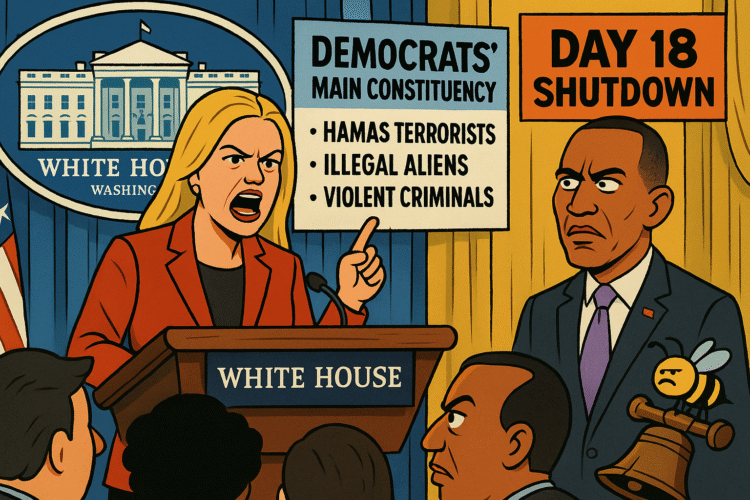
There’s something theatrically grotesque about a nation grinding to a halt while its communications director snarls into a microphone that the party in control of half the electorate is really a coalition of “Hamas terrorists, illegal aliens, and violent criminals.” On October 17, 2025, White House Press Secretary Karoline Leavitt breathed those words on Fox News, while the federal government honored its eighteenth straight day of shutdown — a self-inflicted stop-the-world pause triggered by one party’s demand for deep spending cuts and the other’s defense of health subsidies and foreign aid. Meanwhile, paychecks for federal workers are missing, SNAP benefits for 40 million Americans risk disappearing come November 1, and some 80 percent of U.S. nuclear-stockpile managers are facing furlough. Yet the narrative carefully shifts: the real enemy isn’t the fiscal chaos — it’s “them.”
In the swirl of press briefings and cable news loops, House Minority Leader Hakeem Jeffries stood on Capitol Hill and condemned the statement as “baseless and divisive,” calling Leavitt “sick” and “possibly demented.” The optics were sharp: a crisis of governance paired with a crisis of rhetoric. Behind the podiums and hashtags, something deeper was unravelling: when the machinery of state stalls, one way to preserve power is to declare that the fault lies not in policy but in identity.
The Theater of Collapse
Imagine a high-stakes drama where the lights go out on the set and the stagehands get locked backstage. That’s the scene in Washington: clerks aren’t getting paid, weapons systems aren’t being maintained, hungry families wait for checks that haven’t arrived. The shutdown is not abstract. It’s tangible. Yet while the gears of government grind to stillness, an official mouths a message so incendiary it distracts.
Leavitt’s remarks are shock-and-awe diplomacy through rhetoric. The Democratic base isn’t just Democrats anymore — it’s a club prefaced by murder, invasion, theft. It reduces complex policy debates — immigration, terrorism, crime, foreign aid — into a single grotesque caricature: the foe inside the tent. The moment was calibrated: day 18 of the shutdown, when frustration is raw. The script: shift blame. Tag the enemy. Escalate the fear.
Jeffries’ firing back isn’t just rebuttal; it’s alarm. His words didn’t simply challenge her claims — they challenged the speaker’s grip on reality. When one side accuses the other of aiding terrorists and criminals, the political fight becomes existential. It becomes not about how we govern, but who is fit to govern. And if you can persuade the many that their rivals stand for “illegal aliens” and “violent criminals,” then you need not fix the paycheck gap or protect SNAP benefits — you just rally harder.
The Crisis We Can See, and the Crisis We Don’t
The unpaid federal workers are visible: TSA agents, park rangers, IRS staff. The SNAP-eligible citizens worried about missing food stamps—they’re visible too. The test of nuclear-stockpile monitors? Less visible but terrifying for national security hawks. Each of those is a real cost. A real risk. A real collapse in progress.
Yet the narrative marches on: the shutdown isn’t about the delayed paychecks or the risk to nuclear readiness. It’s about empathy for terrorists. The policy impasse becomes a moral trap. Spending cuts? Health subsidies? These become side elements to the core: you’re either with us, guardians of order, or with them, terrorists and criminals. The message is simple: your side wins by defining the other side as not just wrong but dangerous.
In practical terms, this is political alchemy. A stalled government ≠ failure. The enemy within the other party = treachery. The question America should ask is not “Who will shut down the government?” (we know: Republicans pushing cuts) but “Who defends a pluralist democracy when its own machine betrays the common good?” Meanwhile, the machine keeps halting.
Scapegoat Politics and Identity Warfare
Leavitt’s phrasing—“main constituency includes Hamas terrorists, illegal aliens, and violent criminals”—is not stray rhetoric. It’s tactical. It sets up a worldview in which your opponent isn’t just mistaken, they’re traitorous. It aligns with a broader strategy: when governance fails, create an enemy so vast that failure becomes secondary. Immigration debates, terrorist threats, criminal justice become feedstock. The message: If you oppose me, you stand with them.
It’s a shift from “we’ll run the country better” to “we’ll purge the country of them.” That’s why the shutdown becomes a backdrop not a headline. Because if the crisis is policy mess, you fix the mess. If the crisis is identity betrayal, you chase the betrayers. It feeds a cycle: shutdown → panic → enemy naming → rallying. Then repeat.
When Jeffries says the remarks are “sick and possibly demented,” he’s signaling something more than anger. He’s signalling fear. Because once you paint half the electorate (or more) as criminal and terrorist, you delegitimize not only their policy positions but their existence in the system. You put pluralism on trial.
Governance in a Carnival of Fear
Let’s take a closer look at the consequences for governance. With the shutdown in place, decisions get deferred: maintenance postponed, investigations delayed, subsidies stalled. The price tag: perhaps in the billions, perhaps in national security. Maybe in human lives when a hungry child doesn’t get food stamps. But those are undervalued when the narrative billboard says: your opponent backs terrorists.
The administration’s spokesman is operating like a carnival barker. The state is the circus; the enemy is the sideshow. The scoreboard is in red letters. The concessions? Whistled away. The austerity? Branded as liberation. And the collapse? Marketed as crusade.
Meanwhile, voters hear: the money isn’t coming because they are coming. It’s not about policy delays—it’s about moral urgency. If your paycheck is late, that’s secondary to the existential threat you’re told you face. The lens shifts from “Why is the government shut?” to “Who shut it?” The “who” is the other side’s base.
When Reality Keeps Interrupting
Yet, despite the messaging, reality pokes through. The SNAP data. The nuclear-stockpile statistics. The list of federal workers missing pay. Each of those is a megaphone for the substantive failure. But they’re muffled by the loudspeaker of fear. When the official story is that your opponents are terrorists, you don’t ask, “Why are the paychecks late?” You ask, “Why do we still have terrorists in the tent?”
And that’s how the loop traps us. Because when you fix the narrative, you don’t have to fix the policy. If the crisis is identity, you don’t need to restore workers’ pay; you need to purge criminals. If the crisis is betrayal, you don’t need to end the shutdown; you need to wage the war. The war becomes the fix. The shutdown becomes the tactic.
Jeffries’ denunciation is accurate, but it is also reactive. The moment lags the message. While he scolds the rhetoric, the machine keeps running. And the machine isn’t built to govern—it’s built to provoke.
The Risk to Democracy
Here lies the true danger: when one side claims the other stands fundamentally for crime and terror, you reduce politics to identity purification. Policies are dethroned. Institutions become weapons. The press is not a watchdog but a participant. The courts are not blind but beholden. The system’s gears aren’t lubed for service—they’re greased for survival.
If the narrative sticks, then missing paychecks won’t prompt demands for reopening the government—they’ll prompt demands for witch hunts. SNAP delays won’t lead to relief packages—they’ll lead to loyalty tests. The nuclear stockpile risks won’t spur bipartisan fixes—they’ll justify radicalization. And that shift is subtle but massive: from democracy under challenge to democracy under siege.
When the official message says your opponent embraces terrorists, you stop treating them as fellow citizens and start treating them as enemies. That undermines the contract of democracy: that we govern ourselves through debate, not purges; through ballots, not indictments; through mutual recognition, not existential empowerment.
How We Get Past This
Opponents of the grand message must not merely rebut the rhetoric—they must reclaim the ordinary. They must show that the delayed paycheck is a story; the stolen identity is another. They must emphasize the basic rules: government serves people, not vendettas; citizenship isn’t a crime; policy isn’t a battlefield of absolutes.
But there’s a deeper problem: the opposition too often insists on civility as if that itself is a policy. In this moment, it must be more aggressive: call out the smears, hold the narrative accountable, demand that governance resume. Because when you stand silent while the machinery of government stops, you abdicate. And when you don’t argue that the payday matters more than the smear, you concede the shape of the system.
The crisis isn’t simply the shutdown—it’s not the paychecks, but the message that the paychecks matter less than the purge. The crisis isn’t just that the government stopped—it’s that the reason given is not policy but identity. If we let that become normal, then we don’t need future shutdowns; we need future loyalty oaths.
The Haunting End
The midnight of democracy doesn’t arrive when votes stop being counted—it arrives when half the house says the other half legitimately houses terrorists, and life continues. On day 18 of the shutdown, the press secretary doesn’t worry about the hungry child who won’t get SNAP. She worries about naming the enemy loud enough so you forget the child exists.
Because if the nation can’t feed its guardians while accusing its opponents of murder, then what guards the guardians? If we accept that the victims of delayed pay are secondary to the accusation of betrayal, then we’ve already changed the social contract.
And it is this truth—quiet, ugly, peripheral—that lasts. The chairs of Congress are empty. The briefings go on. The rhetoric rises. The machines groan. The money stops. And whether we fund the state or fund the war is no longer a question—it’s assumed. The price of admission to the tribe is compliance, and the cost of dissent is delegitimization.
We are not just paused—we are being rearranged. The real failure is not that the government is shut. The real failure is that the government is being repurposed.
And if we don’t make that the headline, then we’ve already forfeited the story.