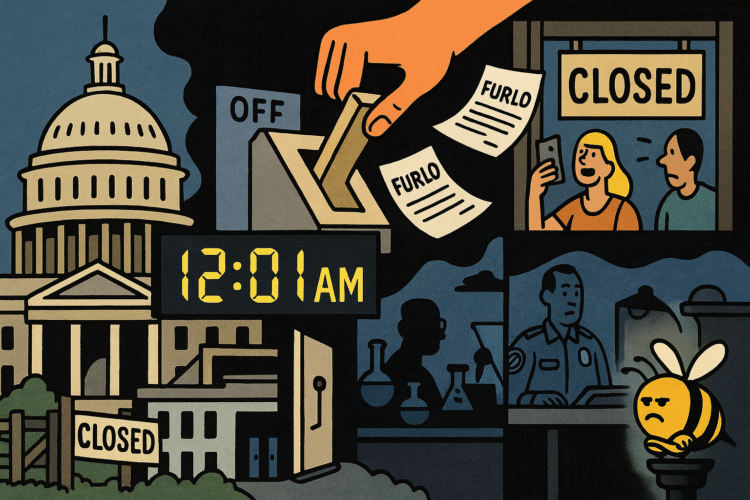
Washington, D.C. — the unfortunate date when “the lights go out” became literal again. After the Senate failed to pass a stopgap spending bill, the White House ordered agencies to activate shutdown protocols at exactly 12:01 a.m. on October 1. Through memos from OMB and OPM invoking the Antideficiency Act, the chaos began: mass furloughs, “excepted” operations continuing, union lawsuits threatened, and blame missiles already aimed at Democrats. Meanwhile, Reuters, USA Today, AP, and every live desk from Maine to Guam tracked the hour-by-hour unraveling as if it were the Super Bowl of bureaucratic apocalypse.
This is more than a lapse in funding. It’s a fight over who controls the machinery of government—and whether democracy stays powered when someone refuses to play by the rules.
What Closes, What Doesn’t (By Agency)
Here’s the grim scorecard of the shutdown rollout, according to AP’s agency-by-agency plans:
- Hundreds of thousands furloughed: across departments. Career staff, program officers, non-essential roles all sent home.
- Air traffic control & TSA: continue under “excepted” status, but with skeleton crews. Expect delays, backlog, overworked controllers.
- DHS (Dept. of Homeland Security): largely operational. Border, immigration enforcement, customs, and national security work still active—but support staffing, research, and nonurgent admin roles suspended.
- Medicare / Medicaid: payments will continue, but with delays. New enrollments or expansions are deferred.
- NIH: new clinical trials halted, most research paused, noncritical grants frozen.
- CDC: more than half the workforce furloughed. Outreach, public health research, vaccination campaigns, surveillance systems scaled way back.
- FDA: essential safety operations continue (drug approvals in emergency mode, foodborne outbreak response), but routine inspections, facility reviews, and rule-threshold work suspended.
- EPA: skeleton crew runs Superfund oversight and enforcement, but most rulemaking, inspections, environmental programs shuttered.
- State Dept.: domestic furloughs, but consular services abroad continue (visas, passports)—though expect bottlenecks and delays.
- FEMA: disaster relief for active emergencies is maintained, but new NFIP (flood insurance) policy issuance is suspended—affecting real-estate closings in flood zones.
- National Parks & Forests: “open, unstaffed” mode. Gates may be unlocked but no rangers, no regulation, no trash pickup, limited rescue services.
In short: core public-safety work is preserved, but everything else goes comatose.
Cascading Fallout: The Dominoes No One Warned You About
The furloughs and service freezes are only the first act. What follows is a creeping paralysis.
- Procurement & grants freeze: universities, small research labs, NGOs that depend on federal funding suddenly lose their lifeblood. Projects stop midstream. People wait for reimbursements that never arrive.
- State & university reimbursements stall: Medicaid reimbursement, infrastructure grants, disaster aid payments—many states will be forced to bridge with short-term borrowing or cut budgets.
- Contractors: companies that build bridges, IT systems, support services—many are idled, staff unpaid, bills mounting.
- Modernization projects slip: the FAA’s NextGen air-traffic upgrades? On ice. Other long-range systems—defense procurement, cybersecurity infrastructure, cloud modernization—deferred.
- Scientific data gaps: longitudinal studies, environmental monitoring, public-health surveillance—all suffer discontinuities. Once datasets go dark, later analysis is compromised.
- Passport/visa backlogs: consular staff under extreme strain; backlog explodes. People planning travel, families separated, students waiting.
- Small business loans & SBA support: programs paused, applications not processed, capital dries up. In border towns, tourist areas, rural regions, this is real pain hitting real people.
- Macro risk: inflation already high; supply chains stressed by tariffs; now government procurement, regulatory actions, and stimulus pipelines slow. GDP growth on edge, confidence shaken.
Governors and mayors brace for safety-net pressure—food assistance, mental-health programs, local matching grants hit by delayed federal pay. City police budget, public transport, waste removal—many municipal services tied to federal funds.
Meanwhile inside agency halls, chiefs circulate memos: prioritization guides, contingency staffing, what programs must absolutely continue. Lawyers pore over shutdown authority, pocket rescission risk, “RIF planning” (reduction in force) memos, and messaging that reassigns blame without ceding power.
Politics, Messaging & the Moral Template
Of course, Republicans in the White House have already framed the shutdown as “the Democrats refusing to pass funding.” We will hear every variant: “wall duty,” “border funding,” “wasteful programs,” “socialist agencies” etc. They want the political narrative: the party that blocks the lights off is the villain.
Yes, Democrats will get blamed. Yes, people will suffer up and down the country. Yes, media cycles will highlight closed national parks and survivors waiting for passport renewals. But the alternative—funding a government that wants to use shutdown leverages as bludgeons—is surrender. We cannot fund a government run by a would-be despot. Sometimes standing your ground means taking the hit in public opinion, because the long-term baseline is more important than temporary pain.
Unions are already filing suit—arguing that threats of layoffs, abrupt execution plans, or forcing efficacy-based recalls violate contracts or law. Some litigation may force injunctions, but in the meantime, courts debate whether an administration can weaponize shutdown rules—or whether those rules are limited by statutory constraints.
This is not neutral governance. This is assertion of executive power over Congress’s purse, rescuing the “bully pulpit” at the expense of daily public services. The posture itself is a test: how much can you make the people suffer while insisting you’re simply “running out of options”?
The Satire in the Shadows
Let’s not pretend: this is bureaucratic brinkmanship sold as necessity. The administration issues “excepted” memos like stage directions in a play. Only the essential lights stay on—emergency rooms, air traffic, border security—while parks, science labs, cultural grants, small programs vanish overnight. It’s a spectacle of concentration.
They treat shutdown as a policy lever rather than failure of compromise. The Show must go Dark—but lighting, safety, staffing, emergency response still must function. So you get this weird half-life of government: the skeleton agencies, the ghost staff, the public told “it’s normal.” But nothing about it is normal. It’s a power test.
Why Democrats Must Not Flinch
Yes, this will hurt. Power centers will scream. Press will fixate. Polls may wobble. Governors will nag. But shepherding the narrative is as important as voting the bills. Because once you fund by default what politicians refuse to negotiate, you prime future shutdowns as tactics, not emergencies. You cede the lever of budget hostage to executive whim.
Democrats must show that there is a line you don’t cross: the people must not be the damned margin of your negotiation. Once the public expects shutdowns like seasonal storms, democracy becomes predictable dysfunction.
Stand the ground, push for public visibility, force the optics of suffering onto those who wield shutdown as weapons. Make it clear: this is not about legislation. This is about power.
The Final Act: Lights Out?
When the clock struck 12:01, the order went out. Hundreds of thousands furloughed. Health research paused. Airports snarled. Passport lines lengthened. The skeletal government limped on. But something else happened: a choice was made. Someone chose darkness for leverage. Someone turned the government off.
Democrats will be blamed. But remember: those who turn off the lights first lose the moral high ground. Those who wield closure as political arrow lose the claim to legitimacy. A government that must threaten shutdown to govern is already governing by hostage.
And one day, the public will ask: who lights the government back up?