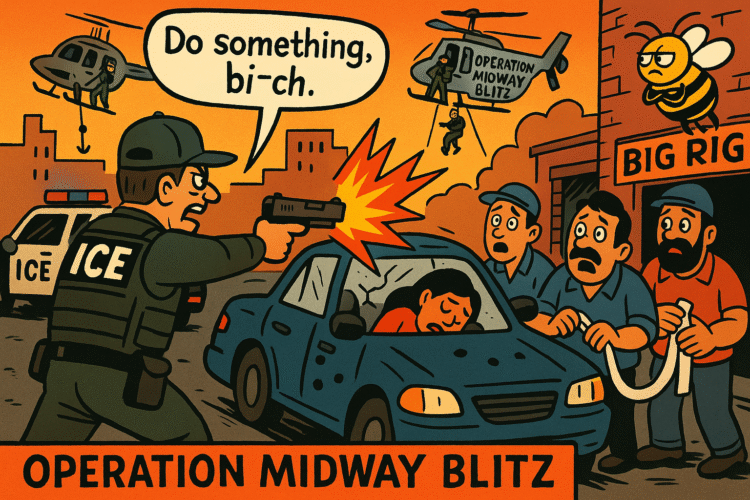
On October 6, 2025, the Chicago Sun-Times reported what you might call a plot twist, if the plot weren’t someone’s bleeding arm. A federal magistrate judge in Chicago, Heather McShain, rejected prosecutors’ demand to keep Marimar Martinez, 30, and Anthony Ian Santos Ruiz, 21, in jail while they await trial. Why? Because the government’s story about what happened on October 4 in Brighton Park is already falling apart like a cheap stage prop.
Here’s the headline version: prosecutors insisted Martinez and Ruiz recklessly tailed a DHS convoy, ran red lights, honked, and livestreamed like clout-chasing daredevils. Agents, they said, were menaced. Then bodycam footage surfaced. A Border Patrol agent allegedly sneered, “Do something, b—-,” hopped out of a vehicle, and fired five shots into Martinez’s Nissan at South Kedzie Avenue and 39th Street.
DHS had originally claimed Martinez “drove toward” agents. The video apparently shows the exact opposite: a federal SUV turned into her car, followed by the agent’s little Hollywood audition for Bad Lieutenant.
Martinez, somehow alive despite “seven holes” in her body, ended up at Big Rig Oil Pros on 35th and California. Workers wrapped her bleeding limbs in tourniquets as bullets literally fell out of her arm. The FBI then arrived to tape off the scene like it was the set of CSI: Brighton Park.
And that was just Act One.
Act II: The Prosecutors’ Tall Tale
According to the charging complaint filed October 5, Martinez and Ruiz, both U.S. citizens, spent 20–30 minutes chasing DHS vehicles after an Oak Lawn operation. Assistant U.S. Attorney Sean Hennessy painted them as reckless vigilantes, claiming Martinez honked repeatedly and streamed over two minutes of video. A loaded gun sat on her passenger seat—though no one claims she brandished it.
The problem with this tidy prosecutorial narrative is that Judge McShain and the defense attorney, Christopher Parente, have eyes. And apparently, they’re willing to use them. Parente promised to play bodycam footage showing the agent’s SUV turning into Martinez’s Nissan and the subsequent profanity-laced dare before the shooting. He then dropped the line that will haunt DHS like a bad Yelp review: the true danger to the community might be the shooter, not his clients.
Act III: The Miracle and the Holes
Judge McShain’s quote deserves to be engraved on a plaque outside the Dirksen courthouse: “It’s a miracle no one was more seriously injured.” Martinez has seven bullet wounds. A bullet literally popped out of her arm while paramedics worked. Workers at Big Rig Oil Pros saved her life with tourniquets. If this is what counts as “not more seriously injured,” then the threshold for “serious” has been moved somewhere near Game of Thrones battle scenes.
The judge looked at Martinez and Ruiz—two young Chicagoans with clean records and community ties—and concluded they were not public menaces. She ordered their release under conditions, a decision that reads less like leniency and more like a recognition that the state’s story doesn’t hold water when the footage looks like a bad training reel.
Act IV: DHS’s Theater of the Absurd
This shooting isn’t happening in a vacuum. It’s part of DHS’s grand performance piece called “Operation Midway Blitz.” Starting September 25, DHS decided to spice up Chicago’s fall season with military cosplay: riverboat patrols featuring long guns, helicopter rappels, chemical agents, and “appearance-based” street stops where agents reportedly considered “how they look.”
Yes, you heard that right. In the middle of Chicago, agents were sizing people up based on vibes and aesthetics. That’s not law enforcement; that’s an off-brand episode of Project Runway. “Today, we stop suspects not by probable cause, but by whether their outfit screams ‘felony chic.’”
So when a Border Patrol agent sneered, “Do something, b—-,” before emptying his magazine into Martinez’s car, he wasn’t improvising. He was workshopping a character. He was playing his part in the new reality show DHS has been filming in Chicago’s streets.
Act V: Paperwork, Ballistics, and Broken Trust
Now comes the forensic mop-up. Courts will have to comb through dashcams, bodycams, drone footage, warrant logs, ballistics, and hospital records. Every second of Martinez’s livestream, every frame of Border Patrol’s video, every trajectory line will be scrutinized. The problem is that the damage to trust is already done.
The government said Martinez drove toward agents. The footage suggests the agents drove into her. The government said she was an imminent threat. The bodycam allegedly shows an agent daring her to escalate before escalating himself. The government said jailing her was necessary for community safety. A federal judge said the real miracle is that she survived their definition of “safety.”
Act VI: Community Ties, Protest Signs
Chicago is not exactly short on reasons to distrust federal policing. Throw in a shutdown-era backdrop, looming layoffs, and protests already mounting, and you have a perfect storm. City and state leaders are demanding transparency: what are DHS’s stop criteria? How many people have been arrested? What rules of engagement are agents following when they roll military convoys down Kedzie Avenue like extras in Black Hawk Down?
For Martinez and Ruiz, the next court dates are about survival, both physical and legal. For DHS, the next months are about whether their shiny “Operation Midway Blitz” will collapse under scrutiny. For the rest of us, the question is how many holes one has to accumulate before someone admits the tactics aren’t working.
The Stakes: Beyond Brighton Park
This case isn’t just about Martinez, Ruiz, or the reckless bravado of one Border Patrol agent. It’s about the elasticity of federal power in American cities.
- Appearance-based stops: Can agents pull you over because you “look wrong”? What if the look they dislike is just “being brown in Brighton Park”?
- Force-protection rationales: How far can DHS stretch “protecting agents” when the evidence suggests agents initiated the confrontation?
- Convoy chases: What does it mean to “aggressively follow” if the bodycam shows DHS SUVs weaving into civilian cars?
The courts will wrestle with these questions while Martinez recovers from seven bullet wounds and Chicagoans weigh whether federal patrols are safeguarding neighborhoods or staging dystopian set pieces.
The Irony of Protection
Here’s the structural irony: DHS called this “Operation Midway Blitz,” framing it as a campaign to protect communities. Instead, we have Border Patrol agents firing into traffic in Brighton Park while DHS spokespeople try to spin the footage as “driving toward agents.” Protection has become indistinguishable from provocation.
And while agents are measuring community safety in discharged rounds, actual Chicagoans are left holding the bag—or in this case, the tourniquet. Big Rig Oil Pros employees saved a life while DHS escalated violence. Community ties turned out to be stronger than federal tactics.
What Now?
The legal case will grind forward. Martinez and Ruiz will show up for their hearings under conditions. Their attorney will play the footage, and if it matches his description, DHS will be left with egg on its Kevlar. Prosecutors will pivot, rewrite, and reframe. Judges will parse statutes. Ballistics experts will testify. Protesters will march.
But the larger story is already etched in the public record: a federal agency deployed like an occupying force, with rules of engagement that look suspiciously like improv. A judge rejecting the government’s plea to jail the supposed menaces because the true menace might be the shooter. A city demanding transparency. And a woman with seven holes in her body, still alive, embodying both the fragility and resilience of human flesh in the face of state violence.
When Law Enforcement Becomes Street Theater
The Brighton Park shooting is a test not just of evidence but of legitimacy. Can DHS maintain credibility when bodycam footage undercuts its official line? Can Operation Midway Blitz survive once its tactics are subjected to forensic daylight? Can Americans stomach a federal presence that treats neighborhoods like training grounds?
The case may hinge on angles, frames, and transcripts. But its meaning is already larger: in Chicago, the state’s definition of safety collided with reality. A Border Patrol agent, armed and armored, told a civilian to “do something” and then made sure the something was five bullets. The miracle is not that Martinez and Ruiz walked free pending trial. The miracle is that she walked at all.