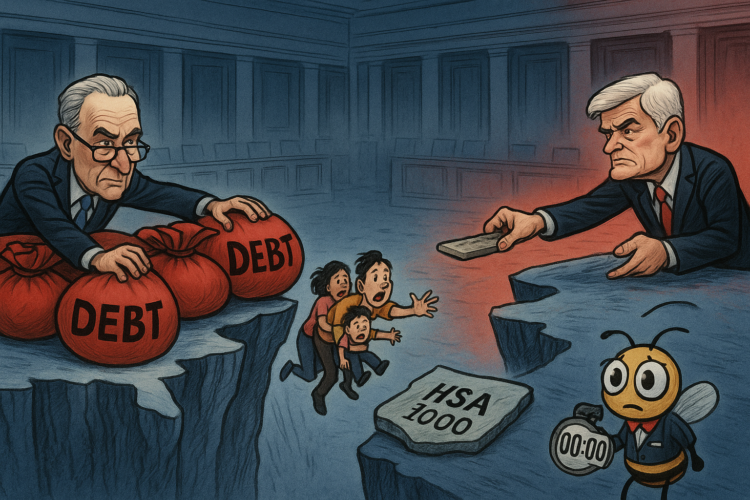
Two 51-48 votes, two dead plans, and a whole lot of lawmakers acting like “imminent” is a decorative word that looks nice in press releases.
The U.S. Senate just performed one of its signature magic tricks: taking a cliff, putting a warning sign next to it, posing for photos in front of the warning sign, and then walking away as if gravity is a private-sector problem. The cliff in question is the looming expiration of the enhanced Affordable Care Act premium tax credits, the subsidies that have been holding down marketplace premiums for millions of people. They are set to lapse at the end of the month, and the Senate responded with two back-to-back procedural votes that failed, not because nobody had a plan, but because the Senate is an institution built to be very impressed with itself while doing nothing.
Republicans hold a 53-47 edge. That fact matters mainly because it doesn’t. Under the filibuster, you need 60 votes to advance most major legislation, which means everything is hostage to the idea that the minority should have veto power, and the majority should have the right to complain loudly about being blocked while refusing to change the rules. So the Senate held two votes, one on a Democratic plan, one on a Republican plan, and both failed. Both ended in 51-48 tallies, a neat symmetry that feels less like governance and more like the chamber signing its name on the same “not our problem” form in two different ink colors.
The clock is not subtle here. When the enhanced credits expire, many marketplace enrollees face steep premium spikes in 2026. Health policy analysts warn the shift will push some people out of coverage. Open enrollment deadlines are colliding with Congress’s calendar and holiday recess, and the Senate is doing what it does best in a crisis: announcing it is out of runway while still revving the engine and taking selfies in the cockpit.
Two Plans Enter, Two Plans Die
The Democratic plan, pushed by Senate Democratic leader Chuck Schumer, would have extended the enhanced credits for three years for most ACA enrollees. According to the Congressional Budget Office, it would add roughly $83 billion to deficits over the next decade. That number became the ritual object, held up by opponents as proof that keeping people insured is a fiscal sin unless you are doing it through a tax break that already has a lobbyist’s phone number attached.
The vote failed 51-48. All Democrats voted yes, joined by four Republicans: Susan Collins, Josh Hawley, Lisa Murkowski, and Dan Sullivan. That lineup tells you everything about how strange the incentives have become. Collins and Murkowski are familiar names in the genre of “moderate Republicans who occasionally remember constituents exist.” Hawley is a different creature, a man who can treat populism like a costume and still get applause for it, which is exactly why his vote matters. Sullivan is less of a headline character, but his presence in the crossover list signals what everyone in this building understands: even some Republicans can see the political and human cost of letting the subsidy cliff hit.
Then came the Republican alternative, offered by Sens. Bill Cassidy and Mike Crapo. Their plan would end the enhanced credits entirely and replace them with time-limited health savings account style payments for certain buyers of lower-cost, higher-deductible bronze or catastrophic exchange plans, with eligibility up to 700 percent of the federal poverty level. The payments would be $1,000 per year for ages 18 to 49 and $1,500 per year for people 50 and up, over two years. The funds could not be used to pay premiums, only other health costs.
This is the kind of proposal that only makes sense if you think premiums are a vibe and deductibles are a motivational tool. It is also the kind of proposal that sounds like “help” on paper until you notice what it does in the real world: it does not actually stop premium hikes caused by the subsidy expiration, it just gives some people a modest pot of money that cannot pay the bill that is rising. It’s like watching someone propose a solution to rent increases by giving tenants a coupon for socks.
That plan also failed 51-48. Democrats opposed it. Sen. Rand Paul voted no, because Rand Paul is the Senate’s recurring reminder that libertarianism is a religion that rejects almost everything except its own purity. Sen. Steve Daines did not vote, because sometimes the most powerful vote in Washington is the one you don’t cast while the rest of the chamber pretends that absence is a scheduling conflict instead of strategy.
Republicans argued the pandemic-era subsidy expansion is fiscally unsustainable and should be replaced with a different affordability model. Democrats and outside analysts argued the GOP plan does not actually prevent premium spikes and would leave families juggling deductibles that can run thousands of dollars while also absorbing higher monthly bills. Both sides said “affordability.” Only one side was describing a path where people keep coverage without turning their household budget into a stress test.
The Filibuster as a Customer Service Line
The Senate’s favorite way to do nothing is to route every urgent problem through procedure, because procedure gives lawmakers something to talk about that is not the actual human consequence. The chamber will never say, “We chose not to stop premium hikes.” It will say, “We failed to advance a procedural motion,” which is the political version of telling a customer, “Your call is very important to us,” while the hold music plays until the phone dies.
The 60-vote threshold has become the Senate’s moral alibi. It is the voice that says, “We wanted to help, but the rules,” while the same lawmakers who invoke the rules treat them as optional when the goal is tax cuts, judicial confirmations, or anything else aligned with power’s long-term scaffolding. The filibuster is not a neutral tradition, it is a policy choice, and like all policy choices it has winners and losers. The winners are the people who can afford the delay. The losers are the people whose health coverage depends on Congress acting like a government instead of a club.
This is why the two failed votes matter as theater. They were not just attempts to pass policy. They were attempts to assign blame. They were, essentially, competing press-release devices. Democrats wanted to say, “Republicans blocked a three-year extension.” Republicans wanted to say, “Democrats rejected our alternative.” Both got to do that, because both plans failed, and the public got the same outcome either way: the cliff is still there.
What the Subsidy Cliff Actually Means
It is tempting to treat ACA subsidies like an abstraction, a spreadsheet line that gets argued over by people who treat numbers the way sports fans treat stats. But for marketplace enrollees, the enhanced premium tax credits are the difference between having coverage and not having it. They lower monthly premiums, which is the lever most families feel immediately. If those credits expire, premiums rise, sometimes sharply. People respond the way humans respond to sharp increases in recurring bills: they look for cheaper options, they downgrade coverage, or they drop it.
The harm is predictable. Some people will try to move into lower-cost plans, which often means higher deductibles and narrower networks. Some will delay care. Some will gamble with their health. Older Americans, who already pay more for premiums because of age rating, will feel the spikes more acutely. Lower-income enrollees will be pushed into a cruel choice between coverage and everything else. And because open enrollment periods and plan selection deadlines are tied to the calendar, the confusion and the cost hit at the same time people are trying to make decisions for the next year.
Health policy analysts have been warning about this for months. The warning is not mysterious. It is the basic logic of subsidies: remove the subsidy and the price rises. When the price rises, demand falls, especially among people who are already stretching. That means some people will lose coverage, which means hospitals and clinics will see more uncompensated care, which means costs shift in other directions, which means the system pays anyway, just in a more chaotic and cruel form.
The Senate is not unaware of this. The Senate is simply built to treat foreseeable harm as acceptable collateral for partisan positioning.
The GOP Alternative as a Philosophical Statement
The Cassidy-Crapo proposal is not merely a policy plan, it is a worldview with a costume on. It says: the government should not help you pay premiums, because that looks too much like the government helping you. Instead, the government should give you a limited amount of money to handle other costs, but only if you buy certain kinds of plans, and only for two years, and not for the bill that is actually rising.
The eligibility cap, under 700 percent of the federal poverty level, looks generous on paper, and in a sense it is. It captures a broad range of households who buy their own coverage. But the structure of the benefit matters more than the headline eligibility. The payments are small relative to the costs they are meant to offset. A thousand dollars a year is less than a hundred dollars a month. A thousand five hundred is a bit more. These sums are not meaningless, but they are not the kind of support that makes premiums feel manageable if premiums are surging. And because the funds are barred from paying premiums, they cannot directly prevent the sticker shock that causes people to drop coverage in the first place.
It is also designed to steer people toward bronze or catastrophic plans, which are cheaper for a reason. They come with high deductibles and more out-of-pocket exposure. For healthy people, that might be tolerable. For people with chronic conditions, it is a trap disguised as a deal. It can turn routine care into a financial obstacle course. The plan is built on the idea that people should bear more risk, because risk is seen as a moral teacher. The trouble is that risk in health care does not teach, it punishes, and it punishes people unevenly.
Republicans argue the enhanced credits were a pandemic-era expansion that is fiscally unsustainable. That claim has a surface plausibility because everything costs money, and deficits are always convenient when you want to stop paying for something that helps ordinary people. But the fiscal argument often ignores the real budget reality of health coverage. People without coverage still get sick. They still show up in emergency rooms. They still require care. The costs do not vanish, they just move, often into the most expensive and least efficient parts of the system.
The other unsaid part is political: the ACA is still a symbol. Some Republicans still treat any expansion of ACA support as surrender, even if their voters depend on it. So they propose alternatives that allow them to say they are not extending “Obamacare,” they are creating a different model, even if the different model is less effective at the immediate problem.
The Democratic Plan and the Deficit Drum
Democrats offered a three-year extension and accepted the CBO score as the price tag. That price tag will now be used in campaign ads and floor speeches as if it is a moral indictment rather than a budget estimate. Eighty-three billion over a decade is not small, but it is also not an apocalyptic number in a federal budget that routinely tolerates far larger sums when the beneficiaries are already powerful. The question is not whether the extension costs money. The question is what kind of country refuses to spend money to prevent millions of people from being priced out of insurance while readily spending money to protect other interests without blinking.
Democrats also face their own political trap. They want to defend the ACA as a core achievement, but they also know that some voters have subsidy fatigue, a sense that the government is always patching things instead of fixing the underlying costs. Extending credits is not the same as lowering health care prices. It is a shield against prices, not a cure. But when the immediate choice is “shield or no shield,” and the Senate chooses “no shield,” the moral stakes become clear.
The Democratic plan drew four Republican votes, which is not nothing. It suggests there is at least some discomfort inside the GOP with letting the cliff happen. But it also demonstrates the brutal math of the filibuster: four crossovers is a headline, but it is not enough. Democrats needed many more. They did not get them. And now the deadline is closer.
The Senate’s Favorite Trick: Make the House the Villain
After the Senate fails, pressure shifts to the House. That is how Congress offloads responsibility like a hot pan. The Senate can now point to the House and say, “They need to act,” even though the Senate is the chamber that just spent two votes proving it could not assemble sixty people to do anything. House GOP leaders are signaling “health care cost” votes soon. Moderates are pushing extension ideas. Bipartisan stopgaps circulate, including shorter extensions paired with new eligibility limits, a classic Washington compromise shape where the help gets smaller and the paperwork gets larger.
The near-term decision points are stark. Will House leadership allow any extension vehicle to reach the floor. Will centrists try procedural end-runs like discharge efforts. Will this fight get stapled to the next must-pass deadline package, because Congress has become addicted to governing only when the lights are already dimming. And all of this is happening while millions of enrollees, especially lower-income and older Americans, brace for higher monthly bills, potential plan downgrades, or dropping coverage entirely.
If you want to understand the modern Congress, watch how it treats deadlines. A deadline is not a warning, it is a strategy. It is the moment when lawmakers hope panic will replace principle and force a deal that could not be reached under normal conditions. It is also the moment when leadership can demand concessions, because the alternative is catastrophe. Deadlines are the fuel that powers America’s must-pass machinery.
The problem is that people’s health coverage should not be a bargaining chip in that machinery.
The Illusion of Choice When Both Options Hurt
The Senate staged two competing plans, but neither plan was designed to be the kind of bipartisan solution that could actually clear sixty votes. The Democratic plan was a straight extension, expensive in deficit terms, and thus an easy target for fiscal hawks. The Republican plan ended the credits and offered a limited alternative that did not prevent premium spikes, making it an easy target for Democrats as inadequate. Both plans were, in a sense, messaging bills.
The 51-48 tallies tell you the chamber is locked in maximal partisan trench warfare, plus a few high-profile crossovers that allow individual senators to say they tried. The crossovers become character moments. Collins becomes the careful New England guardian of decency. Murkowski becomes the Alaska senator who occasionally reminds people she exists outside the party’s whip line. Hawley becomes the populist who wants to be seen caring about working families. Sullivan becomes the quieter crossover who suggests the pressure is not perfectly uniform. Rand Paul becomes the libertarian no. Steve Daines becomes the missing vote. Each is a role in the Senate’s ongoing reality show.
And meanwhile, the subsidy cliff remains.
This is the cruel brilliance of the system: it creates the illusion of choice while delivering the same harm. You get two votes, two debates, two press conferences, and the same outcome. The Senate can claim it considered options. It can claim it held votes. It can claim it did its job. But the only job that matters to the person staring at next year’s premium is whether the credits are still there. That answer is currently no.
The Human Math Under the Senate Math
When lawmakers talk about “premium spikes,” they often do it in the tone of someone reading a weather forecast. But premiums are not weather. They are bills. Bills have consequences. A premium that rises by a hundred dollars a month is a grocery budget. A premium that rises by several hundred is rent pressure. It is the difference between keeping a car that gets you to work and losing it. It is the difference between staying in a plan with your doctor and being forced into a network that treats you like an inconvenience.
People respond to premium spikes by making rational choices inside an irrational system. They skip coverage. They delay care. They take on medical debt. They crowd emergency rooms. They ration medications. They ignore symptoms until they can’t. They try to stay healthy by avoiding the places that keep them healthy. That is how a health care system built on cost-sharing becomes a system built on denial.
The Senate knows this. The Senate is just better at describing it in phrases like “marketplace dynamics” and “consumer behavior,” which makes it sound like an economics seminar instead of a human crisis.
The Budget Argument as a Moral Filter
One of the most revealing features of this debate is how deficits get used as a moral filter. The Democratic plan’s CBO score becomes a reason to oppose it, framed as fiscal responsibility. The Republican plan claims fiscal sustainability while shifting costs onto patients through higher deductibles and limited assistance. Both claim to care about affordability, but they define affordability differently. One defines it as whether the federal government spends money. The other defines it as whether individuals can pay their bills.
In practice, the budget argument often becomes a way to say some forms of suffering are acceptable. If the federal budget is the only sacred object, then people losing coverage is unfortunate but tolerable. If people’s coverage is the sacred object, then federal spending is a tool, not a sin.
The reality is that the United States spends a staggering amount on health care already. The argument is not truly about whether the country can afford to keep the credits. It is about whether the political system wants to. It is about whether a Senate that can mobilize quickly for other priorities is willing to mobilize for this one. It is about whose pain counts as urgent.
Pressure Builds Where Power Is Afraid of It
Now the pressure shifts. It moves to the House, where the rules are different and the majority can, in theory, pass something with fewer procedural hurdles. But House leadership controls the floor. If leadership does not want an extension, leadership can prevent it from coming up. That is why moderates are talking about discharge petitions and other procedural end-runs, because in the House, the real filibuster is often not a rule, it is a speaker’s calendar.
The political pressure will intensify because the consequences are easy to communicate. “Your premiums will rise.” That is not a complicated message. It is also a message that lands differently when it arrives in the mailbox attached to a real number, not an abstract warning. Once enrollees start seeing the projected costs for next year, this becomes a pocketbook issue in the most direct sense. You can argue ideology all day, but you cannot argue with a bill that is due monthly.
Republicans in the House may try to frame the lapse as a correction, the end of a temporary expansion. Democrats will frame it as a deliberate choice to raise costs and push people out of coverage. Both frames have a kernel of truth, but only one frame fully captures the cruelty of letting the cliff happen without a viable replacement that prevents premium spikes.
And then there is the must-pass package question, the Washington classic. If Congress cannot pass an extension on its own, it may try to staple it to the next deadline bill, the next funding package, the next crisis that forces action. That is how modern governance works: you do not fix the roof when the sun is out, you fix it during a hurricane because that is the only time leadership can get votes.
Receipt Time Two Votes, One Cliff, and a Lot of Shrugging
The Senate held back-to-back votes on two competing plans, both failed at 51-48 because the filibuster demanded sixty, and the chamber responded to an imminent subsidy expiration by producing symmetry instead of solutions, leaving millions of people staring down 2026 premium spikes while lawmakers argue about deficits, alternative models, and procedural pathways like those words can pay a monthly bill. If Congress lets the credits lapse, the result will not be a philosophical statement, it will be a pile of downgraded plans, delayed care, dropped coverage, and a fresh wave of Americans learning the oldest lesson in this building: the Senate can always find time to vote, but it rarely finds the will to protect people who do not come with donors attached.