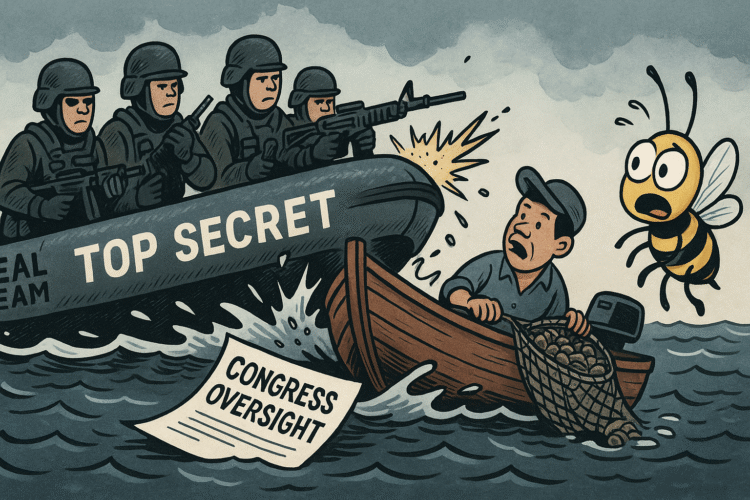
On September 5, 2025, the New York Times detonated a story so bizarre it sounded like rejected fan fiction from a Tom Clancy knockoff: in 2019, SEAL Team 6 allegedly slipped into North Korea to plant a covert listening device, stumbled across a small boat of unarmed shellfishers, opened fire, and then—because this was the kind of mission where bad decisions snowball—dumped the bodies at sea to preserve secrecy.
The kicker? Congress wasn’t briefed. Not before. Not after. No Gang of Eight, no oversight, no legal fig leaf. Just a top-secret raid in the middle of nuclear diplomacy that apparently treated constitutional checks and balances the way SEALs treat night vision goggles: optional but fun to have.
Asked about it Friday, Donald Trump, back in presidential mode, swore he knew “nothing” about the mission. Which, depending on your angle, is either a lie, a confession, or an inadvertent advertisement for the dangers of freelancing black ops while your commander-in-chief is distracted by Twitter feuds.
The Shellfish Incident
Let’s pause on the detail that has already launched a thousand memes: SEAL Team 6, the most elite warriors on Earth, allegedly panicked at the sight of a small boat of unarmed shellfishers.
Not soldiers. Not spies. Shellfishers. Imagine training years for the deadliest missions, being fed a steady diet of Navy SEAL mythology, and then your operational compromise comes from guys hauling clams.
It would be slapstick if it weren’t tragic. But here we are: a mission to plant a James Bond–style bug collapsed not because of North Korean patrol boats or Kim Jong Un’s secret police, but because elite forces apparently decided the best way to protect secrecy was to create a bigger crime.
Bodies Overboard
According to the Times, the SEALs allegedly disposed of the bodies at sea. As if adding maritime grave-dumping to international incidents somehow reduces the paperwork.
This is where the satire writes itself. We have an operation designed to harvest intelligence, derailed by civilians harvesting shellfish, followed by bodies harvested into the ocean to harvest silence. Each escalation more absurd than the last, until the mission reads like a Mad Libs of bad decisions.
The Congressional Blackout
The Gang of Eight—the bipartisan group of congressional leaders meant to be briefed on top-tier intelligence operations—was apparently cut out entirely. No heads-up, no after-action. For six years, Congress had no idea the United States had conducted a covert raid inside North Korea that ended with civilian deaths.
This is not oversight. This is undertow.
Lawmakers now demand answers, briefings, accountability. But let’s be real: the answers won’t come easily, the briefings will be redacted, and accountability will vanish into the black budget. That’s the point of operations like this: deniability. Except when they leak years later and everyone pretends to be shocked.
Trump the Unknowing
Asked about the raid, Trump insisted he knew “nothing.” He framed it as if he were an innocent bystander, just a guy who happened to be president while clandestine frogmen went joyriding in enemy waters.
It’s an extraordinary claim, given that presidents are supposed to authorize Tier 1 missions in hostile states. Either Trump was lying (which would not be shocking), or he genuinely wasn’t told (which would be even worse), or he signed off on something vague and never bothered to ask follow-ups (which is the likeliest Trump scenario).
In all three versions, the satire is brutal: America’s most dangerous operations were being run with the accountability of a group chat.
Audacity vs. Recklessness
The national debate has split into two predictable camps. One argues this was audacious intelligence-gathering. Risky but necessary. A rare chance to get inside the hermit kingdom and plant the kind of device that might prevent war.
The other argues it was reckless to the point of criminal. A mission approved without oversight, bungled into civilian deaths, and covered up with ocean burials. A gamble not just with lives, but with nuclear diplomacy, conducted in the shadows of summits where Trump was busy exchanging “love letters” with Kim Jong Un.
Both are right, of course. It was audacious and reckless. That’s the cocktail America keeps ordering on repeat.
Diplomacy on Fire
Remember the backdrop: 2019 was the year of Trump strutting into the DMZ for a photo-op handshake with Kim. While cameras broadcast history, SEAL Team 6 was allegedly sneaking around the North Korean coastline planting bugs and shooting shellfishers.
Diplomacy on the surface. Covert war beneath. The contradiction is the story of U.S. foreign policy: smile for the cameras, scheme in the dark. The only problem is when the dark schemes unravel and the smiles look even faker.
The Pentagon Shrugs
Official comment? None. Pentagon spokespeople refuse to confirm or deny. The White House clams up (no pun intended). The result is a silence so loud it sounds like guilt.
Meanwhile, ex-officials whisper to reporters about “tradecraft errors” and “compartmentalization.” Translation: the op was botched, and not everyone was told because not everyone wanted fingerprints on it.
This is how accountability dies—buried in jargon, drowned in secrecy, floated out to sea with the bodies.
Oversight as Optional
The raid exposes a deeper rot: the normalization of skipping Congress when it’s inconvenient. Oversight has become less a constitutional requirement than a courtesy call. Lawmakers find out years later, from newspapers, about missions that could have triggered nuclear crises.
It’s government by vibes again—high-stakes missions greenlit on the assumption that if no one talks, no one asks. Until someone leaks, and then everyone scrambles.
The Satirical Core
The satire here is cruel and sharp:
- America’s elite warriors allegedly turned a shellfishing boat into an international incident.
- Bodies were dumped into the ocean as if that erased consequences instead of compounding them.
- The Gang of Eight, tasked with oversight, was ghosted like a bad Tinder date.
- The president claims ignorance about an operation launched under his nose during a summit with the very leader being spied on.
- Diplomacy above the table, covert recklessness below.
It’s the story of empire in decline: audacity without accountability, secrecy without strategy, violence without clarity.
On September 5, 2025, the shellfish story broke. It will dominate headlines for a week, maybe two. Congress will hold hearings. Pentagon lawyers will polish their denials. Trump will double down on knowing “nothing.” And then, like the bodies, the scandal will sink beneath the waves.
But the haunting truth is this: the danger isn’t just the raid itself. It’s the precedent. If presidents can greenlight—or ignore—covert missions in nuclear states without oversight, if civilian deaths can be erased with a burial at sea, if accountability only arrives years later through leaks, then the republic is not governed. It is managed. Poorly.
The SEALs may have been aiming for a listening device. Instead, they planted a warning: America’s wars aren’t just endless. They’re secret, reckless, and accountable to no one until it’s far too late.
And somewhere in the Pacific, beneath the waves, the silence of the shellfishers lingers louder than all the official denials.