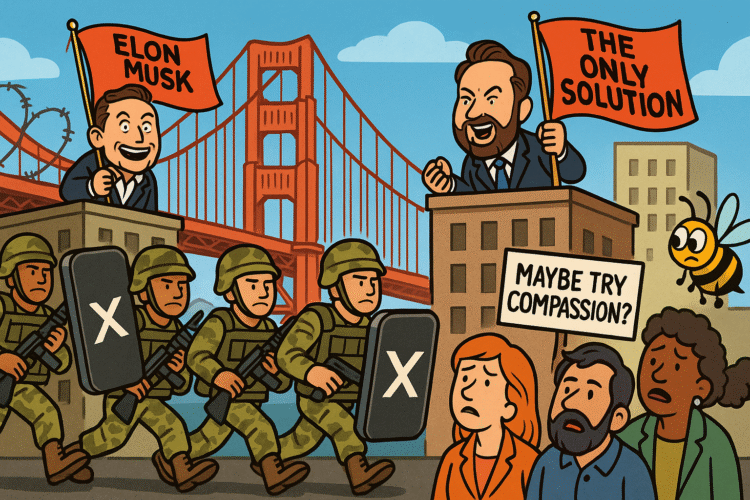
In a city famous for kombucha, kale, and kombucha-flavored kale, it was only a matter of time before San Francisco’s billionaires decided the next great innovation would be fascism—but with better UX. On October 12, 2025, the San Francisco Chronicle reported the unthinkable: Elon Musk and Marc Benioff, two of the Bay Area’s most inflated egos, agreed on something. For the first time since the tech boom began, the billionaire class has found its North Star. And apparently, that North Star points directly to martial law.
Yes, Musk publicly endorsed Benioff’s call for President Trump to send federal troops—specifically National Guard units—into San Francisco. Not to stop an invasion or quell a coup, mind you. To deal with homelessness and fentanyl. Because when your solution to public health looks indistinguishable from a scene in Black Hawk Down, maybe you’ve been mainlining your own press releases.
When Tech Bros Go Full Junta
The rare harmony between these two men would almost be touching if it didn’t reek of tear gas. Musk called troop deployment “the only solution,” which, coming from the man who once said AI would either save or destroy humanity, should terrify everyone. It’s never “the only solution” with these people—it’s the fastest, flashiest, most authoritarian one that gets them trending.
Benioff, whose Dreamforce convention opens this week at Moscone Center, backpedaled almost immediately. Within hours, he was onstage praising the mayor and SFPD for their “heroic work,” a phrase that in San Francisco now means “showing up to work despite Elon Musk tweeting about you.” Still, the damage was done. The two richest men in the Bay Area had just baptized the National Guard in the holy waters of performative tech activism.
The optics alone were jarring. One minute, Benioff’s Salesforce Tower beams rainbow lights in celebration of “Love and Equality.” The next, he’s calling for armed troops to patrol Market Street. It’s as if the city’s spiritual leader decided Jesus needed a riot shield.
Apocalypse by Press Release
This is the new Silicon Valley religion: apocalypse as branding. Musk and Benioff’s newfound alignment isn’t about ideology—it’s about narrative control. Every data point that contradicts their doom prophecy becomes fake news, a bug in the Matrix, or worse—proof that their intervention is “working.”
And the data does contradict them. Violent crime is down 19 percent. Property crime has dropped 25 percent. Homicides are down 35 percent. These numbers are available to anyone with Google, a tool both men ironically helped fund. But if you admit things are improving, then how do you justify turning downtown into a military zone with Wi-Fi?
Benioff’s original call for troops came wrapped in corporate empathy. “We must act,” he declared, sounding less like a CEO and more like a Hallmark card on meth. Musk, of course, stripped away the pretense: “The only solution,” he wrote on X, a platform he’s turned into the digital equivalent of a car crash. And like all things Musk, it was less about San Francisco and more about Musk’s lifelong dream of commanding an army. He’s been waiting for this moment since he bought Twitter and renamed it after a variable.
The Gospel of the Algorithm
The irony is staggering. These men built empires on the promise of data-driven solutions. Yet when the data says, “Actually, crime is down,” they toss it aside in favor of vibes. Because the truth doesn’t trend; fear does.
It’s the same energy that fuels every right-wing panic about cities being “lawless wastelands.” You can show them graphs, maps, or even personal experience, and it won’t matter. The narrative is the product, and the product sells. So now we have tech CEOs cosplaying as saviors, demanding military intervention for a city that statistically needs more social workers, not soldiers.
This is the natural end of a culture that confuses management with morality. It’s not enough to make money; they must also play god. When Benioff calls for “leadership,” he doesn’t mean democracy. He means himself—onstage, mic’d up, bathed in LED light, commanding applause for solving the problem he helped create.
Operation Diligent Venture Capital
If this sounds familiar, it should. Trump has already tried versions of this “federal help” in Oregon, Los Angeles, and Illinois. Courts blocked most of them, citing things like “the Constitution” and “basic human decency.” But now, with his loyalist Attorney General Pam Bondi testing the limits of the Insurrection Act, it’s only a matter of time before the White House decides that “law and order” means “send in the drones.”
San Francisco would be a perfect test case. It’s liberal enough to trigger his base, small enough to control with a PR blitz, and photogenic enough to serve as backdrop for a campaign ad about “taking back our cities.” Add two billionaires practically begging for troops, and you have the propaganda trifecta: chaos, consent, and cable coverage.
The scariest part isn’t that Musk and Benioff want troops—it’s that they might actually get them. Because once you’ve normalized deploying soldiers for a public health crisis, there’s no going back. Today it’s fentanyl. Tomorrow it’s protestors. The day after, it’s journalists. And by the time we realize the National Guard has replaced the neighborhood cop, the algorithm will already have convinced us it’s progress.
The Aesthetic of Emergency
Both men understand the value of optics. Musk has SpaceX rockets to project power; Benioff has his philanthropic photo ops. But together, they’ve discovered the ultimate performance art: dystopia as stagecraft. Their shared message is simple—“Look how broken this city is”—and it works best when things aren’t that broken.
Because the truth about San Francisco is messy. Yes, the fentanyl crisis is real and catastrophic, with over 4,300 overdose deaths since 2020. Yes, homelessness remains visible, brutal, and largely unsolved. But there’s a difference between addressing a humanitarian disaster and militarizing it. You can’t heal addiction with a bayonet.
If they actually cared about the crisis, they’d be funding treatment centers, not lobbying for soldiers. But that’s the problem with billionaires—they only understand solutions that can be trademarked. “Operation Clean Streets” sounds good until you realize it’s just a rebrand of “Operation Diligent Valor,” the same failed DHS playbook that once had federal agents kidnapping protestors off Portland streets in unmarked vans.
The Gospel According to Marc and Elon
When Musk says “the only solution,” what he means is “the only one I can tweet about.” When Benioff says “leadership,” what he means is “visibility.” These men don’t fix problems—they monetize them.
Benioff has already begun the corporate repentance tour, tweeting platitudes about “partnerships” and “local responsibility.” He even praised the new mayor, Daniel Lurie, for “showing compassion and courage,” as if the two weren’t mutually exclusive. But by next week, when Dreamforce opens, expect him to declare the conference a “force for good,” complete with a military-style logo and a fireside chat about “fighting the war on hopelessness.”
Musk, meanwhile, will continue his descent into authoritarian cosplay. He’ll post a meme about “cleaning up the streets” and call it policy. He’ll retweet conspiracy accounts until the line between parody and power disappears. And he’ll convince millions of followers that if San Francisco resists the troops, it must be because it “has something to hide.”
A City Held Hostage by Tech Messiah Syndrome
There’s a tragic poetry to watching two men who built their fortunes on “disruption” try to solve human suffering with armed occupation. Their version of civic duty is a TED Talk in fatigues. It’s not about safety—it’s about control. About proving that democracy is inefficient, that compassion is weakness, and that only billionaires can save us from the problems their policies created.
And maybe that’s the real crisis: not fentanyl, not crime, but moral disintegration disguised as leadership. We’ve let wealth stand in for wisdom for so long that we can’t tell the difference anymore. When a billionaire speaks, it’s treated as revelation. When the poor speak, it’s called “noise.”
The Numbers Don’t Lie, But No One Cares
The Chronicle did the work. It printed the numbers. Violent crime: down 19 percent. Property crime: down 25 percent. Homicides: down 35 percent. These aren’t small fluctuations; they’re genuine signs of progress. But those numbers don’t fit the narrative, so they vanish.
Because in this new civic religion, fear is the currency and spectacle the sacrament. The fact that San Francisco’s own police department reported nearly 90 kilograms of fentanyl seized last year—proof that enforcement is working—doesn’t matter. What matters is that Musk can tweet “total anarchy” and get ten million views.
Posse Comitatus and Other Inconveniences
Of course, there are still those pesky laws that say you can’t just send troops into a city because billionaires are nervous. The Posse Comitatus Act exists precisely to prevent this kind of theater from becoming governance. But the Trump administration has already shown it treats legality as a suggestion, not a constraint.
What’s next? A “Patriot Partnership” where ICE handles city permits? A “Tech Task Force” that arrests graffiti artists for defacing corporate murals? Don’t laugh—it’s all possible once the line between public safety and private branding dissolves.
The Luxury of Fear
Fear has always been a luxury product in San Francisco. It’s sold to people who can afford to be afraid of things that don’t actually threaten them. The unhoused man outside your WeWork isn’t the danger; the system that created him is. But fear is marketable, and empathy isn’t.
So we get performative outrage instead of solutions. Troop deployments instead of detox beds. Billionaires playing generals while social workers burn out. Because nothing says “thought leadership” like turning your city into a militarized TED Talk.
The Revolution Will Be Sponsored
The irony, of course, is that the people most affected by these policies—the poor, the addicted, the unhoused—don’t have X accounts or Salesforce dashboards. They won’t get a say in the conversation that defines their survival. But they’ll be the ones staring down the barrels of the “only solution.”
Meanwhile, Dreamforce will beam holographic butterflies across the skyline, and Musk will livestream his moral superiority from a Cybertruck. The city will look clean, sterile, quiet. Not because the problems are solved, but because they’ve been relocated. Out of sight, out of conscience, out of mind.
Final Analysis: Welcome to the Republic of Optics
San Francisco doesn’t need troops. It needs courage—the kind that doesn’t trend, monetize, or hashtag well. It needs to stop mistaking noise for progress. But as long as billionaires control the narrative, policy will remain theater.
Musk and Benioff’s alliance isn’t a policy proposal. It’s a mirror, reflecting the rot beneath our civic self-importance. It’s what happens when innovation forgets empathy, when capitalism eats its own mythology, and when “the only solution” is always the one that gets the best engagement metrics.
So go ahead. Send in the troops. Build a barricade out of buzzwords. Deploy empathy like it’s an app update. Just don’t be surprised when the city you “saved” no longer feels alive. Because once you militarize compassion, you can’t get it back.