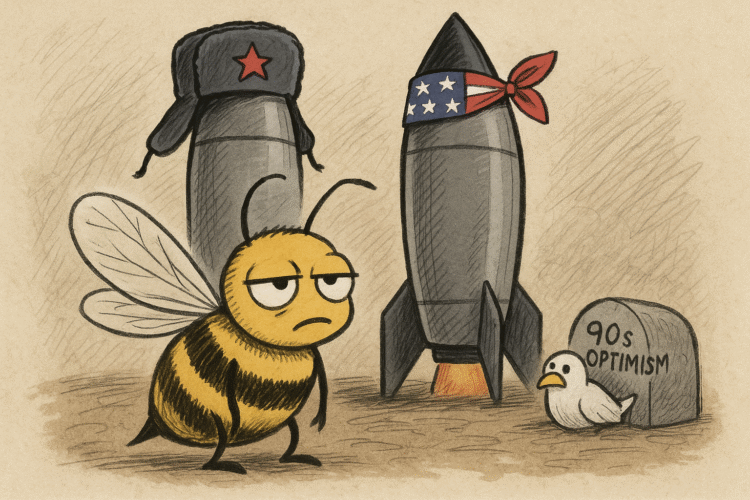
Nothing says “global foreplay” quite like a country unsheathing its mid-range warheads and staring across the bar at America like you up?
Russia, not one to let a perfectly good Cold War go un-reheated, has decided to toss the nuclear matchbook back on the table. As of this week, Moscow has formally announced it will no longer honor its self-imposed moratorium on deploying nuclear-capable intermediate-range missiles. Which is a lot of words to say: “We missed being terrifying.”
And just like that, we’re back in the thick of it. The posturing. The veiled threats. The diplomatic eyebrow raises. The tightrope of annihilation stretched taut over the brittle spine of mutually assured destruction. Again.
It’s 1983 in the group chat, and nobody even had the decency to bring Cyndi Lauper.
But really—what did we expect?
A superpower led by a man who stages shirtless bear photo ops was never going to age into peaceful obscurity. Putin doesn’t retire. He reloads.
And the U.S., our dear emotional support empire, can’t resist the bait. We are a nation that would rather fund the military-industrial complex than universal lunch. We don’t just meet threats—we choreograph them. Flag-wrapped, budget-approved, and aired in HD during Sunday football.
So now we’re in a standoff, again. One side flexing tactical missiles. The other side flexing tactical amnesia—as if this hasn’t happened before.
This is what happens when you leave men in charge of global conflict resolution. They turn Earth into a group project, then show up with a flamethrower and say they’re “just leveling the playing field.”
Intermediate-range missiles, in case you’ve repressed that era…
…are the emotionally unstable middle children of the nuclear arsenal. Too powerful to ignore, too localized to avoid. They don’t launch from oceans or orbit. They slip in just under the radar—geographically and morally.
They’re the ghosters of geopolitical strategy. Always almost here. Always promising to show up “if provoked.”
And that’s what’s changed. Russia’s no longer pretending to restrain itself. That thin diplomatic veil—the self-imposed moratorium, the “we could but we won’t”—has been lifted.
What we’re left with is naked threat, draped in bureaucracy.
A warhead in a trench coat.
The timing, of course, is impeccable.
It’s an election year. America is already elbow-deep in conspiracy theories, voter suppression, and red-state cosplay. The last thing we needed was a real-life reboot of Dr. Strangelove, but here we are—sitting in a cracked recliner, eating cold fries while nuclear tension creeps back onto the stage like an understudy who never learned the lines.
Because distraction is a currency now.
When the headlines read like satire, the real threats get buried under algorithm-friendly chaos. Russia knows this. The U.S. knows this. And the rest of us? We’re just trying to figure out how to afford groceries while Google sends us push alerts about Doomsday Clock updates.
Let’s name the absurdity.
Russia didn’t just wake up and say “time to missile.” This is performative war theater. This is trauma drag. This is strategic masculine insecurity cosplaying as policy.
And before someone suggests I’m being flippant—let’s be clear. Nuclear escalation isn’t funny. It’s suicidal. But satire is what’s left when sincerity dies screaming under a pile of broken treaties and forgotten history textbooks.
We have built a world where threat is normal. Where extinction is ambient. Where people plan weddings and missile defense systems in the same fiscal quarter.
So no, I’m not laughing. I’m just writing while the clock ticks.
And where, exactly, are the adults?
You’d think someone—anyone—would step in.
But the UN is an exhausted guidance counselor with no funding and a thousand overdue reports. NATO is a group project where everyone brought snacks but forgot the thesis. And the U.S.? We’re too busy throwing drag queens and migrants under the bus to notice that the Russians are quietly unsafetying their nukes like it’s a Tinder date gone wrong.
It’s not just that the adults have left the room.
It’s that the room never existed. Just a hallway with mirrors, war budgets, and the echo of missed opportunities.
Final Thought:
There’s a specific kind of dread that comes from watching history loop with better graphics.
A knowing. A fatigue. The kind of ache that sits between your ribs when you realize the world isn’t ending—it’s repeating itself with slightly different villains and less patience.
Russia is flirting with fire again. America is checking its reflection in the blast radius. And the rest of us? We’re just hoping the missiles miss our zip code.
Not because we’re afraid.
But because we’re tired.
And because some of us still have books to finish.