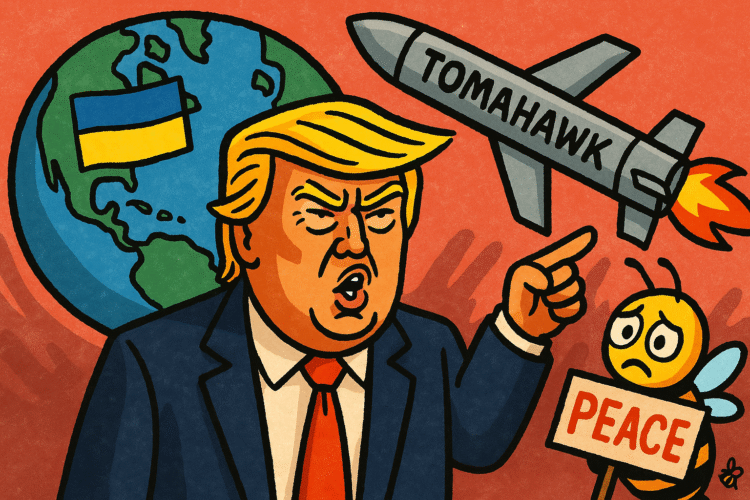
It begins, as all global crises now do, with a push notification and an open microphone. President Donald Trump, standing at a White House podium flanked by flags and self-importance, threatened to send Tomahawk missiles to Ukraine unless Vladimir Putin “ended the invasion immediately.” In Trump’s world, diplomacy is performance art—equal parts bluster, bluff, and Broadway show tune. Somewhere deep in the Pentagon, a general probably mouthed the words “Oh, for God’s sake” into his coffee.
Trump told reporters that Volodymyr Zelenskyy “personally requested” the missiles in what he described as a “beautiful call.” As always, Trump’s adjectives arrive first; reality trails behind, limping. He has “sort of made a decision,” he said—a phrase that, in Trumpian dialect, usually translates to “I’m about to do something insane, but I want credit for self-control.” Moscow, predictably, reacted with panic. Belarus shrugged, Europe lit another diplomatic cigarette, and the world sighed into its anxiety medication.
A Prophet With a Launch Code
Only Donald Trump could find a way to make “peace through threat” sound like a motivational poster at a hedge fund. His entire foreign policy seems based on the idea that menace equals strength, that the louder the threat, the more stable the world becomes. It’s as if he’s conducting international relations the way a landlord handles overdue rent: loud, threatening, and deeply unserious.
But for all the absurdity, the danger is real. The Tomahawk cruise missile isn’t a metaphor—it’s a weapon capable of traveling 1,000 miles to destroy something most people can’t pronounce. Trump waves it around like a car salesman offering a test drive, while the rest of the planet quietly measures fallout zones.
Moscow’s “Extreme Concern,” America’s Extreme Confusion
Dmitry Peskov, Putin’s poker-faced spokesman, called this a “very dramatic moment.” That’s Kremlin-speak for “please stop.” Moscow knows that once U.S.-made missiles cross into Russian airspace, escalation moves from theory to catastrophe.
Meanwhile, Washington drowns in chaos. The White House insists that “no final decision has been made,” which usually means the order’s already written in Sharpie. Inside the Pentagon, aides are split between writing contingency plans and searching “Can we unlaunch a Tomahawk?” on Google. Diplomacy has become improv theater with live ammunition.
Zelenskyy’s Tightrope
For President Volodymyr Zelenskyy, every Western promise is a double-edged sword. Yes, Ukraine needs long-range strike capability. But accepting Trump’s gift means inheriting his recklessness. The man offers missiles the way a toddler offers a crayon—generously, but without considering the walls.
Zelenskyy has mastered the art of cautious gratitude. He praises the “solidarity” while gently praying the missiles remain theoretical. After months of drone swarms and missile strikes—over three thousand in just one week—he can’t afford to alienate any ally, even one with the attention span of a goldfish in a thunderstorm.
Europe’s Tight-Lipped Panic
European leaders are treating Trump’s outburst like a gas leak: everyone pretends nothing’s wrong while slowly backing away. Brussels has entered what diplomats call “active listening mode,” which is code for “we’re drafting statements that sound supportive but commit to nothing.”
There’s quiet panic behind the scenes. Routing Tomahawks through European partners would technically spread the responsibility—but also the target. Nobody wants to be the country whose airfield becomes the missile’s return address.
It’s a familiar cycle: Trump throws the grenade, and Europe scrambles to find the pin.
Belarus Plays the Skeptic
Belarusian strongman Alexander Lukashenko has publicly doubted that Trump will follow through, calling it “just pressure tactics.” Coming from a man who once threatened to bomb his own capital, that’s saying something.
Lukashenko’s skepticism isn’t compassion; it’s strategy. If the threat turns out to be empty, he can claim prophetic wisdom. If it’s real, he can say, “I told you he was crazy” while hiding under Putin’s nuclear umbrella. The game isn’t about peace—it’s about optics.
The War’s Burning Core
While the headlines orbit Trump’s ego, Ukraine’s reality remains brutal. Russian missiles continue to hammer power grids, leaving millions without heat or light. Hospitals run on generators. Utility crews, exhausted and targeted, have become wartime heroes in hard hats.
Kyiv still reports small territorial gains in Zaporizhzhia and Donetsk, but every victory is offset by civilian suffering. Trump’s theatrics do nothing to change that. To Ukrainians, his missile threat isn’t strategy—it’s background noise to the sound of falling debris.
The Theater of Deterrence
Trump’s defenders insist that unpredictability makes him effective. The problem is that unpredictability and instability look identical until someone’s city disappears. “Madman theory” may have worked for Nixon, but Nixon didn’t livestream his mood swings.
In theory, threatening Tomahawks deters aggression. In practice, it hands Putin a propaganda gift—proof that America’s foreign policy is run like a reality show. Deterrence only works if both sides believe in rules; Trump’s rules change every tweet.
When Threats Become Currency
For Trump, everything is transactional. Threats are not policy—they’re currency. He trades them for attention, applause, leverage, or headlines. The Tomahawk episode is just another in a long line of performative brinksmanship: tariffs, troop withdrawals, indictments, and now, missiles.
It’s exhausting. Allies have learned to interpret his words as weather forecasts: dramatic, unpredictable, and mostly inaccurate. Yet the repetition dulls the shock. The longer he plays with matches, the more we start treating the fire as normal.
The Bureaucracy of Escalation
Every Trumpian improvisation becomes a bureaucratic migraine. Even a hypothetical missile transfer triggers paperwork, coordination, and contingency planning. Staffers scramble to make sense of chaos, and in doing so, they move the machinery forward.
That’s how escalation happens—not through decision, but through momentum. By the time the president backtracks or loses interest, half the system has already mobilized. The missiles don’t need to fly to cause damage; they just need to be imagined long enough to force others to prepare for them.
An Age of Self-Fulfilling Crises
We live in an era where threat and theater are indistinguishable. The very act of announcing something makes it halfway true. The markets swing, alliances tremble, cables flood with speculation—all because a man with a podium can’t resist hearing himself talk.
The tragedy is that this erosion of seriousness doesn’t just cheapen diplomacy; it normalizes recklessness. Every unfiltered remark blurs the line between deterrence and provocation. The apocalypse doesn’t come with sirens anymore—it trends.
The World’s Worst Group Project
If global diplomacy were a group project, Trump would be the student who deletes everyone’s slides and calls it leadership. Europe drafts careful plans. Ukraine pleads for focus. Trump storms in, labels his chaos “vision,” and then complains that nobody appreciates his genius.
When the next Ukrainian delegation arrives in Washington, their real mission won’t be securing aid—it’ll be decoding tone. They’ll leave with polite smiles, talking points, and a renewed sense that the superpower they depend on is piloted by a man who treats war like an audition.
The Economics of Fear
Behind the missiles lies the money. Ukraine’s call for secondary sanctions on Russian oil remains gridlocked, while Western firms quietly look for loopholes. Every embargo leaks. Every condemnation has a clause.
Winter is coming again, and Russia’s energy war strategy is simple: freeze morale, freeze infrastructure, freeze resolve. For every speech about freedom, there’s a transformer exploding somewhere outside Kharkiv. The power struggle is literal—and no Tomahawk can fix it.
The “Sort-Of Decision” Doctrine
Trump’s “sort-of decision” perfectly encapsulates his governing philosophy. It’s neither yes nor no—it’s Schrödinger’s policy. The ambiguity keeps everyone guessing, markets swinging, and pundits employed.
But governing by uncertainty is not strategy; it’s addiction. He’s hooked on attention, and the world keeps supplying the fix. Even if the missiles never launch, the consequences of his noise ripple across continents.
The Peace That Never Comes
At some point, the word “peace” becomes ornamental—just another headline placeholder. Trump’s “peace through strength” has devolved into “peace through chaos,” a slogan destined for history’s discount bin.
If anything defines this moment, it’s the contrast between people who have to live with the fallout and those who treat it like content. Ukrainians are rebuilding hospitals under shellfire. Washington is rebuilding narratives under soundbites. Both are exhausting endeavors, but only one involves actual blood.
Final Analysis: The Show Must Go On
In the end, Trump’s missile threat isn’t about strategy or security—it’s about performance. Every word, every bluff, every “sort-of” proclamation is staged for the audience. He doesn’t seek peace or war; he seeks attention. The Tomahawks are just props in a theater that never closes.
We’ve entered a new phase of geopolitics where the line between foreign policy and fan fiction is barely visible. The cast changes, but the plot remains: power without principle, spectacle without substance. The curtain rises, the missiles glint in the distance, and the world keeps clapping nervously, waiting for the next act.
Because in Trump’s America, the only thing scarier than war is silence.