
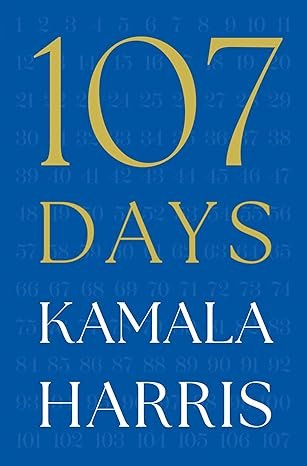
I listened to Kamala Harris’s new memoir 107 Days on audiobook today, and I can say without hesitation: I loved it. I’ve been a Kamala Harris fan since her days as District Attorney in San Francisco, when her mix of sharp legal instincts and political fearlessness made her one of the most interesting figures in public life. Over the years, through her time as California’s Attorney General, Senator, Vice President, and eventually Democratic nominee for president, my admiration for her has only grown. This book only deepened it.
The memoir is raw, detailed, and candid in a way that feels rare for modern political figures. Harris has always been skilled at blending personal texture with institutional seriousness, but here she strips away the polish. 107 Days is the story of an impossible sprint: the shortest presidential campaign in modern history, born from President Joe Biden’s withdrawal on July 21, 2024, and ending in her loss to Donald Trump in November. It is, in her words, “a campaign measured in hours, not years.” And through it all, the recurring theme is time—how little of it she had, and how much it shaped every choice.
The Sprint of a Lifetime
The book opens in chaos: Biden steps aside, the party scrambles, and Harris is suddenly at the center of history. She describes the initial phone calls, the rushed decisions, the palpable sense of running into battle with armor half-fastened. Harris doesn’t wallow in self-pity; instead, she emphasizes how structural constraints—107 days to introduce herself anew to the country, against a unified Trump operation—set the stage for what followed.
Listening to her narrate those early chapters, I was struck by how vividly she recalls the physical exhaustion. You can almost hear her reliving the blur of airports, rallies, policy briefings, debate prep, and late-night calls. It’s not a polished highlight reel—it’s a grind, presented honestly.
Biden, Loyalty, and Recklessness
Harris is candid, even cutting, about Biden’s decision to run again. She calls it “recklessness” that the re-election choice was left solely to Joe and Jill Biden, given the stakes. She details Biden’s visible fatigue, the disastrous Atlanta debate, and the denial that consumed his inner circle afterwards. The campaign’s insistence that “JOE BIDEN WON” in the debate’s aftermath becomes a symbol of how frayed the partnership had become.
As someone who has admired both Biden and Harris, these passages were difficult to hear. But I appreciated her honesty. This wasn’t gossip; it was diagnosis. She loved Biden, respected his decades of service, but she could no longer ignore what was unfolding before the nation’s eyes.
Choosing a Running Mate
One of the most fascinating sections covers the vice-presidential deliberations. Harris reveals that Pete Buttigieg was her first choice, but she ultimately concluded that a ticket pairing a Black woman and a gay man was “too big of a risk” in such a compressed timeline. Buttigieg later pushed back publicly, but the book makes clear Harris’s reasoning: the campaign simply didn’t have the luxury of taking chances with voter prejudice.
She also doubted whether Pennsylvania Governor Josh Shapiro would truly accept a No. 2 role. In the end, she chose Tim Walz, emphasizing his steady demeanor and midwestern sensibility. Yet she doesn’t hide her frustrations, recounting her annoyance at certain moments during Walz’s debate performance. These details make the book shine—not because they’re petty, but because they show the weight of leadership. Every decision carried risk, every alliance was fragile.
Owning Mistakes
Perhaps the most refreshing part of 107 Days is Harris’s willingness to admit mistakes. She calls her Oct. 8 appearance on The View a “self-inflicted grenade.” When asked what she’d do differently than Biden, she famously answered, “There is not a thing that comes to mind.” In the book, she labels that answer a failure of imagination under pressure, acknowledging she should have signaled a GOP cabinet pick or some gesture of independence.
It’s rare for politicians to own blunders with such clarity. Harris doesn’t excuse it. She analyzes it, takes responsibility, and moves on. That’s the mark of a leader who learns.
Election Night Shock
The chapters on election night are heartbreaking. Harris describes the campaign’s internal analytics, which had them ahead in battlegrounds as late as the Friday before the vote. The loss blindsided her team. The image of scraping icing off “Madam President” cupcakes is seared into my mind—a moment of hope turned to disbelief. Harris writes, “I could barely breathe.”
Hearing her voice crack as she read those words on audiobook was devastating. It reminded me that behind the headlines and polling numbers are human beings carrying the weight of history.
Family and Personal Texture
Despite the intensity, Harris weaves in moments of personal texture. She shares Secret Service code names for Doug Emhoff and his kids, small anecdotes that humanize a story otherwise dominated by politics. These vignettes—late-night dinners, quiet moments with family—provide contrast to the chaos.
It’s these glimpses that make the book intimate. You’re not just watching a candidate run; you’re sitting in the car with her after a rally, exhausted but still strategizing.
Rivals and Allies
Harris doesn’t shy away from relaying unvarnished exchanges with rivals and allies. Trump, bizarrely, called her privately to offer backhanded compliments even as he attacked her publicly. Gavin Newsom texted a curt “Hiking. Will call back.” at a pivotal moment. And JD Vance earns a profane aside that made me laugh out loud.
These anecdotes aren’t included for shock value—they illustrate the absurdity of politics in the modern age. High-stakes history is unfolding, and yet it’s punctuated by texts, ego trips, and surreal conversations.
The Central Thesis
The heart of the book is Harris’s argument that the campaign was doomed not by one mistake, but by the structural reality: 107 days was simply not enough. She inherited fractured party dynamics, lingering Biden-world mistrust, and a brutal calendar. Against a unified and ruthless Trump operation, the odds were stacked.
It’s a sobering conclusion, but one that resonates. Political campaigns are not just about message—they’re about time. And time, for Harris, was the one resource she could not conjure.
Immediate Reception
Harris acknowledges that the book has already provoked reactions. Buttigieg and Shapiro pushed back on their portrayals. Commentators debate whether her candor helps or hurts her prospects in 2028. But Harris seems unconcerned. The memoir is less about spin and more about setting the record straight.
As a reader—and listener—I found this honesty refreshing. Too often, political memoirs are bland victory laps or defensive excuses. 107 Days is neither. It is candid, reflective, and brave.
Why I Loved It
As someone who has admired Kamala Harris since her San Francisco days, I loved this book for many reasons:
- It is brutally honest. She does not sugarcoat her mistakes or others’.
- It is emotionally raw. The election-night passages alone are unforgettable.
- It is historically important. Few campaigns will ever replicate the circumstances of 2024.
- It is inspiring. Even in loss, Harris demonstrates resilience and clarity.
Listening to Harris narrate her own story added a layer of intimacy. You hear the pauses, the sighs, the humor, the occasional crack in her voice. It reminded me why I’ve admired her for so long.
Looking Ahead to 2028
This book makes me hope even more that Kamala Harris runs in 2028. She has the experience, the clarity, and the resilience to lead. If 107 Days proves anything, it’s that she can withstand extraordinary pressure with grace and honesty.
I believe Harris’s voice is essential in American politics. She understands the stakes, she acknowledges mistakes, and she refuses to retreat from the fight. That is the kind of leadership we need.
Final Thoughts
107 Days is more than a campaign memoir. It is a case study in leadership under impossible circumstances. It is an intimate portrait of a candidate who gave everything she had, only to be undone by forces beyond her control. And it is a reminder that politics is not just about victory—it is about resilience, honesty, and the willingness to keep going.
As I finished the audiobook, I felt both heartbreak and admiration. Heartbreak that Harris’s campaign ended in defeat. Admiration that she chose to tell the story with candor and courage.
I loved this book. I remain a huge Kamala Harris fan. And I hope she runs again in 2028. Because if anyone has earned another chance, it’s Kamala Harris.