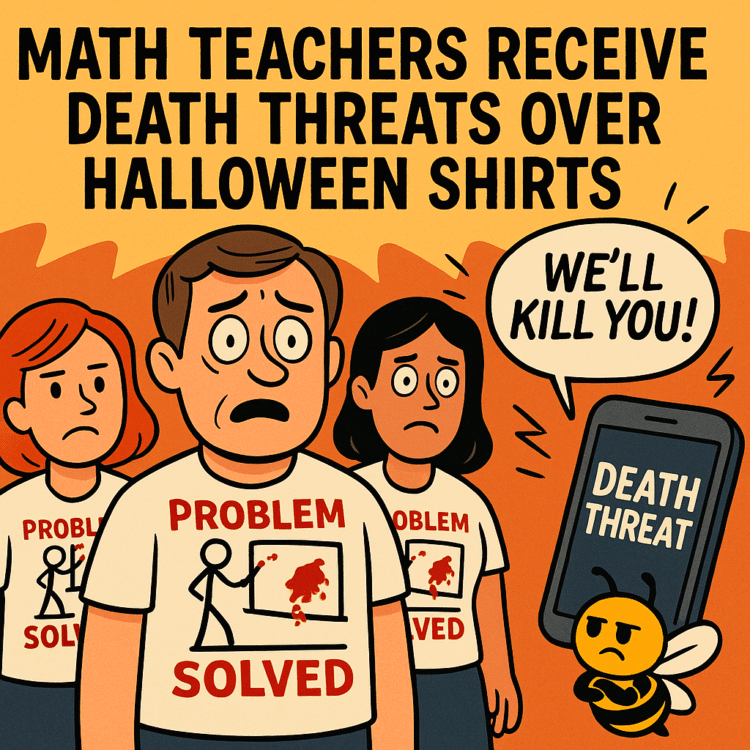
In the country that once invented public education, the new national pastime is death threats.
Last week, a group of math teachers at Cienega High School in Arizona discovered that their Halloween costumes—a recurring staff joke shirt that read Problem Solved splattered with fake red ink—had been rebranded by the internet as evidence of moral collapse, media bias, and the Deep State’s alleged plot to celebrate Charlie Kirk’s assassination.
Yes, the same Charlie Kirk who died in Utah a month ago, and the same shirts that first appeared in 2024, long before his death, as a pun about correcting equations. America looked at a blood-splashed math joke and said, “Clearly, this is an insurrection of algebra.”
The teachers, who spend their days trying to convince teenagers that PEMDAS is not a Pokémon, woke up to over 3,000 death threats. The internet, once again, had solved a problem that didn’t exist by creating one that now does.
The Shirt That Broke the Algorithm
A group of educators wore shirts showing a stick figure solving a problem on a whiteboard. The figure erases a math error, and the resulting splatter of red marker humorously resembles blood. The caption reads Problem Solved.
It’s the kind of dry humor beloved by teachers whose annual budgets are smaller than the average influencer’s skincare haul. The shirts were originally made in 2024, sold at math conferences, and worn to celebrate a unit on linear equations.
Fast-forward to 2025: a tragedy occurs. Conservative activist Charlie Kirk is assassinated in Utah on September 10. The story dominates the news cycle, conspiracy theories bloom, and somewhere deep in the feed, an old photo of the Cienega math team resurfaces.
The caption is rewritten: Teachers Celebrate Kirk’s Murder.
Within hours, outrage metastasizes. The algorithm doesn’t care that the photo is from last year. It doesn’t care that the teachers live in a different state, in a different district, and were likely grading tests when the assassination happened. The only thing that matters is that the image looks incendiary and the engagement numbers are pure gold.
By morning, the district’s voicemail system collapses under threats of violence. The teachers are doxxed. Their children’s names are posted online. Someone drives past the school blasting patriotic anthems through a megaphone and yelling “We know what you did.”
All over a math pun.
The District’s Press Release from Hell
In a saner world, a single statement from the Vail School District confirming the shirts’ innocent origins would have sufficed. They even produced photographic evidence—dated 2024, months before Kirk’s death—showing the same staff wearing the same shirts for the same joke.
But in 2025 America, evidence is just another form of propaganda.
State Senator Jake Hoffman (R-Conspiracy Caucus) took to social media to declare, “Whether this was intentional or not, the message it sends is sick.”
Representative Anthony Kern added, “We’re investigating what kind of teachers would make something like this.”
Translation: We found an outrage that polls well. Please don’t ruin it with context.
Soon, “MathGate” was trending nationwide. Pundits described it as a “window into the moral depravity of public schools.” Talk show hosts speculated that liberal educators were “conditioning students to celebrate political violence.”
Nobody seemed to notice that the teachers’ real crime was trying to make math relatable to 15-year-olds.
The Outrage Economy
This is the modern American market cycle: find a photo, misinterpret it, monetize the rage, and move on before the truth catches up.
It’s outrage arbitrage. The people who shared the image didn’t believe it. They didn’t have to. Outrage posts are algorithmic currency. The more absurd, the more lucrative.
A single viral lie can generate millions of impressions. Conservative influencers raised money off the story within hours. One site sold “Protect Our Kids From Marxist Math” mugs. Another offered T-shirts that said “2+2=Kirk.”
Meanwhile, the real teachers—actual human beings—were answering calls from people promising to “solve them next.”
Arizona’s Political Theater
If Arizona politics were a movie, it would be a dark comedy set in a gas station parking lot.
Senator Hoffman, famous for running a digital marketing firm that once pushed election conspiracies, treated the Cienega situation like a sequel. He appeared on local radio claiming that “symbolism matters” and that the teachers “should have known how this would look.”
Yes, how it looks. In this version of civic discourse, perception outranks reality. You can disprove the story entirely, but if the lie feels truer to your audience than the truth, the lie wins by acclamation.
Representative Kern chimed in with promises of a “legislative review” of the incident—because nothing says limited government like subpoenaing algebra teachers over a meme.
The Internet’s Mob Math
Here’s the real equation that played out:
(One old photo) + (a national tragedy) x (politicians needing relevance) = thousands of strangers demanding your death.
The same voices who once defended free speech as sacred now weaponize it as plausible deniability. They don’t threaten the teachers directly; they just post their faces next to words like evil, demonic, and traitor.
The audience takes it from there.
The irony, of course, is that the teachers’ shirts were about erasing mistakes. The mob’s rage proved the point: the equation of American outrage no longer has a solution, only variables multiplying endlessly.
The Real Math Problem
This story isn’t just about one Arizona school. It’s about what happens when the people who scream “fake news” build entire careers on it.
Public educators are already navigating political minefields—curriculum bans, book challenges, “patriotic education” mandates. Now they have to worry that a decades-old T-shirt joke might get them killed.
Cienega’s faculty didn’t plan a political statement. They planned a lighthearted group costume. But in 2025, context has the lifespan of a TikTok trend.
Within hours, verified accounts were sharing the photo with captions like “This is what your tax dollars pay for.” Except they weren’t taxpayer-funded at all; the shirts were paid for by a teacher who sells Avon on weekends.
The district’s clarification post—accompanied by dated photos and staff testimonials—barely reached a fraction of the original audience. Misinformation always wins the speed race. Truth is slow, expensive, and boring.
The Aftermath
By the end of the week, a few right-wing commentators quietly retracted their claims. They cited “newly discovered evidence,” as though they had personally uncovered it instead of ignoring it for five days.
But the damage was done.
Teachers took leave for anxiety. Parents pulled students out temporarily. The local police department increased patrols around campus.
And yet, in a particularly grotesque twist, some of the same lawmakers who amplified the smear offered “thoughts and prayers” to the targeted educators.
As if you could cyberbully someone, light the fire, and then solemnly attend the arson scene you created.
The Ghost of Charlie Kirk
Even in death, Kirk’s name has become a Rorschach test for the American psyche. His assassination, an act universally condemned, has nonetheless become a litmus test for performative outrage.
The tragedy should have been a moment for reflection—about the toxicity of political violence, about the radicalization pipeline that drives people to act out conspiracies in real life.
Instead, it became another tool in the culture war. In that warped logic, random math teachers 600 miles away became avatars for evil.
When every event must fit into a narrative of persecution, truth becomes an inconvenience.
The Teachers Respond
When local reporters interviewed one of the targeted teachers, she said simply, “It was a math joke. We do this every year.” Her voice cracked halfway through the sentence.
She described deleting her social media accounts, locking her doors, and teaching geometry through a police escort.
Her biggest regret wasn’t the costume. It was assuming that people would believe the obvious.
“Next year,” she said, “we’ll just dress as calculators.”
Lessons Unlearned
This entire saga could have ended with a headline correction. Instead, it became another symbol of how American discourse feeds on misunderstanding.
In this climate, outrage is the only bipartisan currency left. The left sells moral panic about fascism; the right sells moral panic about pronouns. The middle ground is a crater where teachers used to stand without flak jackets.
Meanwhile, the actual students of Cienega High are watching adults melt down over fake blood while their district struggles to afford real textbooks.
It’s a perfect microcosm of modern governance: hysteria at the top, hunger at the bottom, and a school counselor caught in between with a stress ball shaped like an apple.
The Extra Credit Nobody Asked For
The Cienega incident isn’t about shirts. It’s about power. The power to define meaning, to weaponize misunderstanding, to turn a harmless joke into a political scandal.
Conservative lawmakers like Hoffman and Kern don’t care about context because context doesn’t trend. They care about engagement, sound bites, and the dopamine rush of a well-timed “how dare they.”
They will never apologize because outrage is a subscription model.
The teachers, meanwhile, will go back to their classrooms, teach integers under fluorescent lights, and hope that this year’s Halloween joke doesn’t accidentally become a congressional talking point.
They’ll remind students that math, unlike politics, has right answers. They’ll erase the red marks from the board. And somewhere in the distance, someone will still be screaming into their phone about blood.
The Only Problem Worth Solving
If there’s any moral to extract from this civic farce, it’s that America has forgotten the difference between error and evil.
An old photo mistaken for new malice. A rumor mistaken for fact. A death mistaken for an opportunity to trend.
The teachers of Cienega High didn’t celebrate a tragedy. They became a mirror for one: a country so addicted to grievance that it will invent enemies faster than it can feed children.
When history looks back on this, it won’t ask how teachers could make such a mistake. It will ask how a nation could.
The problem isn’t the shirt. The problem is the math of madness.
Because if three thousand strangers threaten ten teachers over one photo, the equation doesn’t solve itself. It multiplies.
And no amount of red ink can erase what that says about us.