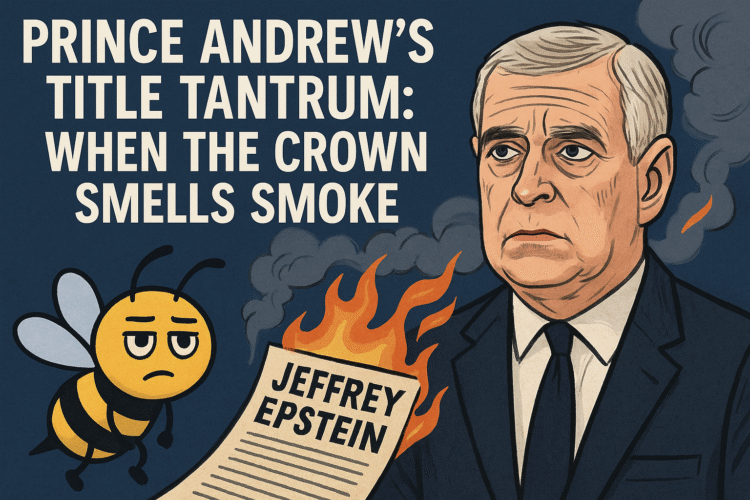
There’s something about the smell of royal scandal that hits differently—less like smoke and more like an expensive candle trying to cover up the scent of a body decomposing under the palace floorboards. The official word from Buckingham Palace this week is that Prince Andrew, formerly the Duke of York, is voluntarily “stepping back” from his title and a stack of royal honors so that his “ongoing situation” doesn’t “distract” from the monarchy’s work.
Translation: whatever’s in the Epstein files must be really, really bad.
The palace, in its usual tone of silk-draped understatement, has announced that Andrew will no longer use the style “His Royal Highness, Duke of York,” nor participate in the Order of the Garter, the Royal Victorian Order, or other distinctions that used to sound like a medieval guild for people allergic to accountability. He does, however, remain a “Prince” by birth, which is less about grace and more about the sheer accident of being born in a castle instead of a cul-de-sac.
It’s a curious hybrid of punishment and preservation—like taking away a child’s Xbox but leaving the trust fund untouched. Officially, this isn’t “deprivation,” since removing a peerage under U.K. law would require Parliament to act. And God forbid Parliament actually do something decisive when it can instead issue a report, form a committee, and quietly look the other way.
In plain English, this is what passes for royal accountability: Andrew gets to keep being “Prince,” but can’t call himself “Duke.” It’s as if the monarchy just decided to cancel itself in slow motion.
There’s something deeply British about the whole affair—how scandal is managed not with confessions or consequences but with language. “Voluntary withdrawal” sounds so noble, doesn’t it? Like he’s doing this for the good of the realm, instead of to keep the family name off another subpoena. The statement reads like it was written by someone who’s spent decades sanitizing history books. “His Royal Highness has agreed that continued use of the title would distract from the Crown’s work.”
Distract from the Crown’s work.
What exactly is that work again? Waving? Cutting ribbons? Looking stoic while other people pay your security detail? The entire institution is a distraction from work.
The reality, though, is that this move wasn’t optional. This wasn’t a family chat over tea and scones—it was a survival meeting. King Charles, whose own reign has been a balancing act between public exhaustion and private humiliation, knows how close the fire is creeping. The monarchy’s power is reputation. Strip that away, and all you’ve got left are hats and scandals.
Andrew’s ongoing “association” with Jeffrey Epstein has haunted the royal PR machine for years. Every new document dump, every unsealed testimony, every grainy photo from the archives breathes new life into an already dying institution. You don’t “voluntarily” surrender titles unless you’ve seen what’s coming.
Let’s talk about those Epstein files.
We don’t know exactly what’s in the unreleased sections of the case material, but every time a new name or date leaks, someone in the global elite suddenly remembers they have “health reasons” to retire. Now Andrew has joined the exodus—fleeing not to Switzerland or the Caribbean, but into the warm velvet of plausible deniability.
It’s worth remembering that Andrew already paid a civil settlement to Virginia Giuffre, the woman who accused him of sexual abuse when she was 17. He has always denied wrongdoing, of course, and the settlement included no admission of liability. Still, you don’t drop millions of pounds for the fun of it. You do it to keep discovery out of daylight.
If that were the end of it, Buckingham Palace could have spun a redemption arc by now. A charity tour here, a foundation ribbon-cutting there, maybe a soft-focus BBC interview about “growth.” But now that Epstein’s flight logs, communications, and financials are being reexamined by investigators in multiple jurisdictions, something new has clearly surfaced. Something so toxic that even the world’s most insulated family decided to cut its own blood loose.
When a monarchy throws one of its own to the wolves, it’s not morality—it’s triage.
Of course, this isn’t just about one scandal-prone prince. It’s about what happens when hereditary power collides with modern transparency. For centuries, the British royal family has functioned like a constitutional screensaver: something nice to look at while pretending the government is working. But every new scandal—Diana’s death, Harry’s exile, and now Andrew’s disgrace—reveals how little substance remains beneath the ceremony.
And yet, the spectacle endures. The palace’s announcement wasn’t a confession, it was a performance—a gesture to show the world that the institution can still discipline itself, without ever admitting why. Andrew’s titles are gone, but his privileges remain. He’ll keep his estates, his bodyguards, his income streams. He’ll live in Windsor like a ghost of bad decisions past. The Crown doesn’t cancel its own—it just buries them under etiquette.
What makes this moment different, though, is how terrified everyone looks. You can feel the panic vibrating beneath the velvet. King Charles is desperate to preserve what’s left of the monarchy’s public legitimacy before it dissolves completely. William and Kate are working overtime to look relatable. Even the tabloids—those jackals of scandal who feast on royal blood—are treading carefully, because no one knows how deep the Epstein connection goes.
If the monarchy were confident, they’d have stripped Andrew completely. Instead, they’ve done something more revealing: they’ve half-punished him, half-protected him, signaling that they still fear what full exposure might bring.
And somewhere across the Atlantic, you just know Donald Trump is sweating.
The Venn diagram of Epstein associates and Trump-world insiders is practically a circle. The man who once bragged that Epstein “likes beautiful women as much as I do” has every reason to watch this royal defenestration closely. When a prince starts hiding, the oligarchs start calling their lawyers.
You can almost hear the diaper-rustle from Mar-a-Lago.
Trump’s own handling of Epstein’s orbit—his brief banishment from Mar-a-Lago, his later evasions, his continued friendship with Ghislaine Maxwell’s social set—reads like a how-to manual in selective amnesia. And now, as new documents circulate through the press and prosecutors sift through Epstein’s network, Trump’s allies are already preemptively framing everything as “fake news.”
But here’s the problem: Andrew’s retreat proves the danger is real. No one gives up centuries of aristocratic entitlement because of gossip. They do it when their lawyers tell them that “cooperation” is the only thing standing between them and a subpoena.
For years, both Trump and Andrew treated their proximity to Epstein as a nuisance, not a liability. But Epstein’s world wasn’t just about sex—it was about power. His Rolodex was a murder weapon of leverage. The people on those lists weren’t there by accident. They were there because influence is the currency of corruption, and Epstein was a banker of sin.
When someone like Andrew suddenly renounces his title, it means the overdraft is coming due.
Buckingham Palace insists this is about “moving forward.” But forward to where? The palace has spent years trying to modernize the monarchy through rebranding campaigns and social media optics. Yet here we are again, back in the swamp of privilege and predation, watching a man born into wealth and protection play the victim of circumstance.
York’s civic leaders called the move “long overdue.” Survivor advocates, more bluntly, said it’s a small but meaningful victory. Meanwhile, royal commentators—those endlessly polite translators of moral rot—describe it as “a necessary step in the Crown’s evolution.” That’s one way to put it. Another would be: the palace knows it’s cornered and is bleeding parts to stay alive.
It’s all image management. The monarchy survives on narrative, not substance. Strip away the pomp and circumstance, and what’s left is a hereditary PR firm whose product is continuity. Charles isn’t protecting the institution from scandal; he’s protecting it from irrelevance.
But the Epstein connection is something different. It’s radioactive. It doesn’t fade; it mutates. The names, the records, the testimonies—they don’t disappear. They resurface in new lawsuits, new leaks, new whispers. You can’t outlast that kind of truth with a press release.
And yet, the palace still believes it can control the story. That’s the delusion of old power—it confuses secrecy with survival. But in the age of leaks, there is no such thing as royal privacy. There’s only delay. And the delay, in this case, looks like a panicked institution trying to make a sacrificial offering before the next shoe drops.
So yes, Andrew has lost his titles. But he hasn’t lost what matters: the machinery of protection that ensures accountability stops just short of consequence. He’ll live comfortably, photographed occasionally, the scandal always implied but never spoken aloud. The monarchy will call this “closure.” The rest of us should call it what it is—a reminder that wealth and power still buy silence, even in disgrace.
The question now is whether that silence will hold. The Epstein files have already claimed billionaires, bankers, and politicians. Now, it’s nibbling at the edges of royalty. And if it ever breaches the walls of Buckingham Palace completely, we may finally see what happens when divine right collides with earthly evidence.
The British monarchy has survived wars, divorces, abdications, and Diana. But it’s never faced a reckoning like this. Scandal, once its oxygen, now feels like poison. Andrew’s downfall isn’t just his—it’s the monarchy’s mirror. What does it mean when your most sacred titles can be surrendered at the first whiff of criminal exposure? When “Your Royal Highness” becomes a liability instead of a shield?
This isn’t evolution. It’s panic management dressed as reform. And no amount of pageantry can hide the truth: when even princes are running for cover, something monstrous must be crawling out of the vault.
Whatever is in those Epstein files—it’s not gossip. It’s gravity. And the Crown, for all its centuries of inherited grace, may finally be learning that even divine institutions fall at the same speed as everyone else.