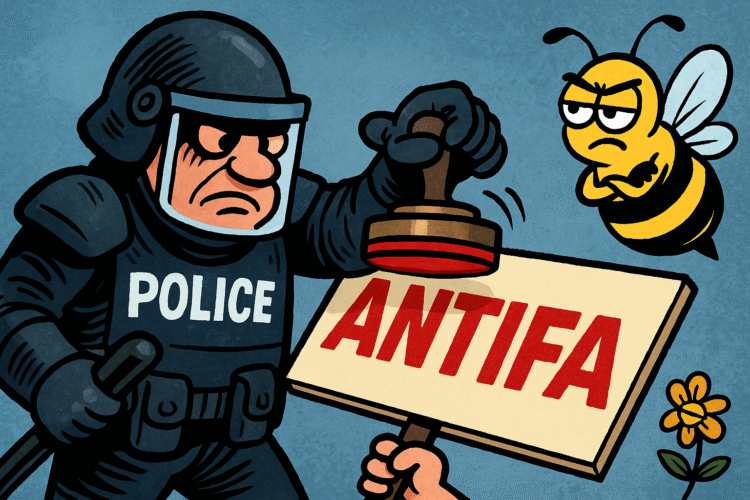
Somewhere in a Pentagon sub-basement or a Mar-a-Lago group chat, someone must have said, “What if we just did 2020 again—but meaner?”
Because here we are, October 2025, and President Donald Trump has decided to reboot his greatest hits tour: the “War on Antifa.” It’s like the “War on Drugs,” but with fewer facts and more merch.
This week, MSNBC broke down how Trump’s new executive order claims to “designate antifa as domestic terrorists,” which sounds tough until you realize there is no legal mechanism for the federal government to “designate” domestic groups as terrorists. It’s like declaring your neighbor’s kid a hurricane—lots of noise, zero legal standing.
But that’s never stopped this administration from turning grievance into governance.
Executive Orders and Executive Disorder
Let’s start with the obvious: you cannot designate a domestic organization as a terrorist group under U.S. law. The statutory authority only applies to foreign entities.
But Trump’s DOJ, led by Attorney General Pam Bondi (the same one currently auditioning for “The Handmaid’s Tale: Cabinet Edition”), apparently decided to treat the Constitution like a suggestion. They drafted an order anyway, complete with ominous language about “left-wing extremists” and “urban violence,” terms vague enough to cover anyone who’s ever protested, recycled, or voted for a Democrat.
The order itself reads like it was ghostwritten by a Fox News chyron. It cites “coordinated domestic threats” and “foreign-inspired anarchist networks,” which is MAGA code for “people holding cardboard signs that hurt my feelings.”
And because this is America, where every bad idea gets a sequel, the rollout included a fresh round of DHS escalations in Portland—the same city that spent a hundred nights being tear-gassed in 2020 by anonymous men in unmarked vans.
They’re calling it “Operation Diligent Valor 2.0.” You’d think after the first one ended with lawsuits, resignations, and a 200-page Inspector General report confirming “mass violations of civil rights,” they might try something else.
Nope. They just added the word “revived” and hit print.
Déjà Vu in Riot Gear
The new campaign pairs DHS agents, federal marshals, and—wait for it—a proposed deployment of National Guard troops without Oregon’s consent.
Yes, you read that right. The federal government wants to send troops into a state against its will. If that sounds like a constitutional crisis, congratulations—you passed 8th grade civics.
Oregon sued. A federal judge granted a temporary restraining order blocking the deployment, noting that “states retain sovereignty over their own Guard forces absent congressional authorization.” Translation: you can’t just invade Portland because you saw graffiti on Telegram.
Now the Justice Department is appealing, arguing that the President’s “plenary authority” (a phrase Stephen Miller recently used on CNN before they cut the clip for being too fascist-sounding) gives Trump the power to do whatever he wants if it’s “for national security.”
Apparently, a protest in front of an ICE building qualifies as “national security.” Somewhere, James Madison just threw up in his powdered wig.
The Rebrand: From Protesters to Paramilitaries
What’s really happening here is a political magic trick: turn dissent into danger, and suddenly you can police ideology instead of crime.
The White House messaging machine has gone full 1984, claiming “antifa coordination networks” are “infiltrating cities” and “funded by liberal donors.” Never mind that the FBI already debunked that theory five years ago.
But it’s not about truth—it’s about television. Tucker Carlson’s spiritual successors at “TruthNet” and “PatriotWire” have been pushing the narrative nonstop, airing grainy protest footage under ominous music while Trump donors nod along at country clubs.
And just like that, protesting police violence becomes “terrorism.” Marching with a union banner becomes “anarchist activity.” Chanting “no justice, no peace” becomes “foreign subversion.”
This is how authoritarianism happens—not in one stroke, but through the bureaucratic creep of “security measures” that all sound reasonable until you realize you’re living inside them.
Operation Diligent Valor: The Sequel No One Asked For
Remember the first Diligent Valor in 2020? The one where federal officers in camo were filmed pulling protesters off the street and stuffing them into unmarked vans?
The new version is the same cast, new script. DHS claims it’s “protecting federal property.” Portland officials say it’s provoking violence to justify federal overreach.
And here’s the kicker: internal DHS memos leaked last month show that some agents are being reassigned from immigration enforcement to “domestic unrest response.” ICE, the deportation arm of the federal government, is now essentially the Gestapo in tactical khakis.
So when officials say “we’re only targeting extremists,” what they mean is: anyone who doesn’t cheer loudly enough.
The Courtroom Cold War
The restraining order on unauthorized troop deployment has become the new legal frontline. An appeals court is set to review the case next week, and legal scholars say it could set precedent for whether a president can use the National Guard like personal security at a rally.
Civil liberties groups, led by the ACLU and the Brennan Center, are already preparing injunction motions to stop the administration from expanding “domestic terrorism” authorities originally designed for al-Qaeda.
Because here’s the part the headlines barely mention: these designations open the door for expanded surveillance, material-support charges, and asset freezes—all without oversight.
If Trump gets his way, “antifa sympathizers” could include journalists, clergy, or literally anyone who once tweeted “Black Lives Matter.”
The Business of Fear
Meanwhile, Portland’s downtown looks like the set of a dystopian reboot of Portlandia. Businesses are boarding up again. City officials say they’re fielding threats from right-wing groups emboldened by federal rhetoric.
And online, the algorithm has already monetized the chaos. “Antifa watchlists” are trending. T-shirt sellers are hawking “Deport Antifa” merch next to “Blue Lives Matter” mugs.
The entire apparatus runs on rage, and rage is currency.
What Trump discovered in his first term—and is perfecting in his second—is that authoritarianism doesn’t need censorship. It just needs engagement metrics. If people are too busy fighting about the definition of “terrorist,” they won’t notice their rights quietly expiring in the comments section.
Historical Flashback: The Playbook Was Always There
The “war on antifa” is just a reboot of every American panic that came before it.
- In the 1920s, we had the Red Scare.
- In the 1950s, McCarthyism.
- In the 1960s, COINTELPRO.
- In 2001, the Patriot Act.
- And now, in 2025, the Trump Doctrine: All dissent is domestic terrorism until proven profitable.
The pattern is simple: manufacture a threat, invoke patriotism, expand surveillance, criminalize protest, and then sell the T-shirts.
The Quiet Enablers
Of course, the real danger isn’t just Trump or Bondi or whatever Pentagon official signed off on “Operation Diligent Valor 2: Tear Gas Boogaloo.” It’s the quiet compliance of the institutions around them.
Corporate donors still cut checks. News outlets still chase access. Judges still equivocate in the name of “balance.”
Even some Democrats are hedging, worried about looking “soft on crime.” It’s the same cowardice that let the first Patriot Act pass 98–1.
But authoritarianism doesn’t arrive waving a flag. It arrives with a press release that says “public safety.”
Why No One Cares Anymore
Maybe the scariest part isn’t that Trump is doing this—it’s that the public barely flinches.
After years of mass disinformation, pandemic trauma, and algorithmic numbness, America’s threshold for outrage is gone. People scroll past news of federal troops in Portland the same way they scroll past cat videos.
The administration knows this. That’s why they’re testing the boundaries here. Portland is the lab. If they can normalize federal crackdowns on blue cities, they can roll it out anywhere.
The war on “antifa” isn’t about Portland—it’s about precedent.
What Happens Next
In the coming weeks, watch for three things:
- The court battle over National Guard authority, which could redefine state sovereignty.
- Congressional “oversight” hearings, which will generate noise but no real limits.
- Escalating rhetoric about “domestic enemies” as Trump leans into his 2026 reelection midterms narrative: chaos versus control.
And if history holds, the “chaos” will always be the people asking questions.
The American Experiment, Now with Riot Gear
Here’s the thing authoritarian regimes always get wrong: repression doesn’t breed obedience—it breeds resistance.
But here’s what democracies get wrong: we assume resistance will show up automatically. It doesn’t. It has to be organized, protected, and loud enough to be heard over the hum of apathy.
If this crackdown succeeds, if the courts rubber-stamp it, if we keep scrolling past it, then “antifa” won’t just be a label—it’ll be a warning.
Because once the government gets comfortable labeling movements it dislikes as “terrorist,” they don’t stop there. Next time, it won’t be antifa. It’ll be teachers. Or journalists. Or you.
Closing Section: The Land of the Free, Pending Review
Every empire has a breaking point—the moment it stops pretending it’s about freedom and starts calling obedience “law and order.” For America, that moment might look like a federal agent in Portland pepper-spraying a kid with a camera while the President tweets “ANTIFA SCUM.”
The “war on antifa” isn’t a policy. It’s a posture. It’s performance fascism, rehearsed for a public too divided to notice it’s not a show.
And the next time someone says “it can’t happen here,” remind them it already did—on livestream, with hashtags, and a press release that began with the words “for your safety.”