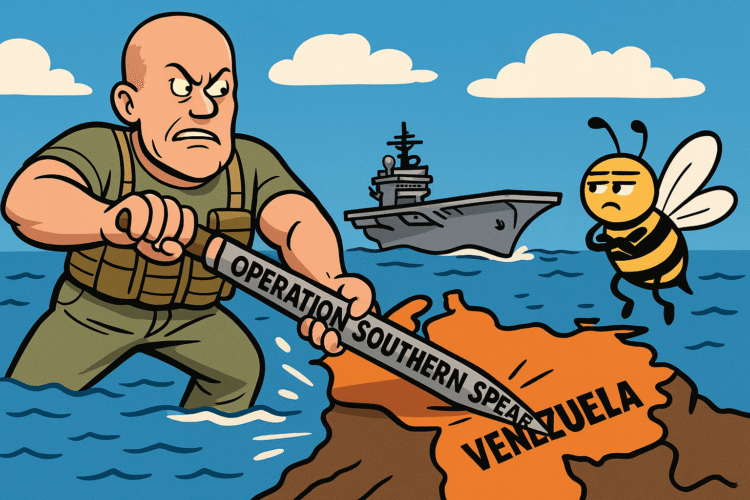
Somewhere in the bowels of the Pentagon, there must be a windowless room where names for military operations are spitballed by men who still believe Axe body spray counts as grooming. It is the only explanation for how, during a national reckoning over Epstein’s global child trafficking ring and the Trump administration’s frantic effort to bury half the receipts, we have arrived at a brand new military venture titled Operation Southern Spear. Nothing says “we definitely aren’t hiding anything” like announcing a thrusting operation pointed south during a week when the Epstein files are vomiting up fresh references to Trump “knowing about the girls.” The administration had one job, and it was literally “don’t choose a name that sounds like an undercooked Pornhub category.” They failed.
But maybe this is the perfect name for the perfect moment. A White House covered in scandal, a Pentagon acting like a power washer with a hair trigger, and a mission whose goals shift more often than Trump’s excuses, now packaged inside a term that is both deeply unserious and weirdly revealing. When an administration is juggling a carrier strike group, a nuclear submarine, dozens of lethal maritime strikes, and a credibility crater big enough to park the Ford-class carrier inside, of course they unveil it with the branding instincts of a teenage boy making a ClanTag in Call of Duty.
Operation Southern Spear is not new. It is just newly named, newly bragged about, newly framed as bold action instead of what it actually is, a months long run of deadly boat bombings near Venezuela and across the Caribbean and Eastern Pacific. The Pentagon has been blowing up vessels since early September. The body count is over sixty. The footage has been triumphant, cinematic, and conspicuously poorly documented once questions land. And now, Defense Secretary Pete Hegseth has wandered onto a stage, declared the strikes a noble push against “narco terrorists,” and slapped a brand on it like he’s launching an energy drink.
The timeline is almost too on the nose. The first at sea kills came just after Labor Day, quietly explained as interdictions and “defensive engagements.” Then came more engagements, more explosions, more evasive press briefings with words like “credible threat indicators” that meant nothing but sounded official. By October, the Southern Command theater was crowded with assets. Multiple Navy destroyers. Marine expeditionary units. A nuclear submarine. And last week, the USS Gerald R. Ford, America’s newest supercarrier, drifted into the region like a yacht someone lost the keys to.
But the branding needed a final flourish. Something muscular. Something suggestive. Something that would distract from the fact that the administration is simultaneously swallowing shards over the Epstein document dumps. And so they christened it. Southern Spear. Because nothing distracts like innuendo mixed with power projection.
Once the name hit the wires, Pentagon briefer faces tightened in that particular way they do when they know a storm is coming. Caracas called it coercion. Regional blocs warned this looked like the prelude to a war they absolutely did not authorize. Civil libertarians asked, loudly, whether we were now in the business of declaring undeclared wars by press release. And hawks cheered the move as if someone had resurrected the Monroe Doctrine and given it a flamethrower.
Meanwhile, sailors and Marines are being told by Hegseth that this “isn’t training,” which is a hell of a thing to communicate when the public still has no clarity about the rules of engagement, the chain of command, the evidence thresholds, or the reporting requirements. If you are going to tell people to prepare for combat, maybe also tell the country why.
The legal plumbing behind this entire operation is a circus. The White House insists the strikes fall under counter narcotics authorities, a claim that normally requires coordination with domestic agencies like CBP and DOJ. But in this case, the Pentagon is the one doing the shooting while the civilians whose agencies would normally define targets seem to have been positioned as spectators. Congress has not authorized a new conflict. War powers notifications, if they exist, are behind a curtain. The administration’s rhetoric swerves between “national security event” and “regional policing,” depending on the hour.
On international waters, law is not optional. There are rules of engagement governing proportionality, identification, and immediate post strike assessment. There are documentation requirements, chain of custody rules, and coordination mandates with partner nations. Yet every press call has contained the same phrases, “ongoing review,” “cannot comment,” and “credible intelligence” that remains forever classified.
The mission is being sold as clean and righteous. But nothing is clean. Not when the Epstein scandal is coughing up new questions and old nightmares. Not when House committees are moving closer to subpoenaing custodians of Epstein’s estate. Not when Pam Bondi and Kash Patel are in hot water trying to manage the disintegrating narrative around the so called transparency push that nobody on the right seems eager to pursue now that Trump’s emails are name checking his behavior in the most ominous terms possible. And not when the White House needs a distraction tall enough to hide a carrier behind it.
So here we are, watching a massive military buildup get christened with a name that sounds like a rejected title for a Cinemax after dark documentary. And we are told it is about drugs. That it is about “narco terrorists.” That it is about homeland safety. But the same administration fighting to keep Epstein files from being disgorged into the sunlight wants us to believe this is nothing more than maritime policing.
Regional reactions show the stakes. Venezuela’s Nicolás Maduro has mobilized forces and promised resistance, accusing the United States of staging a naval siege. Colombia’s Gustavo Petro warned against “imperial theatrics.” A chorus of CELAC nations spoke out against militarization in the Western Hemisphere. Even normally quiet allies asked why a supercarrier is required for drug interdiction operations that traditionally involve Coast Guard cutters and law enforcement task forces.
Markets, more honest than most governments, priced in tanker risk within days. Insurance firms began modeling premium spikes if hostilities escalate. Defense analysts noted the oddity of tasking a carrier strike group with chasing smugglers who favor civilian vessels and fast boats. It is like sending a cruise ship to settle a bar fight.
And beneath all of this, the human fallout remains uncounted. Who died in the sixty plus fatalities? How were targets identified? Who authorized the actions? Where are the videos? Were weapons drawn on evidence or assumptions? These are not abstract questions. They are the spine of accountability. When your operation is named like a rejected pitch for a gladiator themed bachelor party, you owe the world more than slogans.
In the next few weeks, the checkpoints are everything. The Pentagon must publish its authorities and rules of engagement or admit that they are inventing it as they go. Congress must force votes, hearings, and paper trails, whether leadership wants to or not. Regional partners must decide if they are willing to provide basing, overflight, or intelligence. The administration must decide whether it stands by its rhetoric or tries to retrofit the mission into something that passes legal scrutiny. And casualty lists, evidence chains, and post strike documentation must come into daylight, or this becomes something far darker than an operation with a stupid name.
The press must not repeat euphemisms. If a supercarrier is being used as a weapon of coercion against a regime the president has openly said he wants removed, say that. If this looks like a prelude to undeclared conflict, name it. If this is what war powers creep looks like, describe it. And if the name Southern Spear feels like a Freudian slip from a White House haunted by its own entanglement with the Epstein saga, acknowledge the grotesque symmetry.
Because satire or not, here is the truth in plain English. The United States has parked one of its most powerful military assets in range of a government the president loathes, wrapped the action in a name that sounds like the punchline to a joke no one should be telling right now, and expects the public not to connect any dots. It is insulting. It is reckless. It is also, unfortunately, perfectly on brand.
Operation Southern Spear will not be remembered for its tactical achievements. It will be remembered as the moment an administration drowning in scandal, secrecy, and misdirection tried to cloak military escalation in the language of adolescent swagger. And in that way, perhaps the name is the one honest thing about the entire venture.