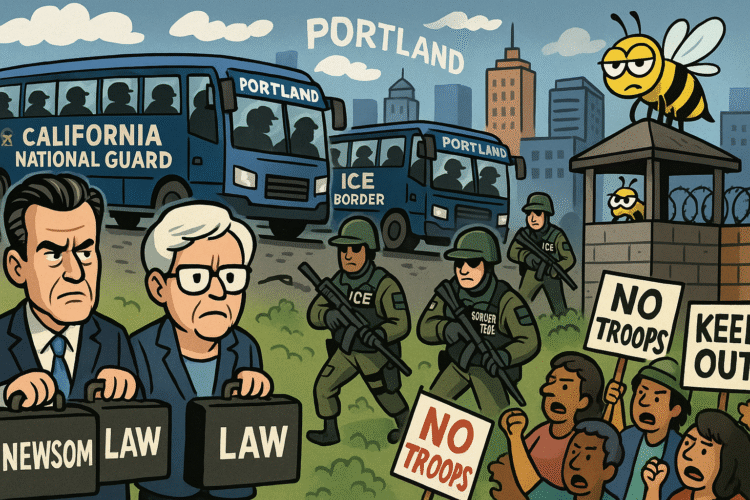
Every once in a while, power shifts so quickly it looks like smoke. On October 5, 2025, reports broke that President Donald Trump had moved to federalize and send out-of-state Guard troops—specifically from California—to Portland, Oregon, circumventing a court order and two governors’ objections. Federal spokesmen claimed 200–300 California National Guard would deploy to protect federal officers and property, because the Oregon Guard had been temporarily blocked by a judicial ruling. Governors Gavin Newsom and Tina Kotek vowed immediate lawsuits, calling the move an unlawful end run.
This is not theater. It’s a constitutional crisis in rapid motion. What follows is a reconstruction of the chain, the legal posture and counteroffers, the competing narratives, and the stakes when the top brass treats state sovereignty as optional and cross-state deployments as a workaround for resistance.
The Buildup: From Rivers to Rhetoric to Roadblocks
In the run-up to this moment, a federal presence had already inserted itself in urban spaces. Border Patrol boats with long guns patrolled the Portland and Chicago rivers. On Michigan Avenue, agents in tactical gear paced storefronts. The appearance of federal force in cityscapes was no accident—it was signal.
Then came the Quantico speech: Trump, standing before generals, floated the idea of using U.S. cities as military training grounds. He talked about “dangerous” urban zones, implied local governments were failing, urged federal insertion under force protection logic. That rhetoric set a template. (It is not incidental that Portland, already a locus of federal protests, became a target.)
By October 4, a judge issued a Temporary Restraining Order (TRO) halting Trump’s plan to send 200 Oregon National Guard soldiers into Portland. The decision blocked that deployment pending legal review. The order rested on arguments that the Trump plan lacked proper statutory predicate—a president cannot dispatch a state’s Guard without consent or lawful justification under insurrection, rebellion, or impossibility of enforcing laws.
Yet on October 5, the Pentagon quietly announced that 200–300 California Guard members, federally controlled, would be reassigned from their base in Los Angeles to Portland to fulfill the same protective role. Sean Parnell, Pentagon spokesperson, framed this as legal and consistent with federal mission. Newsom and Kotek reacted fast: they pledged litigation, saying the transfer violated state sovereignty and bypassed the TRO.
Legal Posture & Constitutional Crossfire
At the heart of the dispute lie several intertwined questions:
- Statutory authority: under what law can a president federalize and deploy a state’s Guard elsewhere? The Insurrection Act allows deployment when rebellion or “impracticability” justifies it—and even then, typically to protect federal property. The White House claims a “protect federal officers and property” hook. The governors argue that without insurrection, the move lacks statutory grounding.
- TRO sweep and workaround: The court’s TRO blocked Oregon Guard deployment specifically. But the administration is swapping in California units under federal control. That plays a dangerous game: can you sidestep a state-specific court order by importing troops from another state?
- Posse Comitatus / Title 10 vs. Title 32: Normally, active-duty troops are limited from domestic law enforcement under Posse Comitatus. Guard units under Title 32 remain under state control and have more latitude. But when a Guard unit is federalized or controlled by the Department of Defense (Title 10), it becomes ambiguous whether law enforcement functions cross a boundary. Once control shifts, the protections and limits blur.
- State sovereignty: Governors objecting is not simply rhetorical. States have constitutional authority over their militias (Guards). If both sending and receiving governors refuse, can the federal government override both? The question is not hypothetical; it’s now being tested.
Courts will be asked to weigh not just deployment’s legality, but whether a president can short-circuit a TRO by swapping state forces. That is not precedent, but a real gamble.
Competing Narratives: War Zone or Contained Block?
The White House narrative paints Portland as a war zone: federal officers under assault, local law enforcement overwhelmed, buildings under threat. The California Guard deployment is framed as “force protection,” not occupation.
Portland officials and community affidavits tell a different story. They describe mostly calm neighborhoods, centered friction near a single ICE facility block. They argue the federal claim exaggerates danger to justify escalation. Business owners say foot traffic is normal until the show of force begins. Neighbors say late-night raids terrify the elderly, children, and community institutions.
The tension is classic: federal claims of threat versus local claims of normalcy under siege. Whose version gets belief? When power has arms, credibility becomes collateral.
Dangers, Disclosures, and How This Could Expand
If the swap stands, the implications ripple:
- Court calendars: TRO hearings, injunction requests, appeal briefs, cross-jurisdiction moves. The governors will push for preliminary injunctions.
- Rules of engagement (ROE): Will the Guard use crowd-control munitions? Tear gas? Is there a limitation against arrest or enforcement, or only protection of federal assets?
- Transparency demands: The public will demand arrest and stop logs; warrant records; deployment orders; communications between the Pentagon and governors.
- Replication in Chicago: Already ~300 Guard have been authorized in Illinois. Could out-of-state Guard units be imported there too? Portland may be the blueprint.
- Economic fallout: Downtown businesses depend on foot traffic. A show-of-force drives away shoppers, tourists, diners. Q4 tourism and holiday commerce may bear the cost.
- Precedent: If a president can bypass state resistance by importing troops, the next governor becomes irrelevant. Shutdown weeks could become windows of federal force expansion.
The Satirical Anatomy
Let’s caricature it: A president glances at a state resisting federal theater. He shrugs and says, “Fine—use someone else’s militia.” He federalizes troops from a neighboring state and marches them in. It’s like being denied at the velvet rope and then sneaking in through the kitchen with someone else’s guest list.
The premise is audacious: that military force can be moved across state lines as casually as a logistics shift, especially under shutdown conditions. It treats the constitutional map like a road trip when the signage doesn’t align with your route.
If sovereignty is a pattern of refusal, the playbook says: override state boundaries until resistance collapses. The irony is sharp: the same administration that rails against “federal overreach” now asserts that control begins at city limits, not state law.
The Final Act
So here we are: a federal bypass, a judicial check stripped around the edges, a president lifting guard authority like a hat. Governors promise court fights. Citizens debate whether they wake to troop sounds or city birds. Businesses wonder whether they are collateral damage in theatrics they must not be part of.
If courts cave, the structure changes: cities become optional battlefields, states optional YouTube background. If courts push back, then we may see the first real test of whether laws, not power, still rule.
The showdown is not just in Portland streets—it’s in opinions, arguments, and doctrine. The question is whether the Union is a line drawn across the map or a line drawn through the balance of powers.
The federal government’s new tool is not just presence—it is cross-state projection. And the day that stops being contested is the day sovereignty becomes a myth.