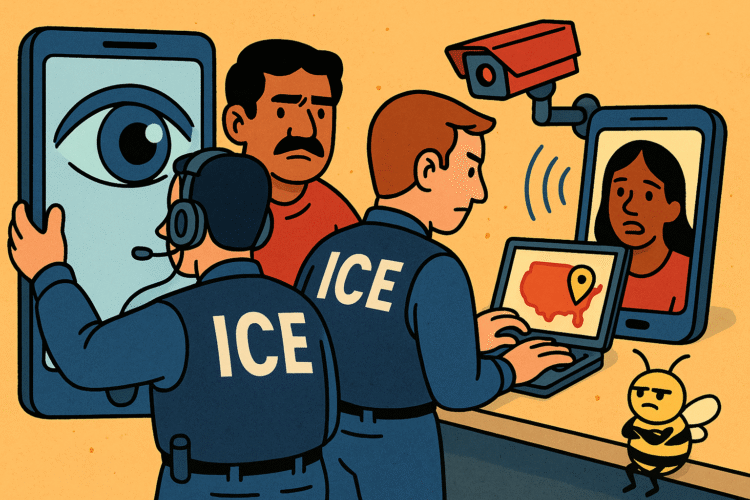
They call it “discipline” and “modernization,” but it walks like illegal mass surveillance, chills speech like a gag order, and it is the biggest story no one on primetime wants to say plainly.
I am not here to soothe you. I am here to describe a machine that has been assembled in plain sight while everyone argued about theater. In Trump’s second term, ICE is stitching together an always on surveillance system that treats your social media, your smartphone, and your medical records like friendly informants. The parts are marketed as lawful, the brochures say compliance, the press releases whisper safety. Add them together and you get a domestic imitation of the power journalists call Pegasus like, with the difference that this time the invoices are American and the targets include anyone who falls inside an expandable definition of trouble.
Start with the architecture. ICE has moved to stand up a round the clock social media watch floor, a real time feed of your feeds, scanning X, Facebook, TikTok, and whatever platform you use to breathe out a thought. Pair that with fresh purchases of device hacking and location tools, the kind that turn a phone into a map of your life without your consent. Layer in biometrics, iris scans, face matching, apps that identify you at a glance in a crowd. Then add the policy turn that straps GPS monitors on roughly one hundred eighty three thousand immigrants enrolled in so called alternatives to detention. Finally, connect a separate deal that opens the personal records of about seventy nine million Medicaid recipients to immigration enforcement. This is not a theory. This is a bill of materials.
This is also a test of whether the First and Fourth Amendments still mean what they say out loud. The First protects speech, press, and assembly. The Fourth guards against unreasonable searches and seizures. Those are not lifestyle suggestions, they are binding rules that do not disappear because an agency found a vendor with a clever product. Yet here we are, watching lawful process turn into a brand that can be stamped on tools built to avoid the very friction the Constitution requires. Put differently, if the government needs a warrant to rifle your desk, it does not win a prize for finding a contractor who can rifle your phone by calling it metadata. If the state should not be in your church or in your protest unless a judge signs a paper, it does not gain moral cover by hiring a social media team to do the same thing at industrial scale.
People hear Pegasus and think spy movie. It is not fiction. Pegasus was built by an Israeli company to seize control of a phone without the target tapping anything. Zero click. Once inside, it could copy texts, emails, photos, and live feeds from the mic and camera. It could follow you in real time. It was used against reporters and dissidents and even government officials. The United States blacklisted the vendor, Apple and WhatsApp sued, press freedom groups sounded alarms, and we all learned a vocabulary none of us wanted. Now look at what ICE is buying. Not Pegasus itself, the press office will assure you. Fine. What they are buying is a basket of domestic tools that chase the same outcomes, stitched together by contracts and data broker pipes and a fog of euphemisms about compliance. Pegasus by another route, with a badge attached.
The government has other laws it is supposed to honor while it chases convenience. The Privacy Act limits how agencies collect and share personal data. HIPAA protects medical privacy, with narrow law enforcement carve outs that do not translate to bulk taps of public insurance databases. The Stored Communications Act constrains what content and metadata can be seized and how. The Fair Credit Reporting Act was meant to leash the trade in dossiers that predict your life. Administrative law requires agencies to follow procedure, take public comment where required, and justify major changes with more than mood and branding. Procurement law exists to stop backdoor contracting that hides scope and price and purpose. Every one of those guardrails has a lawyer ready to argue that this new machine is fine. Every one of those guardrails also has a courtroom that can say no. The question is whether anyone will force that answer in time.
Zoom the camera in on what this looks like in a person’s life. A mother who followed every rule now wears a GPS box to work, where it beeps near a metal detector and becomes a rumor faster than she can explain herself. A teenager types a joke about a protest and learns that jokes are now probable cause for a visit from a man in a windbreaker. A local journalist weighs a source’s fear and decides not to make the call, because a phone has become a liability. A clinic clerk logs into a Medicaid record and whispers to a nurse that she no longer trusts the promise that health stays in the health box. Multiply those moments by a city, then by the country. That is not safety. That is a chill.
Defenders of the machine have a script. The process is lawful. The mission is necessary. The tools are neutral. The targets are limited to people in programs. The data is not really private. The critics are dramatic. The script ends with a shrug, as if the Constitution were an old story and not a current rulebook. Here is the counterpoint without any perfume. A twenty four seven social media surveillance team is not limited or neutral, it is a posture shift toward suspicion by default. GPS monitors on one hundred eighty three thousand people are not a marginal convenience, they are a municipal experiment in tethering families to fear. Opening a pipeline into seventy nine million Medicaid records is not a humble request, it is an assertion that poverty erases your privacy. Buying device hacks and face matching at scale is not the modern twist on paperwork, it is a bet that courts are too tired to keep up.
The most dangerous ingredient here is not technology, it is collapse of scope. Immigration enforcement is the gateway. Protest becomes the side door. “Antifa” is the catchall category that can hold whoever the government decides to dislike this week. That is how dragnets grow. The language expands, the categories blur, the procurement list stretches to match the mission creep, and one morning you discover that a team built to supervise a specific program has become a permanent cyclone that sweeps up everything that moves. There is a reason civil liberties lawyers reach for phrases like chilling effect and prior restraint. You do not need to jail a journalist to silence a source. You only need to make the source feel watched.
It is not only ICE. Data brokers have constructed a shadow market where location, purchase history, and social graphs are sold like office furniture. Regulators had a shot at curbing the sale of sensitive data and walked away. That is not a small footnote. When an agency can buy what a warrant would have to justify, it will, then it will call that purchase process and hope you do not notice the insult. Commerce is not a bypass lane around the Fourth Amendment. It has simply been treated like one because platforms and apps learned to monetize your life faster than Congress learned to defend it.
If you think this is just about people without status, read more carefully. Immigrants are the pilot project because power learned a long time ago that the cheapest way to build a tool is to test it on a group the majority will not defend. Once the tool works, the mission expands. Ask any protester who has been tagged in a fusion center slide deck for standing near a sign. Ask any public employee who has been told not to talk to a reporter because media rules now treat ordinary disclosure like treason. Ask any community organizer who learned that a private Facebook group is only as private as the next subpoena or contract. The goal is not to put everyone on a list. The goal is to make everyone act like they are already on one.
So what do we do, beyond shudder. There are near term checkpoints, and each one is a decision point with a clock attached. FOIA requests can force contract files into daylight. Inspectors general can audit the legal basis and the procurement pathways before they calcify. Judges can issue temporary restraining orders against bulk Medicaid data taps and mass ankle monitor expansions, then demand briefing on the constitutional posture. The FTC and CFPB can stop treating data brokerage as a quirky market and start treating it as a threat vector for government workarounds. Congress can hold oversight hearings with real witnesses, not just the usual choreography, and insist that vendors testify under oath about capabilities and targeting. Newsrooms can put a beat on this and refuse to let it drift into the comment section. Pastors, physicians, and school leaders can say out loud that their institutions will not be conscripted into the surveillance state without a subpoena that can survive daylight.
We also need to tell the story without the gentle filter. The government is building an always on dragnet under color of law. It is doing so by combining domestic tools to mimic Pegasus grade power. It is treating your phone, your doctor, and your feeds as informants. It is expanding what counts as a reasonable search while using policy labels like alternatives to detention to normalize instruments that look and feel like detention by other means. It is exploiting regulatory retreat around data brokers to purchase what the Constitution says should be justified. It is relying on a press corps that has learned to use passive voice when power is uncomfortable and on an audience that has been trained to call fear maturity.
If your instinct is to say, I am not an immigrant, I am not a protester, I am not at risk, ask yourself how many times in the last decade a tool designed for one category migrated to another. Predictive policing was pitched as a way to put officers where crimes would be, it became a way to place patrols where poor people live. Stingrays were sold as terror tools, then used to catch low level suspects because the device was already powered on. Fusion centers promised coordination across agencies, then became hoarder basements of rumors because rumor is cheap to store. The path from them to you is shorter than your timeline expects.
The law still matters. The First Amendment is not a sentimental slogan. It is a live wire that protects speech, press, and assembly from the exact kind of suffocating climate that surveillance creates. The Fourth Amendment is not a historical artifact. It is the difference between a government that must explain itself to a judge and a government that can say trust us and log in. The Privacy Act, HIPAA, the Stored Communications Act, and the Fair Credit Reporting Act are not trivia questions. They are leverage points, and they work only if someone pulls on them hard. Administrative law is not an annoyance. It is the boring muscle that forces agencies to slow down, take comment, show their math, and live with the record they created.
Let us also talk about rhetoric, because corruption begins in language. Discipline is the favorite noun of people who want you to stop asking questions. Modernization is the favorite adjective of vendors who want you to stop counting the bodies. Alternatives to detention is the favorite euphemism of a state that has learned to tether without bars. Compliance is the favorite script line for companies that prefer not to say what their software actually does. When you hear those words, ask for nouns that bleed. Who is watched. How many. What is collected. Where is it stored. Which court signed. When does the program end. Why is the category so broad you can drive a motorcade through it.
The political reactions will continue to split. You will hear Republican allies call this discipline and maturity. You will hear some Democrats clear their throats and suggest better oversight later. You will hear surveillance contractors say partnership and public safety and proof of concept and request for information. You will hear data brokers talk about privacy controls none of them enforce when a big client knocks. You will hear civil liberties groups use old words that still work, chill and overbreadth and prior restraint and warrantless dragnet. You will hear doctors, if they are brave, say that patients who fear records will skip care, then watch as public health metrics sag and someone on television blames culture.
What you should not hear is silence. Silence is how this kind of architecture wins. It waits out the week, it buries itself in jargon, it bets that outrage will hop to the next spark. Do not hop. Stay here. If we do nothing, we teach the state a lesson it will remember. We teach it that building Pegasus by purchase order is acceptable if the label says domestic. We teach it that health records are negotiable when a mission memo needs a shortcut. We teach it that GPS monitors are normal, that social feeds are fair game, that a camera in your pocket belongs to whoever has the budget. We teach it that you will trade the rights of the least for the comfort of calling yourself safe.
There is an alternative that does not involve pretending danger is a rumor. Smart power exists. It uses specific warrants, not floating categories. It targets violent actors with judicial oversight, not populations with marketing decks. It walls off health from enforcement and means it, not just in policy but in practice. It funds investigators and prosecutors so they do not reach for the one click convenience of a data marketplace. It narrows language, writes sunsets, publishes audits, and accepts that the pace of law is intentionally slower than the pace of panic. It respects immigrants as people with due process, not as an opportunity to beta test technology you plan to use on protesters next summer.
Until that alternative wins the day, we live with this one. The machine is humming. The watch floor is scrolling. The ankle monitors are charging. The contracts are renewing. The databases are open for business. The shutdown was a helpful fog. The vendors are smiling. The headlines are faint. The passive voice is doing its quiet harm. And your phone, your doctor, and your feeds are standing by.
Say it plainly so no one can pretend they did not understand. The government is building an always on dragnet and calling it discipline. It is illegal where the Constitution says it is, it is immoral where decency says it is, and it is underreported because the story does not fit neatly into a segment about personality. We can still decide that the law is not a costume. We can still force daylight into the procurement maze. We can still make judges read the words probable cause without a smirk. We can still shame regulators into remembering that brokered data is a pipeline for abuse. We can still tell the truth out loud. That is not a superstition. That is the work.