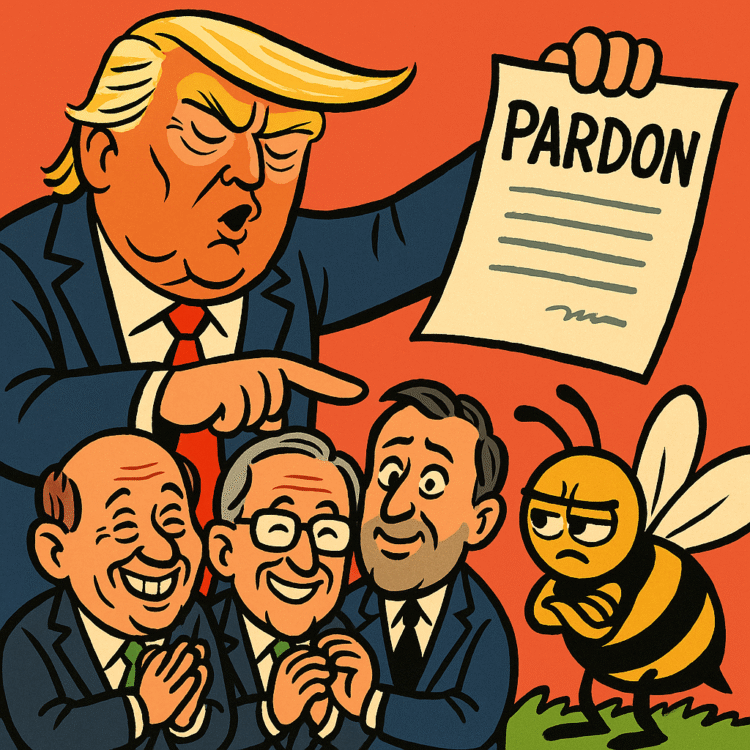
There comes a moment in every political season when you realize the country is not being governed so much as improv’d, and the cast has decided to try audience participation. The latest spectacle arrived with a flourish of parchment and a press release drafted in what appears to be the disappointed sigh of the rule of law. President Donald Trump signed a sweeping federal pardon, reportedly covering somewhere between seventy and eighty individuals who helped him try to kick democracy down a flight of stairs in 2020. Ed Martin, now apparently the nation’s most caffeinated pardon attorney, announced the package as an act of “reconciliation,” which is a lovely way of describing a legal grenade lobbed into the middle of ongoing criminal proceedings.
The White House would like you to believe that universal absolution fell gracefully from the heavens like confetti at a Times Square wedding, one last spasm of national healing from a man who wakes up every morning and chooses violence in all caps. But the thing about law is that it does not care about your marketing. It is not a brunch influencer. It does not swoon over vibes. Article II clemency has edges, and this pardon package is now slicing its way through every statute, docket, and ethics board in sight.
We have to start with the basics because the basics are precisely what the administration is desperate for you to forget. A presidential pardon can wipe federal criminal exposure for anything that occurred before the date on the warrant. Charged conduct, uncharged conduct, federal indictments that never made it out of draft form, the entire buffet of obstruction and conspiracy that federal prosecutors love to outline with footnotes and aggravation, all of that can be neutralized. What a pardon cannot do is reach into state court like an overeager wedding DJ and shut the whole thing down. Georgia is still Georgia. Arizona is still Arizona. Michigan and Wisconsin prosecutors did not pack up their offices because Ed Martin said reconciliation. Civil liability is untouched, including the lawsuits already circling these figures like vultures who have read the balance sheets. Bar discipline does not vanish either. And future crimes remain future crimes, which is always relevant when dealing with people who treat legal boundaries as polite suggestions.
But the real delight hiding inside this pardon casserole is the Burdick problem. When you accept a presidential pardon, you are accepting the premise that you needed one. The Supreme Court has been very clear about this for more than a century. Acceptance of a pardon is functionally an admission of the underlying conduct. And once you admit conduct in the eyes of the law, the Fifth Amendment evaporates like mist in a heat lamp. The recipients of this generous act of reconciliation can now be subpoenaed, hauled in, sat down under oath, and forced to answer questions until they run out of water or reasonable justifications. Their only remaining legal refuges are perjury and brand new crimes. Which means Congress is already warming the microphones for a parade of suddenly talkative witnesses who helped architect one of the dumbest and most dangerous election schemes in American history.
The timeline here matters because the administration is banking on spectacle washing away chronology. The warrant was signed on a weekend, which is the executive branch equivalent of scribbling something into the group chat at 2 a.m. and hoping everyone forgets. The Office of the Pardon Attorney transmitted copies to DOJ, where a small army of career lawyers are now practicing deep breathing exercises. Status filings are being drafted even as prosecutors begin preparing motions to dismiss or vacate federal charges for individuals who were very much mid-prosecution. Meanwhile, state attorneys general in Georgia, Arizona, Michigan, and Wisconsin released statements reminding America that they are not under the jurisdiction of whatever reconciliation ritual the White House is performing. State cases continue because that is how federalism works, no matter how badly the administration wants to treat the Constitution like an annoying coworker who should really learn to take a hint.
If you zoom out for a moment, you can see precisely where these pardons intersect the statutory machinery they hoped to dissolve. Conspiracy under 18 U.S.C. section 371 does not magically evaporate in state court. Obstruction of an official proceeding under 1512 leaves plenty of room for state equivalents. Deprivation of rights under 241 still has civil manifestations. False statements under 1001 cannot save anyone from perjury that has yet to be committed. Aiding and abetting under section 2 continues to echo in every jurisdiction that is not federal. And then there are the separation of powers questions, the ones that legal scholars are already sharpening into op eds. There is a nonzero chance that this package will be dissected for years as a case study in whether a pardon becomes obstructive when timed precisely to kneecap ongoing federal matters.
Reactions were immediate because the recipients are not small names. Rudy Giuliani, who has spent the last few years performing a slow public disintegration that even Shakespeare would consider too much, now finds himself legally revived only to face a line of civil suits and state charges that treat this pardon as the legal equivalent of a participation trophy. John Eastman, architect of constitutional fan fiction, must now decide how talkative he wants to be when he is pulled into committee hearings. Mark Meadows remains the nation’s most committed practitioner of strategic silence, but the Burdick trap will pry his lips open soon enough because executive privilege is not a shield when you have just accepted federal forgiveness.
Christina Bobb and Boris Epshteyn, the supporting cast of the obstruction drama, emerge freshly pardoned and freshly exposed. They can no longer decline to testify on Fifth Amendment grounds. Congressional committees have already begun preparing subpoenas because this administration has a habit of clearing its own obstacles by accident. Witnesses who were previously mute are now required to answer questions with actual words. Bar authorities have opened disbarment reviews for some of these figures, because professional responsibility does not vanish when the president signs a document. It is all quite poetic in a tragicomic way.
The White House insists this is about national healing. The press secretary said reconciliation so many times that the word lost all structural integrity. But no one is fooled. Healing is when you stitch a wound. This is when you staple a wound shut and tell the patient to go jogging. The country is exhausted by the idea that reconciliation is something you achieve by excusing criminal conduct, especially when that conduct involved trying to reverse an election by inventing fake electors and hoping the country would collectively forget what math is.
Now we turn to the checkpoints, the next seventy two hours when this story advances faster than the administration wants and far slower than the rest of us deserve. The public release of the pardon warrants will matter because the scope language will be scrutinized by lawyers who read footnotes the way sommeliers read wine labels. DOJ will have to decide whether to re present matters under newly seated U.S. attorneys who are less beholden to political pressure. Courts will draft findings even as they dismiss counts, and the footnotes in those findings may become the new lodestar for debates about clemency overreach.
Witnesses will be hauled in fast. Meadows will likely be first because his silence has been a constant irritant to investigators. Eastman will follow because he built half the theory that tried to overturn reality. Giuliani will give dramatic testimony whether he means to or not because he cannot help himself in any known universe. Christina Bobb will say something that instantly becomes a trending topic. Epshteyn will attempt to frame everything as normal until the transcript shows otherwise. State attorneys general will issue superseding indictments because the pardon does not cover them, and many of these states have no interest in letting their own cases die quietly.
And then comes the media, the final arbiter of whether the country understands what just happened or whether this becomes another episode in the long running series called Technically Legal, Emotionally Deranged. Reporters must tell the truth plainly. A mass pardon trades criminal jeopardy for compelled testimony. It cannot rescue anyone from state court. It cannot save anyone from civil suits. It cannot erase the factual record that now reads like an admission. The recipients must now talk, and talk under oath, and talk with the knowledge that perjury is a fresh new crime waiting to be committed by anyone careless enough to imagine that reconciliation means rewriting history.
The irony is almost too rich. In trying to save his allies from federal consequences, Trump has ensured they will spend the next year as involuntary narrators of his own legal melodrama. They cannot hide behind silence. They cannot hide behind privilege. They cannot hide behind the federal government because the federal government has just told them, in official legal language, that their only remaining path is truth or jail. No half measures. No rhetorical fog. No campaign slogans masquerading as legal defenses. They must testify, they must do so fully, and they must do so knowing that the rest of the country is tired of watching people pretend the Constitution is optional.
So here we are, another chapter in the saga of a presidency that governs like a performance art installation. A mass pardon announced with the solemnity of a game show prize reveal. A legal system forced to adapt. A political class scrambling to interpret what reconciliation means when spoken by a man who has never reconciled anything in his life except perhaps his checkbook. And a country watching, waiting, knowing that every time someone says healing, a subpoena is drafted off screen.
If this is reconciliation, then the dictionary has left the building.