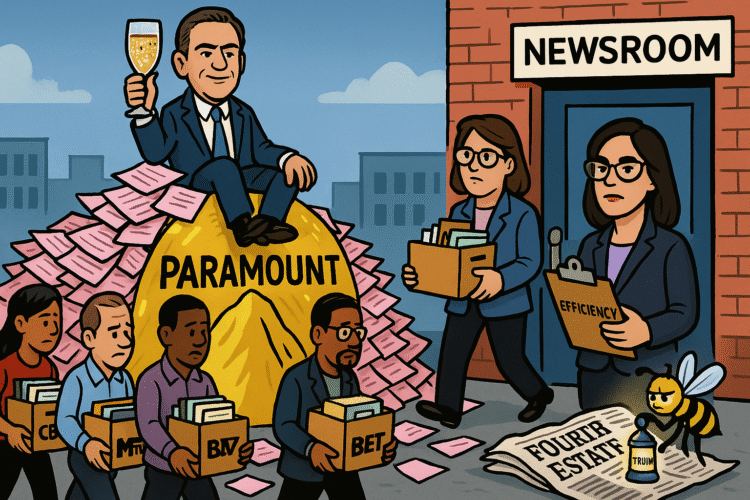
In the golden age of corporate synergy, nothing says “bold new era of storytelling” like firing two thousand storytellers.
This week, Variety confirmed what everyone in media already felt vibrating under their cubicles—the long-rumored Paramount-Skydance merger has completed its most time-honored ritual: the bloodletting. Roughly 10 percent of the combined workforce—around 2,000 people—will soon discover that their employment ended not with a meeting, but with a system notification that reads “Access Denied.”
Of those, about 1,000 pink slips hit today across CBS Entertainment, CBS News, Paramount Plus, MTV, BET, and corporate staff. Another thousand are expected in the coming weeks, as CEO David Ellison and his executive dream team execute a post-merger restructuring plan that promises “billions in synergies” and “a more agile future.” Translation: we’ve decided news and culture are too expensive, but shareholder dopamine is free.
The Gospel According to David Ellison
Ellison, son of Oracle founder Larry Ellison, reportedly told employees in a staff memo that Paramount must “streamline for scale” and “align creative energy with financial discipline.”
The sentence reads like it was assembled from a consultancy Mad Libs generator, but the real translation is simple: we’re replacing journalism with vibes.
In August, when the merger officially closed, executives promised “no immediate layoffs.” The “immediate” part turned out to be the key word. WARN Act filings now show planned reductions across multiple states, each one confirming that “immediate” in corporate-speak means “give it eight weeks.”
And now, CBS News insiders describe today as a “bloodbath.” Entire desks have vanished overnight—foreign bureaus shuttered, cultural beats dissolved, newsroom veterans escorted out before lunch. Johannesburg is gone. So are several domestic field teams.
One staffer summed it up with quiet precision: “You can’t cover the world with one tripod and an intern.”
The New Order: Bari Weiss, Editor in Chief of CBS News
If Ellison’s corporate reorganization sounded predictable, the editorial appointment that followed was pure fever dream. Bari Weiss—the self-branded apostle of free speech and grievance—has been named Editor in Chief of CBS News.
Yes, that Bari Weiss. The former New York Times opinion editor whose resignation letter read like a Substack application essay. The woman who launched The Free Press to liberate journalism from “groupthink,” now helming one of America’s oldest broadcast institutions as it fires hundreds of journalists.
It’s the perfect irony: appointing a “free speech” crusader to preside over the silencing of an entire newsroom.
Insiders say Weiss’s first acts included dissolving the race and culture desk (“too niche”) and merging the climate beat into “general features.” If you’re wondering how long it will take before CBS News runs an hour-long special on “The Tyranny of Pronouns,” the answer is two production cycles.
The Mechanics of Collapse
Let’s map the checkpoints:
- August: Merger closes. Ellison assures employees “no immediate layoffs.”
- September: HR begins “organizational efficiency studies.” Translation: a list of who costs too much.
- October: WARN Act notices filed in California, New York, Illinois, and Georgia.
- November: Pink slips begin at CBS News, Paramount Plus, and MTV.
- Today: Roughly 1,000 employees terminated. Johannesburg bureau shuttered. Several domestic field teams disbanded.
- Next: Another thousand cuts “in the coming weeks,” likely timed before the Q4 earnings call.
The official justification is “cost savings.” The unofficial one is “Wall Street wants it.”
At the next earnings call, analysts will ask about severance costs, buyback appetite, debt service, and projected synergies. No one will ask about journalism.
Because in modern corporate America, human beings are cost centers, and truth is a nonperforming asset.
Legal and Labor Posture: Rights on Paper, Pink Slips in Practice
The WARN Act requires 60 days’ notice before mass layoffs. Paramount’s filings meet the letter of the law, though not its spirit—most employees learned through leaks before official notices went out.
NLRB protections for concerted activity technically apply, but unions across newsrooms are still catching their breath. CBS News workers represented by the Writers Guild of America East are reportedly consulting counsel about whether the company’s “standardized separation agreements” violate CBA provisions around notice and severance.
The agreements themselves come with the usual cocktail of carrots and sticks: take this payout, sign this NDA, waive your right to sue. HR calls it “streamlined.” Workers call it “hush money.”
Meanwhile, state laws require final pay within specific timeframes—California, for instance, mandates payment immediately upon termination. In reality, corporate payroll systems move slower than corporate spin.
Labor lawyers say grievances are inevitable. But the NLRB is underfunded, and corporate counsel is patient. Time favors the balance sheet.
The Civic Cost: Journalism as Collateral
Press freedom groups are already sounding the alarm. When you gut international coverage, close race and culture desks, and fold specialized reporting into generic “lifestyle content,” you don’t just lose jobs—you lose visibility.
The disappearance of the Johannesburg bureau isn’t an accounting line. It’s a statement that Africa is no longer “strategically relevant.”
When CBS fires climate reporters and cultural correspondents, it narrows the world. When it replaces investigative teams with click-friendly features, it replaces scrutiny with spectacle.
The civic tax is invisible but enormous: a public less informed, more polarized, and more dependent on corporate talking points disguised as coverage.
Wall Street’s Standing Ovation
Naturally, the market loves it.
Analysts call the layoffs “an important step toward operational discipline.” The stock popped 3 percent after the news. CNBC’s headline: Paramount Skydance Begins Cost-Saving Integration Plan.
No mention of the 2,000 people whose lives collapsed before lunch.
No mention of the journalism lost, or the civic infrastructure dismantled.
Just “discipline.” As if starving your newsroom is the same as going keto.
The Math of Mergers
Let’s talk numbers.
The merger created a company with roughly 20,000 employees, $28 billion in revenue, $17 billion in debt, and a promised $3 billion in cost savings.
Two thousand layoffs achieve maybe half a billion in annualized savings, depending on severance structures. In other words, the savings are a rounding error in the merger math—but a seismic event in the lives of those cut.
Meanwhile, executives collect retention bonuses for “successfully integrating operations.” Translation: they get paid to survive the layoffs they ordered.
It’s a brilliant formula: privatize the gains, socialize the grief.
The Return of the “Efficiency” Cult
Corporate America has rediscovered the word “efficiency” the way a bored god discovers fire.
Paramount Skydance isn’t alone. Every major entertainment conglomerate is in its own austerity play: Disney is trimming, Warner Bros. Discovery is consolidating, and Comcast just announced its own “optimization” wave.
It’s all the same story: fewer journalists, fewer creatives, more “AI content workflows,” more “brand synergy.”
The cruelest part? It works—financially. For now.
Every cut, every consolidation, every bureau shuttered lifts the stock a little higher. Until the next quarter, when the machine needs another offering.
The market rewards destruction faster than creation.
What This Means for CBS News
Once upon a time, CBS News was “the Tiffany Network”—a phrase that meant trust, gravitas, and Walter Cronkite. Now it’s a case study in how to turn a civic institution into a content farm.
When Bari Weiss takes the helm, don’t expect hard reporting on power. Expect “balanced debate” segments where climate denial gets equal airtime. Expect panels on “cancel culture” instead of investigative pieces on corruption.
And when the next war breaks out or the next disaster unfolds, there will be fewer cameras, fewer local eyes, fewer reporters to bear witness.
Because “efficiency” doesn’t care about truth. It cares about margins.
Reactions: From Anger to Shrug
Inside the newsroom:
One CBS producer described today as “the funeral of a family we didn’t know we were losing.” Another said, “It’s not a newsroom anymore. It’s a brand exercise.”
Unions:
The Writers Guild and SAG-AFTRA issued joint statements calling the cuts “a civic wound disguised as fiscal prudence.” Both groups are reviewing contractual remedies.
Politicians:
A few Democratic lawmakers expressed “concern about media consolidation.” Republican officials called it “market freedom.” Neither side is proposing legislation to stop it.
Press watchdogs:
The Committee to Protect Journalists warned that “American media consolidation is becoming a national security issue.” Without international bureaus, the U.S. relies on secondhand or partisan information.
Wall Street:
Goldman Sachs upgraded Paramount’s outlook to “Buy.”
The Quiet Horror of NDAs
The least discussed part of corporate downsizing is what happens after the pink slip.
Thousands of journalists and staffers will sign NDAs that prohibit them from discussing the terms of their termination. These contracts function as corporate gag orders, preventing the public from hearing the full story of what was lost.
The public narrative will therefore be sanitized: “Paramount Skydance restructured for efficiency.”
The truth—whole departments erased, careers ended, coverage silenced—will remain hidden behind legal boilerplate.
That’s how you dismantle a Fourth Estate without anyone noticing: one nondisclosure at a time.
The Broader Collapse: Media Pluralism as Fossil
The merger of Paramount and Skydance was hailed as a “creative powerhouse.” But in practice, it’s another tombstone in the graveyard of media pluralism.
Every consolidation narrows the range of voices that can reach the public. Every layoff trims the connective tissue between events and understanding.
When one conglomerate owns CBS, Paramount Plus, MTV, BET, and half of the international distribution pipelines, it doesn’t just dominate the market—it defines what counts as “the story.”
And when that conglomerate starts cutting foreign bureaus, investigative teams, and race and culture desks, it doesn’t just save money—it edits reality.
The Human Scale
Imagine the small moments lost in this corporate arithmetic.
A field producer who’s spent fifteen years covering refugee crises learns her position is “redundant.”
A sound engineer with two kids in college gets the 8 a.m. email.
A bureau chief in Johannesburg packs up a decade of footage because “strategic realignment” deemed an entire continent nonessential.
There’s no severance package that covers the loss of purpose.
But somewhere, an analyst updates a slide deck to show “quarterly savings achieved.”
The Future: What Comes Next
- Second Round of Layoffs: Executives will likely accelerate another wave before Q1 to “hit guidance.”
- Regulatory Murmurs: Lawmakers may hold a performative hearing about “media diversity.” Nothing will change.
- Union Pushback: Newsroom unions will file grievances and release statements no one in finance reads.
- Editorial Shift: Expect more opinion, fewer reporters, and the ascension of the “personality journalist.”
- Wall Street Rejoicing: The stock will rise, executives will cash out, and the cycle will continue.
Closing Section: The Price of a Smaller Fourth Estate
Every few years, America rediscovers that journalism is not a luxury product—it’s infrastructure. Like bridges or power grids, when it collapses, everything else does too.
What’s happening at Paramount Skydance isn’t just a business story. It’s a national reckoning.
When you fire two thousand journalists, editors, producers, and technicians, you don’t just lose coverage—you lose memory. You lose context. You lose the connective tissue between reality and accountability.
And when the public shrugs, the vacuum fills itself—with propaganda, disinformation, and algorithmic noise.
But Wall Street will celebrate. It always does. It loves silence. Silence doesn’t cost benefits.
So the next time someone tells you journalism is dying because of “technology” or “changing consumer habits,” remember the simpler truth: journalism is dying because it’s being murdered for sport and dividends.
The body count is public. The motive is profit. The coroner’s report will be titled Earnings Guidance.
And somewhere, in a corner office overlooking Manhattan, a CEO will call it “beautiful efficiency.”