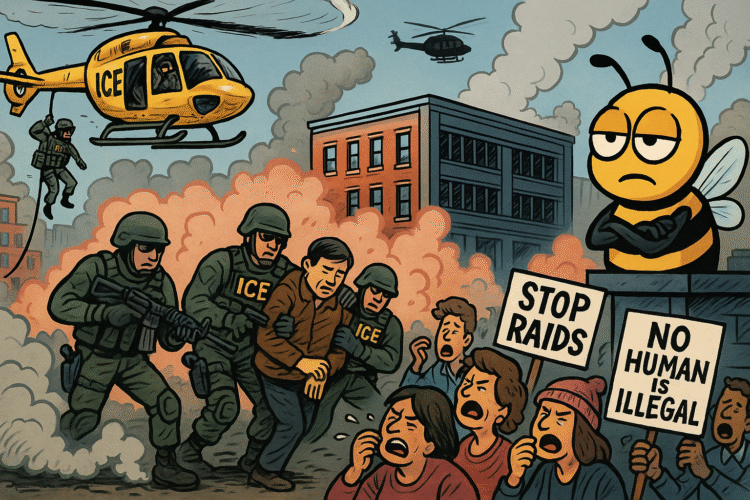
The federal government has never met a metaphor it did not try to literalize. If “war on drugs” produced tanks in Los Angeles neighborhoods, and “war on terror” created airports that feel like holding cells, then it should surprise no one that “immigration enforcement” has been rebranded as a campaign named after a Pacific naval battle. Chicago, once sold as the city of broad shoulders, is now being cast in a reenactment of World War II, complete with river patrols, helicopters, convoys, and chemical clouds rolling across school zones.
The official name is Operation Midway Blitz, a phrase that makes suburban accountants sound like admirals. DHS insists this is targeted enforcement. Illinois officials insist their citizens are collateral damage. In between sits the Magnificent Mile, where shoppers who once worried about parking now navigate between armored personnel carriers. This is the new civic theater: a war zone without a war, enemies who are mostly invisible, and an audience of residents who never bought tickets.
Act I: The River Becomes a Trench
The opening scene involved riverboats. Not the cocktail kind, not the tour boats with guides pointing out art deco cornices, but Border Patrol units outfitted with long guns and tactical vests. Their mission, they said, was visibility. The effect was intimidation. Tourists looked down from the bridges to see rifles glinting in the sun. Chicago, a city that lives and dies by its river, suddenly watched it militarized. It was not a show of force against an enemy—it was a show of force for itself, a flex staged in the very center of the city.
Residents asked, who exactly crosses into Chicago on a kayak? DHS offered no answer. They called it “patrol presence.” The rest of us called it theater.
Act II: Detentions in the Open
From the water, the action moved to the streets. Near the glittering facade of Trump Tower and into River North, federal officers staged visible detentions. Not the kind that disappear into the paperwork of ICE’s back offices, but public arrests, bodies pressed against SUVs, IDs scrutinized under halogen lights. The point was not only who they stopped—it was that they stopped them there, on the sidewalks of Chicago’s most photographed blocks.
The language was “force protection.” The translation was message-sending. If you can be stopped under the shadow of the tower bearing the former president’s name, you can be stopped anywhere. And if you happened to look the wrong way, if your skin tone or accent or hair was a clue, the stop became your problem. A commander explained it bluntly: agents consider “how they look.” Civil rights lawyers did not need a footnote to recognize the equal protection problem already baked in.
Act III: The Broadview Escalation
The protests came next, as protests always do in Chicago. Outside the ICE facility in Broadview, demonstrators clashed with federal officers. Dozens were arrested. DHS called it obstruction. Protesters called it accountability. The optics were unmistakable: citizens demanding answers about tactics met with riot shields. The timeline of arrests blurred—who was protesting, who was swept up incidentally, who will spend weeks untangling misdemeanor charges from a cause they joined for one afternoon.
The agency’s line was that demonstrations had crossed into disorder. The counterline was that disorder was manufactured by officers who came prepared with pepper balls. Truth, in these standoffs, is always the first casualty.
Act IV: Brighton Park Boils Over
The pivotal clash came in Brighton Park. DHS insists the convoy was boxed in and rammed by about ten vehicles. Residents recall chaos: a street choked with agents, a woman shot and wounded, hours of confrontations that spilled into homes and shops. Forensics teams now argue over angles and trajectories while neighborhoods mourn. What is confirmed: a U.S. citizen was shot. What is not confirmed: whether the official story of vehicles ramming holds up.
This was no longer the city center, no longer symbolic stops by tourist landmarks. This was residential, where schools and families coexist with corner shops. And when chemical munitions followed, drifting toward a school zone, the symbolism darkened: the war on immigration had been imported into the daily commute of children.
Act V: Helicopters in the Skyline
Helicopter insertions, rappelling agents at dawn onto an apartment complex roof, smoke plumes visible from blocks away. DHS called it precision, like a SEAL raid staged in a metropolis. The mayor called it escalation. The governor called it a war zone. Residents called it terrorizing.
What remains unverified: how many agents actually rappelled, which warrants authorized which doors, whether those doors belonged to the people DHS claimed to target. What is verified: the skyline was punctuated with rotor blades, the apartment block became a stage for a spectacle, and the message delivered was that Chicago’s airspace is just another operational front.
What We Know
- Dozens of arrests in recent raids.
- Protester arrests at Broadview confirmed.
- The Brighton Park shooting under investigation.
- DHS continues to frame all of this under “force protection” and gang targeting.
What We Do Not Know
- Exact counts of agents dropped from helicopters.
- Which warrants actually existed for which buildings.
- Whether arrestees match the list of “targets” DHS claims.
The gap between those two lists is where fear thrives. Every resident who does not know if their neighbor was arrested lawfully becomes another witness to arbitrary power.
The Legal Stakes
The Guard Question
With the White House floating National Guard federalization, constitutional lawyers return to old texts: the Posse Comitatus Act, the Insurrection Act. The question is whether domestic deployment in a city like Chicago is law or improvisation. Governors insist sovereignty still means something. The administration insists necessity trumps hesitation.
Equal Protection and Warrant Limits
When a commander says appearance is part of the calculus, the Constitution grimaces. Stops based on “how they look” invite equal-protection challenges. Home entries without clarity on warrants invite consent-decree violations. Civil rights groups prepare their filings. DHS insists discretion. The courts will decide which narrative the law prefers.
Chemical Agents in a City
Pepper spray and gas near schools and hospitals introduce their own liabilities. No handbook endorses dispersing agents into pediatric airways. No civic code recommends clouding streets near ICUs. Yet DHS cites “crowd management.” Lawyers cite negligence. Residents cite trauma.
The Civic and Economic Stakes
Chicago thrives on two economies: retail and tourism. Both depend on people feeling welcome. Shoppers now dodge convoys. Tourists now photograph helicopters. Museums, offices, and residents share blocks with checkpoints. Q4 is supposed to be Chicago’s season of lights. Instead, armored vehicles block the view.
Retailers measure lost sales. Hotels count cancellations. The Magnificent Mile looks less like a shopping district and more like a set piece in a security drill. And in a city already weary from inflation, the timing could not be worse.
Accountability Checklist
City and state leaders, caught between outrage and impotence, now demand answers. Their list is long, but not unreasonable:
- Arrest tallies disaggregated by status and charge.
- Criteria for stops, with rules of engagement disclosed.
- Release timelines for bodycam, dashcam, and drone footage.
- Logs of warrants served and buildings entered.
- Reports of hospitalizations and use of force.
- A public explanation for why helicopters, riverboats with rifles, and chemical agents are deemed necessary police tools in a city better known for its museums than for its cartels.
This is not radical transparency—it is the bare minimum of accountability when federal authority decides to cosplay as an occupying force.
Final Curtain: Chicago as Exhibit A
Operation Midway Blitz is not only a campaign of arrests. It is a campaign of optics. Agents on boats, helicopters above apartments, gas in neighborhoods, convoys boxed in and shooting their way out. None of these tactics align with a city where the alleged offenses were administrative, where the targets were supposed to be paperwork violations, overstays, missed hearings. Instead, the optics declare that the city itself is the suspect.
The official line remains that this is “targeted.” The visible evidence suggests otherwise. When tactics spill into schools, when residents are stopped for “how they look,” when downtown shopping streets host convoys, the target is less a person and more a population.
Chicago has been cast into a war it never declared. The set pieces are real: boats, helicopters, gas. The script is improvisation. The casualties, whether measured in hospitalizations, canceled shopping trips, or lost trust, are real. The only remaining question is whether accountability can catch up before the curtain falls again.
Chicago’s Smoke and Mirrors
The smoke is not just chemical—it is political. The mirrors are not just skyscraper glass—they are the justifications held up to defend the indefensible. The city has become a theater for a federal drama, one that calls itself law but plays out like performance art. The audience is tired, frightened, unimpressed. And somewhere above, the helicopters still circle, insisting the show must go on.