When a crackdown starts to look less like law enforcement and more like a government sponsored haunted house
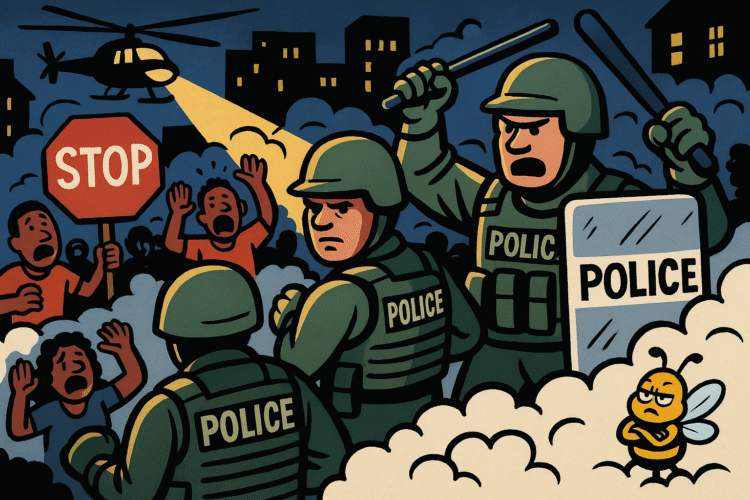
Public safety is supposed to be boring. That is the entire point. Well functioning systems do not need dramatic lighting, surprise helicopter entrances, or senior officials narrating their own heroism. Which is why Operation Midway Blitz, a federal enforcement production playing out across Chicago, feels less like a coordinated response and more like a political action movie filmed on location without telling the residents.
Verified reporting says the lead character in this blockbuster, Border Patrol commander Gregory Bovino, opened the week with a dramatic allegation. According to Bovino, his agents were shot at during raids. If you listened to DHS, you could practically hear the shell casings hit the ground. The claim was amplified immediately because nothing fuels a federal crackdown quite like a threat narrative delivered with shaky urgency.
Chicago police, however, said there was no evidence of gunfire. Zero. No shots detected. No casings found. No forensic trail. The silence was louder than any round that was allegedly fired. It was as if two agencies had attended two entirely different raids on two entirely different planets.
This was not the first time questions had been raised about the accuracy of Bovino’s threat descriptions. A federal judge has already noted in a related case that Bovino admitted lying about being hit by a rock before deploying tear gas on protesters. Courts do not typically write sentences like that unless something in the record is deeply concerning. In response to that earlier conduct, the judge placed restrictions on federal force against demonstrators and the press, a rare constraint that only appears when judicial eyebrows ascend into the stratosphere.
And yet here we are again, watching another discrepancy, another escalated claim contradicted by the local jurisdiction, another moment where the government crafts a storyline better suited for a recruitment poster than a courtroom.
A Chronology Fit for a Case File, Not a Press Release
Let’s reconstruct the timeline, not the version designed for television drones circling overhead, but the version built from receipts.
Step One: The Shooting Claim
Bovino announces that his agents were fired upon. DHS repeats the claim with the confidence of someone reading a weather report off a teleprompter.
Step Two: Chicago Police Fact Check
CPD quietly states there is no evidence of shots fired. None. The divergence between the federal imagination and local physical reality becomes the headline.
Step Three: The Legal Backdrop
Already in place is a set of court orders from earlier tear gas incidents. A federal judge restricted certain federal force tactics after finding that some declarations did not align with the evidence. TROs under Rule 65 began governing what federal agents could and could not do.
Step Four: The Operation Expands
Helicopters sweep across residential neighborhoods. Chemical agents are deployed in enforcement settings. Thousands of arrests accumulate, many involving individuals accused of no violent offense at all. Citizens are swept up. Residents film helicopters hovering low enough to rattle their blinds.
Step Five: The White House Applauds
The administration invokes the word “order,” because nothing sells discipline like a storm of tactical gear, whirling rotors, and press statements written before the facts are confirmed.
The Legal Spine Holding This Mess Upright
Rule 65 gives courts power to intervene when constitutional rights are at risk, which is why TROs are already restricting federal force in related contexts.
The Spending Clause limits the federal government’s ability to coerce or condition cooperation on political demands. It is not a blank authority to run local jurisdictions like annexed territory.
Federal agents policing a city still operate under statutory authority, constitutional boundaries, and judicial review. There is no “Chicago exception” to the Fourth Amendment. There is no “Midway Blitz Amendment” hidden in the Constitution that lets agencies suspend body camera obligations when the lighting gets dramatic.
This legal spine is important, because without it, everything collapses into a haze of helicopter spotlight dust and ambiguous statements about safety.
The Numbers Nobody Wants to Say Out Loud
Thousands arrested.
Helicopter deployments across multiple neighborhoods.
Chemical agents used during apprehensions.
Body camera requirements unclear.
Radio logs not yet released.
Federal declarations contradicted by local police.
When operation tallies start looking like population samples, something systemic is wrong. The role of enforcement is not to see how many bodies can be processed through holding facilities before the public catches on.
Chicago as Occupied Zone Theater
When residents describe the operation as feeling like a militarized zone, it is not hyperbole. Helicopters hovering at low altitude have a distinct, unmistakable psychological effect. Chemical agents drifting through city blocks have a distinct, unmistakable physiological one. Tactical raids sweeping up citizens never accused of crimes have a distinct, unmistakable civic one.
It is intimidation. And intimidation dressed up as public safety does not become something else simply because the costumes are green and the patches say “federal.”
The Federal Imagination versus Municipal Reality
CPD saying “there was no evidence of gunfire” is not a small footnote. It is a foundational contradiction. When the lead federal voice on a high profile operation asserts a violent assault and the jurisdiction responsible for crime scene analysis says it did not happen, trust does not erode. It collapses.
Especially when this is not the first discrepancy. Especially when a federal judge has already placed limits on the same official’s conduct due to misleading claims about force. Especially when the operation is sweeping across a major U.S. city with tactics normally reserved for counterinsurgency, not community policing.
This type of narrative inflation is not just sloppy. It is dangerous. It creates a permission structure for escalating force, for bypassing accountability, for deploying tactics disproportionate to facts, and for masking political motives behind the language of safety.
What Courts Can Still Do
Courts can require daily compliance reports. They can order preservation of all body camera footage. They can demand production of radio traffic archives, phone records, and CVR style internal communications that reveal who crafted the false claims, who approved them, and who ignored contradictory evidence.
Courts can broaden or narrow TROs. They can require joint task forces to comply with municipal policies. They can restrict chemical agent use. They can mandate external monitors. They can stop cities from being used as testing grounds for force that would never be deployed in wealthier, whiter ZIP codes.
Rule 65 is not decorative. It exists because someone, at some point, anticipated exactly this scenario.
Checkpoints Ahead: The Things No One Can Pretend Not to See
The next 48 to 96 hours will clarify whether this operation is a constitutional embarrassment or a political stunt with a sunset clause. Watch for:
Daily Compliance Reports
If the agencies comply, transparency increases. If they drag their feet, something is wrong.
CVR Style Phone Records
These reveal who said what, when, and whether the shooting narrative came from operational chaos or deliberate spin.
Radio Logs and Body Camera Footage
A federal claim unsupported by evidence is not a “difference in interpretation.” It is a discrepancy that demands video.
Discovery Orders
If courts compel discovery, we will learn who crafted the federal storyline and whether it was supported by internal reports.
Appeals Court Signals
If appellate judges tighten the restrictions, it means they see the risk clearly. If they loosen them, it means they believe the operation is still playing by the rules.
Media Coverage
And here we reach the hardest part. Will outlets print the truth plainly? Will they write, without euphemism, that intimidation dressed as public safety is still intimidation? Or will they retreat into both sides language that treats a debunked shooting claim as simply one data point among many?
Closing Section: The Sound of Helicopters Is Not Evidence
Federal agents moving through a city with helicopters, chemical agents, and mass arrests is not a sign of order. It is a sign of power. And power has a long history of narrating its actions as protection even when the facts tell another story.
A shooting that didn’t happen.
A rock that became a justification for tear gas.
A city treated like a film set.
A White House cheering from the balcony.
Intimidation remains intimidation, no matter the branding, no matter the lighting, no matter the roar of rotor blades overhead.
And Chicago, a city that has already lived through every form of political theater the federal government can invent, deserves better than a crackdown written like a script and contradicted by its own supporting actors.