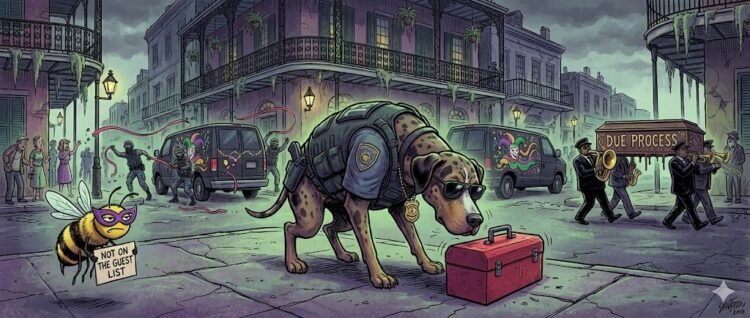
When the “Big Easy” becomes the “Big Empty,” you know the circus has come to town, but this time the parade floats are unmarked vans and the beads are handcuffs.
The sun rose over New Orleans this morning to a parade nobody ordered. Usually, when vehicles crawl through these streets at a walking pace, there is brass music involved. There are go-cups. There is a general understanding that traffic is stopped for the sake of joy. But the convoy rolling down Elysian Fields Avenue wasn’t throwing doubloons. It was throwing a dragnet.
The city woke up to a scene that felt less like law enforcement and more like a dystopian Mardi Gras. Unmarked federal vans, looking like the darker, angrier cousins of the Amazon delivery fleet, idled in the parking lots of Home Depot and Lowe’s. Their occupants weren’t looking for plywood or drywall. They were looking for the people who buy plywood and drywall.
This is the dawn of “Operation Catahoula Crunch,” the Trump administration’s latest branding exercise in performative cruelty. The name itself is a masterpiece of bureaucratic tone-deafness. Named after the Louisiana state dog—a breed famous for hunting wild boars in the swamp—the operation explicitly frames human beings as game to be flushed out, cornered, and bagged.
The atmosphere in the city, famous for its crooked-smile resilience and refusal to take anything too seriously, has curdled into a silent panic. The jazz is still playing in the tourist traps, but in the neighborhoods where the actual work of the city gets done, the streets are empty. Skateboarders who usually weave through traffic with a death wish are clutching their IDs like religious talismans. Day laborers, the backbone of every renovation project from the Bywater to Metairie, have vanished. The “Big Easy” has been put on lockdown, not by a hurricane, but by a press release.
The “Bad Hombre” Myth Meets the Home Depot Reality
The official justification for this raid is a masterclass in bait-and-switch marketing. The Department of Homeland Security, breathless with the excitement of a retailer announcing a Black Friday doorbuster, claims they are targeting “violent criminals.” The press releases drip with terrifying keywords: home invasion, armed robbery, grand theft auto, rape. They are selling the public on a vision of federal agents rappelling down elevator shafts to capture super-villains.
The reality, however, is a guy in a neon vest getting tackled in a hardware store parking lot because he looked nervous.
The disconnect between the sales pitch and the product is staggering. Similar “surges” in Chicago and Charlotte—branded with equally ridiculous names like “Midway Blitz” and “Charlotte’s Web”—promised to sweep up the “worst of the worst.” Instead, they functioned like a drift net, catching anyone unfortunate enough to be standing near a person of interest.
The term “criminal alien” has become the ultimate elastic waistband of legal definitions. It stretches to fit whatever body the administration needs to fill a quota. When you promise 5,000 arrests before Christmas, you can’t be picky about whether the “criminal” in question is a cartel enforcer or a drywaller with a broken taillight from 2018. The “Catahoula Crunch” isn’t a precision strike. It is a bulk-buy program for deportation statistics.
Fear as a Holiday Decoration
The tactical goal of this operation seems less about public safety and more about public terror. A safe city is a loud city. It is a city of commerce, argument, and noise. But right now, New Orleans is quiet in the wrong places.
Local businesses are shuttering. Restaurants like Los Hondureños in Kenner have posted handwritten signs saying they are closed until further notice. Food trucks that usually feed the lunch rush are parked and cold. The economic engine of the city is seizing up because the workforce is terrified to leave their homes.
This is the “order” part of “law and order.” It is the order of the curfew. It is the order of the bunker. Mothers are telling their children to stay inside, not because of gang violence, but because of the people sent to “stop” the gang violence.
The spectacle is the point. The administration deployed 250 Border Patrol agents to a city that is nowhere near the border. They requested armored vehicles. They announced the National Guard would be arriving before Christmas. It is a military occupation in search of a war. The sheer scale of the force suggests they are preparing to retake Fallujah, not arrest a few guys with outstanding warrants.
Sanctuary Theater in the Swamp
New Orleans has long occupied a complicated space in the immigration debate. The Department of Justice lists it as a “sanctuary city,” a label the city wears like a badge of honor and the Feds treat like a target. The local police chief has made it clear that NOLA officers won’t enforce federal immigration laws.
But that refusal is exactly why the Feds are here. This isn’t about cooperation. It is about punishment. It is a federal flex, a way to show a defiant city that local laws are cute suggestions that can be steamrolled by a convoy of SUVs.
The raid is a unilateral power play. It bypasses the messy, democratic work of legislation and court orders. It replaces the gavel with the battering ram. The agents swarming the French Quarter aren’t just looking for undocumented immigrants. They are looking for a fight. They are looking to create images of federal dominance that can be looped on cable news to thrill a base that views cities like New Orleans as foreign territory anyway.
The Eras Tour of Enforcement
Pull the lens back, and you see the pattern. New Orleans is just the latest stop on a nationwide tour. The administration is running these raids like a traveling circus. First Los Angeles, then Chicago, then the Carolinas, and now the Gulf Coast.
The strategy is identical in every city. Blitz-style raids. Agents in heavy gear who look like they’re ready for chemical warfare. Unannounced sweeps. It is a franchise model of enforcement.
The question we have to ask is simple. If the goal is public safety, why the theater? Why the “Catahoula Crunch” branding? Why the press releases that sound like movie trailers?
The answer is that this has nothing to do with public safety. Crime in New Orleans, like in many major cities, has been trending down. The “carnage” the President likes to talk about is largely a ghost story he tells to frighten suburban voters.
This is about intimidation. It is about reminding immigrant communities that they are never safe, that there is no statute of limitations on their fear. It is about reminding cities that the federal government can turn their streets into a checkpoint whenever it feels like it.
The Irony of the Rebuild
There is a specific, bitter irony to watching this happen in New Orleans. Twenty years ago, after the levees broke and the water washed the city away, it was immigrant labor that rebuilt it.
When the roofs were gone and the mold was black on the walls, thousands of workers from Honduras, Mexico, and Guatemala arrived. They did the dirty, dangerous work that nobody else wanted to do. They slept in tents. They were stiffed by contractors. They rebuilt the very homes that are now shutting their blinds to hide them.
To hunt these people down in the parking lots of hardware stores—the cathedrals of reconstruction—is a grotesque betrayal. It is a statement that their labor was welcome, but their lives are not. We used their hands to fix our city, and now we are using handcuffs to thank them.
The Empty Stocking
As the “Catahoula Crunch” grinds on toward Christmas, the city is left to reckon with the wreckage. The arrests will be tallied. The administration will claim victory. They will hold up a few mugshots of actual criminals and pretend that justifies the terror inflicted on thousands of families.
But what is left behind is a shredded social fabric. Trust between neighbors is replaced by suspicion. A public policy once anchored in law now operates like a mobile dragnet.
The United States is in the business of selling security. But what they are selling in New Orleans isn’t security. It is a cheap, knock-off version of safety that comes at the cost of our soul.
We are watching the eviction notice for the American dream. We are watching the idea of “refuge” be dismantled and sold for scrap. And we are watching it happen in a city that knows better than anyone what it feels like to be abandoned by your government.
When the vans finally leave, and the agents go home to their own families for the holidays, New Orleans will still be here. But it will be a little quieter, a little colder, and a lot less free.
Receipt Time
The bill for this performance art will not be paid by the politicians in Washington. It will be paid by the local economy that loses its workers. It will be paid by the children who come home to an empty house. It will be paid by the citizens who realize that when the government sends a hunting party to their city, nobody is truly safe from the crunch.