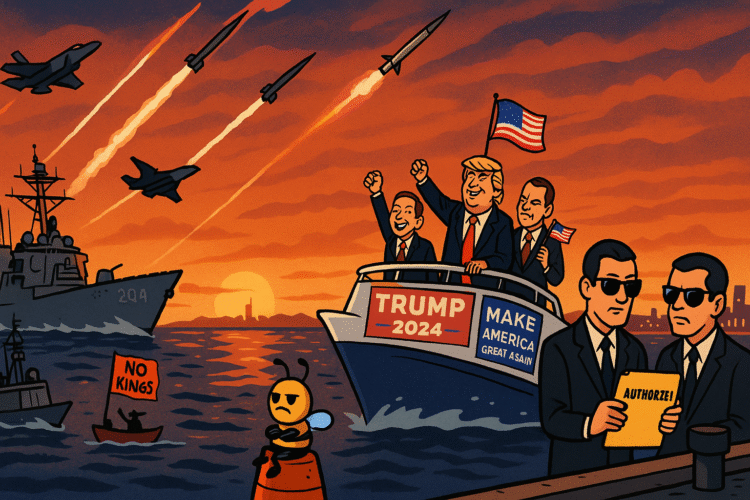
The Caribbean has always had a cinematic allure: turquoise water, tropical breezes, and now, apparently, a naval blockade that could double as the trailer for a Michael Bay reboot of Bay of Pigs. Since early September, President Donald Trump has pushed the United States to the brink of open war with Venezuela, cloaking the move in the familiar theater of “fighting the cartels.” It’s the kind of geopolitical improv that begins with “Just say it’s about drugs” and ends with guided-missile destroyers parked off the coast of South America.
The headlines sound like something dreamed up during a late-night Truth Social binge: five lethal maritime strikes, 27 people killed, 10,000 troops mobilized, CIA operations authorized inside Venezuela, and the president publicly musing about hitting drug labs or “regime-linked nodes.” The Monroe Doctrine has risen from its grave, wearing a MAGA hat and demanding another season.
The whole affair began with Trump’s declaration that Venezuela’s government is “the largest narco-terrorist organization in the world.” It was the sort of sweeping, cinematic claim that sounds authoritative until you remember it’s coming from a man whose foreign policy briefings once included laminated photos and Sharpie arrows. Within days, the Pentagon had scrambled F-35s, repositioned destroyers, and floated a “SOF mothership” into the Caribbean—a phrase that sounds like an Xbox achievement but actually means “special operations floating base,” because nothing says democracy like amphibious covert raids.
Vox’s deep dive confirmed what the visuals already suggested: this wasn’t deterrence, it was theater. The White House even supplied its own trailer. B-roll of boat explosions. Body-cam footage of raids. Trump narrating about “stopping the poison.” The production value was high enough to make Michael Bay nervous.
The script, however, was still being written mid-scene. Congress hadn’t authorized anything, the War Powers Resolution clock was ticking, and the legal justification hinged on a novel interpretation of “self-defense”: that cocaine-related American deaths constitute an armed attack. If logic were ordnance, that argument would’ve detonated on the launchpad.
To understand the scale of this improvisation, consider the numbers. Ten thousand troops. Multiple guided-missile destroyers. F-35 sorties over international waters. MQ-9 drones loitering along Venezuelan airspace. It’s more firepower than some Cold War crises, deployed under a statute meant for counter-narcotics patrols.
The week’s timeline reads like a fever dream of imperial déjà vu. Surviving detainees from a blown-up boat were suddenly reclassified as prisoners of war. Admiral Alvin Holsey, head of SOUTHCOM, abruptly stepped down months early—a career officer’s version of slamming the emergency exit. Meanwhile, the White House floated claims that Nicolás Maduro had “emptied his prisons into the U.S.” and that his government controls the “Cartel de los Soles,” a phrase that sounds like a Netflix show but is now apparently a casus belli.
Even for Washington, where metaphors and missiles often collide, this was ambitious. The legal ground is as thin as a coral shelf. No congressional authorization. A drug-war justification that equates trafficking with terrorism. An executive order that expands targeting authority to “designated groups,” a term vague enough to include anyone caught carrying fertilizer. It’s not so much a doctrine as a vibes-based approach to warfare: if it feels righteous and polls well, launch it.
Experts tried, in vain, to inject reality. Venezuela, they said, is not a monolithic cartel state but a fragmented criminal ecosystem—a feudal archipelago of power brokers and militias. But nuance is kryptonite to cable news, and the narrative was already locked: America versus the narco-state. Cue the dramatic soundtrack.
Meanwhile, the domestic choreography was pure MAGA pageantry. Trump’s rallies played clips of the boat strikes on giant LED screens. Pete Hegseth, now Defense Secretary, described them as “beautiful examples of American precision.” Fox hosts beamed with the reverent awe usually reserved for halftime shows. The Pentagon, mortified, accidentally added a reporter to a Signal chat discussing Yemen operations, proving once again that the only real enemy of this administration is competence.
The conflict, if we can still call it that, exists somewhere between policy and performance art. On paper, it’s about disrupting drug routes and protecting Americans. In practice, it’s about creating a spectacle big enough to drown out the word “indictment.” The administration has learned that foreign aggression photographs better than domestic accountability.
Every administration loves a distraction. Clinton had Kosovo, Bush had Iraq, Obama had drones. Trump’s innovation is collapsing all three into a TikTok reel. The “No Kings” protests that erupted this week—tens of thousands marching from Miami to D.C.—barely made a dent in the algorithm. The footage of explosions at sea did.
If you squint, it’s almost elegant: a geopolitical stunt engineered for social media virality. Maritime strikes as content. Covert operations as engagement strategy. The Pentagon as influencer.
The implications, however, are lethal. Caracas has already rattled sabers about retaliating against “imperialist aggression.” Regional blocs like CARICOM and the OAS are drafting condemnations. The UN Security Council is reportedly preparing an emergency session. European allies—still recovering from the last Trump administration—are hedging bets and issuing statements that read like polite panic.
At home, congressional Democrats are sharpening their War Powers lawsuits, while conservative hawks cheer from the sidelines, pretending this is Reagan in Grenada and not reality TV with body counts. The War Powers Resolution, once a theoretical guardrail, is now just a suggestion scrawled on parchment.
Legally, we are in uncharted waters, both figuratively and literally. Declaring “armed conflict” with a non-state cartel inside another country’s territory blurs lines that once defined international law. The executive branch now asserts that a president can wage maritime war against a narcotics network without Congress, treaties, or measurable objectives. The precedent, once set, will not stay in the Caribbean. It will wash ashore.
There’s an old Washington saying: when you can’t govern, perform. Trump’s Venezuela gambit is a masterclass in this. It’s the cinematic extension of a presidency that never met a stage it didn’t want to occupy. The naval buildup isn’t strategy; it’s set dressing. The boat strikes aren’t deterrence; they’re choreography.
The base loves it. It feels decisive, muscular, biblical. There’s no need to understand the difference between counter-narcotics law and armed conflict when the explosions look this good on TV.
But behind the spectacle lurk the same institutional stress fractures that have haunted every American overreach. Courts are unprepared. Congress is irrelevant. Intelligence agencies are improvising. And the Pentagon is pretending to have a plan while quietly praying no one gets shot down.
The tragedy is that this isn’t even new. We’ve been here before—Panama in 1989, Grenada in 1983, any number of “limited operations” that ballooned into generational hangovers. Each time, the rhetoric was the same: freedom, security, deterrence. Each time, the reality was chaos, blowback, and the slow erosion of restraint.
The question now is whether the United States can distinguish between a policy and a performance. Between deterrence and dopamine. Between the solemn act of war and the cinematic thrill of watching it unfold in 4K.
Because the more the administration blurs those lines, the easier it becomes for every future president to treat the world like a sandbox—and every international law like optional reading.
For now, the ships keep circling. The drones keep humming. The president keeps posting. And somewhere, deep within the bureaucracy, exhausted lawyers are trying to draft a memo that explains how “fentanyl deaths” qualify as an armed attack under Article 51 of the UN Charter. Good luck to them.
Closing Section: The Republic Will Be Televised
Every empire eventually learns how to wage war without declaring it. The United States just learned how to livestream it.
What makes this moment different isn’t the firepower, but the ease. There’s no mobilization, no shared sacrifice, no congressional debate. Just a digital announcement, a few precision strikes, and a highlight reel for the campaign trail. War, once the gravest of decisions, now fits between commercial breaks.
The Marines of the Caribbean will come home. The reporters who accidentally glimpse the Signal threads will move on. The lawyers will file motions that go nowhere. And the rest of us will scroll past the smoke, absorbing it as background noise in a feed already crowded with disasters.
When people once asked how democracies slide into endless war, historians pointed to fear, greed, and ideology. The answer now may be simpler: inertia and Wi-Fi.
There’s a quiet horror in realizing that the machinery of state violence can be activated not by strategy but by spectacle—that the same government that prosecutes leakers for revealing truth will leak explosions for engagement metrics.
Someday, when the war footage is spliced into a campaign ad, when the slogans have faded and the soldiers have returned, Americans might look back and wonder when “defending freedom” became indistinguishable from chasing views.
But for now, the sea glows under a new kind of sunset—orange, artificial, algorithmic—and the republic, such as it is, keeps performing.