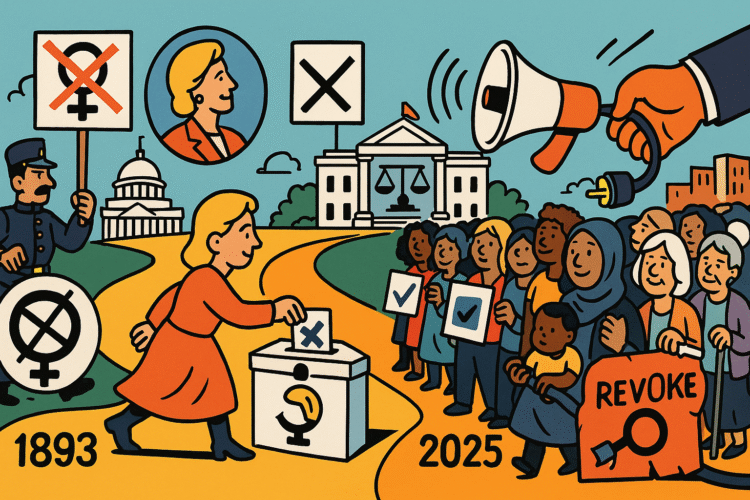
There is a habit in American storytelling that treats progress like a moving walkway in an airport. Step on, move forward, arrive at the gate of equality with time for a coffee. The trouble is that our walkway is seasonal. It runs when people push the button and it stalls when cowards pull the plug. On this day in history, a First Lady won a Senate seat in New York, Colorado affirmed that women were citizens in full, and Paris reminded everyone that patriarchy has a dress code. Here we are, living in a country that has learned how to roll back rights while keeping the music cheerful in the terminal. The announcements still say thank you for your patience. The baggage handlers are throwing lives.
The contrast is not subtle. A woman who turned ceremonial duty into policy muscle went before voters and was told yes. A western state, stubborn and high, said the franchise is not a courtesy, it is a right. A European capital once policed trousers like they were a threat to the state. We learned some lessons and forgot others. Today, the old scolds have upgraded their uniforms. They do not slap wrists for wearing pants. They draft statutes that treat a uterus like a lease. They do not stand in doorways with rulers. They sit on benches and rule that bodily autonomy is a suggestion.
When history is taught as a parade of firsts, it flatters the parade. Look at all the milestones, the narrators say, as if the stones are not still in people’s shoes. The point of naming the day a woman took a Senate seat from a state she adopted is not to romanticize inevitability. It is to remind us how hard it is to build a coalition that can count. The point of praising a state that extended the vote before its neighbors is not to congratulate it forever. It is to notice how aggressively power fights back. The point of laughing at a city that banned pants for women is not to gawk at the past. It is to recognize how quickly a bad idea can become law when it flatters fragile men.
There is a temptation to treat the current moment as an aberration. It is more honest to call it a project. The project is to shrink citizenship, to turn healthcare into a warning, to make the vote a chore, and to keep half the population negotiating for their own bodies like they are asking for a favor. The project is carried out by politicians who mix chivalry with punishment, by media figures who mistake cruelty for wit, and by donors who believe that freedom is something you can inherit but never share. It is not new. It is disciplined.
The shabbiest part is how boring the playbook has become. First, pass something that hurts and call it principle. Second, insist the Supreme Court wanted it that way. Third, tell women to calm down because the states will sort it out. Fourth, discover that the states have turned medicine into a maze and then call the maze a conversation. Meanwhile, in exam rooms and kitchens and courthouses, people make quiet, shattering decisions without the protection of a government that should have been theirs by birthright. It would be easier to call this a misunderstanding. It is not. It is a theft disguised as federalism.
The country just gave the project an answer. Women showed up, again, and the numbers were not polite. They were loud enough to translate rage into arithmetic. Some arrived with toddlers and snacks. Some arrived with walkers. Some wore the T shirt from the last march like a uniform. Many arrived quiet, because you do not need to shout to vote. The point is that the coalition did not wait for a permission slip. It built one out of clipboards and childcare swaps and group chats that read like dispatches from a volunteer army. The pundit class called it enthusiasm as if enthusiasm can fix a law. The truth is less cute. It was self defense at the ballot box.
The reaction from the MAGA creche was a confession. When you respond to turnout by fantasizing out loud about revoking women’s suffrage, you are not making a clever point about checks and balances. You are admitting that equality is a problem for your math. The proposed fix is to break the calculator. It would be shocking if it were not so honest. The movement prefers a democracy that smiles and sits still. It prefers a press that writes profiles of extremists like they are spice in a stew. It prefers a judiciary that treats precedent like a seasonal flavor. When the electorate refuses to play along, the talk turns to surgical changes in who counts as a person.
There is a specific irony in the story of American womanhood and national leadership. Twice, this country had the opportunity to hire a woman who had studied the job like it was a language and practiced it until the sentences sang. Twice, the audition was graded on vibes by a panel that prefers spectacle to homework. The result is a reality show with nuclear codes and a cabinet of people who think government is a hazing ritual for the weak. This outcome was not inevitable. It was purchased by an alliance of grievance and profit. The check cleared. The consequences are on the table.
It takes work to pretend that a man who treats women like props is qualified to legislate their bodies. It takes more work to turn away when women name the harm. The culture has always had methods. Roll your eyes at the accuser. Highlight the complications of memory. Call the timing suspicious. File the allegations under politics as usual. At scale, this becomes a fog machine. In the fog, a president who has collected allegations like trophies is treated as a moral tutor. In the fog, a Congress that owes its majority to districts drawn like knives lectures the country about normalcy. In the fog, the people who refuse to forget are told they are too emotional to participate.
The antidote to fog is not the screaming match the right wing wants. It is specificity. You say a right was removed, and then you name the clinic that closed and the county that has no options. You say the vote is under attack, and then you name the hours cut, the lines lengthened, and the registration purges that make a person feel like a guest in their own town. You say misogyny is on the rise, and then you tally the harassment that women in public life endure each time they open a browser. Voters do not need a poetry reading. They need receipts that fit on a refrigerator door.
History helps when it behaves. It misbehaves when it tries to turn every anniversary into a soft focus nostalgia reel. The point of remembering a pioneer in the Senate is not to glow. It is to ask why her expertise, discipline, and vision for the country were not enough to overcome the machine that prefers men with bluster to women with plans. The point of celebrating a state that enfranchised women early is not to pat it on the head. It is to ask why so many places still treat the franchise like a privilege you can misplace on purpose. The point of mocking a city that policed pants is not to feel superior. It is to watch how quickly a dress code can evolve into a doctrine.
Right now, the doctrine is control wrapped in etiquette. The people pushing it prefer soft words for hard laws. They talk about protecting life while treating living women like afterthoughts. They talk about parental rights while inviting the state into exam rooms and diaries and private conversations that never asked for a chaperone. They talk about returning power to the people while shrinking the number of people who count. It is a magic trick performed with a straight face. The audience knows where the coin went. The magician shouts about tradition to distract the room.
If you want a politics that can beat this, you have to stop accepting the terms of the magic trick. Do not debate the humanity of a patient. Protect it. Do not litigate the moral value of a vote. Expand it. Do not treat a threat to roll back suffrage like an edgy thought experiment. Expose it as a blueprint for soft authoritarianism. The fix is not mystical. It is Masha at the precinct, Janet at the courthouse, Dee on the text bank, Samira at the ride share pickup, and a thousand other names you will never read because the press is busy chasing quotes from men who mistake cruelty for charisma.
This is where the old election night line, women saved democracy, needs revision. Women keep saving a democracy that treats them like a parachute. That is not a compliment. It is a parasitic relationship. The cure is for institutions to behave like they have learned something. The cure is for parties that live on that turnout to put women at the center of agenda and enforcement, not just messaging and merch. The cure is for newsrooms to stop writing performative both sides prose about whether revoking basic rights is simply a policy difference. The cure is for courts to remember that liberty is not a vibe.
Sometimes people ask how to talk to men in a time like this. Try the simplest way. Tell the truth about what happens to someone you love when rights become favors. Talk about healthcare without euphemism. Talk about dignity like it is a utility that can be shut off. Talk about the rage that comes from being told that your body is a community property when the community runs on fear. If a man cannot hear that because it interrupts his brand loyalty, that is not your failure. If he can hear it, he will ask what to do next. The answer is always the same. Vote like someone’s life is in the balance because it is. Then act like the government belongs to the people who showed up to claim it.
There is a satisfaction in pointing out that a movement that claims to love freedom keeps proposing to restrict the franchise. The satisfaction is not the goal. The goal is to make their proposal absurd in practice by making turnout a habit, not a rescue mission. The goal is to defend the institutions that still act like they have spines and to reform the ones that play possum. The goal is to change the map where it can be changed and litigate where it must be litigated. The goal is to outlast the tantrum without normalizing it.
If you want an image for this day in history, it is not a ribbon cutting. It is a door. A woman opens it, not because the room is ready, but because the hallway is full of people who are tired of waiting. Some are older than the country’s current mood. Some are not old enough to rent a car. All of them carry a memory of being told to sit quietly while important men disagree. They have decided that democracy is too heavy to leave to that panel. They have decided to move it themselves.
The people who howl about revoking suffrage are not confused. They are counting. The coalition that answered them is also counting, and the numbers favor anyone who believes in the radical idea that women are people. The work now is to turn a defensive action into a governing mandate that cannot be undone by a tantrum with a robe. That means statutes with teeth, enforcement with budgets, and a culture that refuses to let misogyny pass as debate. It means candidates who do not apologize for centering women and parties that do not punish them for it behind closed doors.
It also means learning to campaign like grownups. Stop outsourcing conviction to consultants who tremble at verbs. If you believe in reproductive freedom, say it and pass it. If you believe in workplace equity, prove it in procurement and contract enforcement. If you believe in safety, fund prevention, response, and recovery with the same seriousness you bring to press conferences. If you believe in democracy, protect the vote with laws that hold when the wind changes, and stop treating court wins like charms you can hang around your neck.
There is a part of the electorate that will never concede that women belong fully in public life. It is smaller than its noise. The way to beat it is not to soften the edges of reality. The way is to govern so well that people stop having to argue their humanity to access routine care. The way is to talk so clearly about what the government did that no one has to translate the benefit. The way is to put women in the rooms where budgets are written and then refuse to accept the old rule that progress is a ribbon cut with someone else’s scissors.
This day in history does not belong to a museum. It belongs to a calendar full of meetings where people make decisions about other people’s lives. The agenda can read as ceremony or it can read as repair. If you want repair, you have to name what broke. You have to say out loud that a president who brags about humiliating women is not a glitch. He is a signal of what some people want to normalize. You have to say out loud that courts can be wrong, that tradition can be a synonym for fear, and that moderation is not a synonym for kindness when it leaves people bleeding in bathrooms and cars.
The women who turned out were not looking for a savior. They were building a scaffold. They did it while working, while parenting, while caregiving, while fighting off the exhaustion that comes from watching the same mistakes wear new suits. They deserve more than a thank you. They deserve power that can be measured. Give them committees. Give them gavels. Give them budgets. Give them the assumption of competence that mediocre men collect at birth. Then get out of the way.
The coalition is bigger than one gender, and that is the point. When misogyny rises, it takes other rights with it. The same people who want to revoke suffrage fantasize about shrinking the press, criminalizing health care, and drawing maps that preselect winners. If you think you can make a deal with that project, you have confused appeasement with strategy. The only strategy is to beat them publicly, repeatedly, and with enough clarity that even the indifferent can follow along.
What The Cameras Did Not Show
Anniversaries are easy. Rights are not. The same country that celebrated a woman winning a Senate seat and a state opening the franchise once told women that trousers were a threat. Today, the dress code has a different uniform, but the motive is the same. Control. Women answered with turnout that translated anger into math, and the reaction from the right made the subtext plain. If votes from women break your model, your model is not democracy. The work now is to turn that defensive win into a governing reality that cannot be rolled back by mood or man. Pass laws with teeth. Fund the offices that enforce them. Put women in charge of the budgets and the briefs. Tell the truth about the people who profit from delay and the institutions that make room for them. Then brag about your results until even your enemies have to use your verbs. The arc bends when enough hands refuse to let go. Keep your grip.