I woke to drums on my phone, not the kind that say war, the kind that say get dressed. Somewhere a sousaphone blared and a snare line snapped, and every clip in my feed looked like a country remembering how to count. A multi-city rhythm rose up from breakfast tables and bus stops and union halls, and I did what a lot of people in small or isolated towns did. I watched. I did not attend because there was not a safe rally within driving distance, not one I could reach without gambling my body or my safety or both. I sat with that for a minute. Then I did the most democratic thing available to me from a living room. I paid attention like it mattered.
Across the map the same sentence kept finishing itself in new handwriting. The “No Kings” coalition pulled off one of those days that belong in civics textbooks, a festival of constitutional literacy braided to everyday grievances. New York and Philadelphia wrote it in horn lines that curled around avenues. San Francisco and Seattle wrote it in marching feet that learned to stop for medics and start for whistles. Small towns wrote it in church lots, VFW lawns, and courthouse steps where somebody’s aunt arrived with clipboards and someone else’s cousin brought the spare megaphone. If you were waiting for a single aerial photo to prove it happened, you missed the way cities had to keep widening the frame.
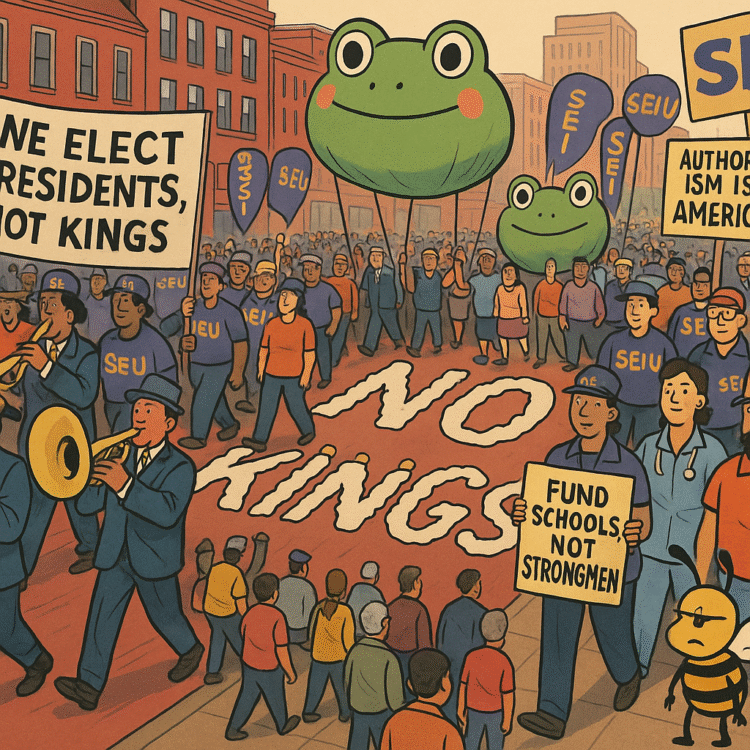
What worked was not celebrity. It was casting. “No Kings” sounds like merch until you realize it is a pocket syllabus. Presidents are hired help who sign paperwork under paper that does not care about their moods. That was the joke and the vow. Homemade signs read like a civics class written in Sharpie. We elect presidents, not kings. Authoritarianism is un-American. Fund schools, not strongmen. These are instructions you can tape to a fridge, not metaphors to argue about for sport.
The mic drifted toward the famous, then swerved back, as if the crowd itself were enforcing the theme. Teachers spoke in union purple with voices that carry through cafeterias and bad acoustics. Nurses spoke in scrubs that still smelled faintly like night shift honesty. Immigrant families spoke without ornament because when your life is already a document set, the flourish is survival, not style. If your sign looked like it was written after a shift, it kept floating to the top.
Labor turned out in a way that felt both classic and newly necessary. AFT and SEIU and cousins underwrote restrooms, water, marshaling, and the thing only unions can bring at scale, disciplined bodies that know how to follow a plan without waiting for a vibe. Picket-line muscle memory traveled to the street, and the street answered with gratitude you could hear. Workplace democracy and constitutional defense shook hands and realized they share shoes.
Style mattered because joy is not the opposite of seriousness. Brass bands made the air feel like oxygen. Human chains spelled NO KINGS on overpasses and parks. The now iconic inflatable frogs bobbed like green question marks aimed at authoritarian cosplay, an artful reminder that satire is a nonlethal tool that punctures costumes better than a thousand adjectives. The mood was merry but not naive, defiant without hoping for a headline. It is a particular American magic trick to turn a protest into a civic parade without losing the argument inside the music.
On the other half of the screen, the pre-loaded insults wilted. Republican leadership had preview-attacked the day as hate America or pro-terror pageantry, then fell quiet when the lenses found grandmothers with whistles, dads with strollers, retirees in union jackets, and teenagers leading chants with the confidence of a future that wants a job. Conservative media tried the astroturf script while the camera panned across miles of feet that have never touched professional grass. The campaign tossed out a trolling video of the president as a literal monarch while denying any kingly tendencies, a bit that landed oddly beside court fights over Guard deployments, rare walkouts by the press pool, and a shutdown that turned paychecks into math problems.
The spine of the day was civil liberties, but the flesh was daily life. Speech and press and the right to assemble are noble, yes, and they are also wages, bus schedules, school lunches, prescription refills, and the freedom to be boring in your own neighborhood. Shutdown-era layoffs are not theory. Immigration crackdowns have names and report times. Federal saber rattling at blue cities does not sound like safety to people who have practiced safety for a living. The rallies did not ask people to pick between dignity and groceries. They named both and marched.
Operationally, the flagship sites ticked like clocks. Big-city police reported minimal arrests and mostly orderly dispersal. Several cities layered crowd-control buffers onto permits and discovered that the buffers worked because the organizers were competent and the participants had come to participate, not to audition for chaos. A heavier federal presence was visible around immigration facilities where friction has erupted before. Organizers answered with trained de-escalators, legal observers, and a strategy that measures victory by safety, not by volume. If this was a drill, it passed. If this was a dance, it learned the steps.
From my couch I kept catching small, telling moments. A city council staffer explaining buffer zones like a geography teacher while a block captain nodded as if learning choreography. A retiree on a union radio net tracking a lost kid across three intersections with the calm of someone who has closed a factory floor without incident. A pastor and a punk negotiating acoustics for the stroller brigade and then unlocking a church bathroom because civic hygiene is also an argument. This is the quiet work that keeps a panoramic photo from needing a property damage footnote.
Capacity is the so-what. Not a hashtag. Not a vibe. Capacity. The lived ability to braid labor, civil-rights, immigrant-justice, and pro-democracy lanes into one banner without tripping over egos. The habit of meal-planning a march so diabetics are fine and wheelchair routes are real. The muscle to file permits correctly, train marshals, translate chants, and still have people left to clean up after the drumline. Capacity wins fights over maps because maps do not redraw themselves. Capacity pushes back on protest restrictions because rules are less bossy when they are read by thousands. Capacity stiffens city spines when the federal government shakes the saber and calls it customer service.
Republicans now have a simple choice and it is in high definition. Either denigrate millions of neighbors or respect the civic ritual they claim to defend. They can keep smearing broadly peaceful assemblies and then retreat when the camera pans wide, or they can rediscover skepticism of royalty and remember that unease with kingship used to be bipartisan. Troll videos are not a plan. Reading the room is.
I kept a running list of near-term tells, the kind that reveal whether this was a moment or a habit. Will October’s turnout surpass the summer baseline and still feel like neighborhoods rather than a concert. Will canvassing and court-watch teams harden into schedules rather than hashtags. Will cities use this momentum to fortify legal defenses before the next attempt to reroute federal power through a single mouth. Will national figures keep popping in without swallowing the program. Most important, will the brand avoid celebrity dependency by continuing to foreground the people who do the work nobody writes movies about, permit wrangling, de-escalation, disability access, translation, and neighborhood-by-neighborhood organizing.
Because I did not attend, I kept asking myself the only honest question available to an absent supporter. What did I do instead. I donated to snack tables and legal hotlines. I boosted local pages rather than national ones. I wrote down the names of the nearest clerks who need poll workers and court watchers and people who can tolerate long afternoons with forms that look like furniture. I mapped the safest route to the nearest public meeting I can actually reach, because democracy is boring by design and boredom is cheaper than regret. If there is not a safe rally within range, there is always safe work within reach. The work just does not pay in applause.
The humor mattered more than the headlines allowed. Those inflatable frogs are not a gimmick. They are a design note that lowers temperature, invites cameras without inviting injuries, and punctures cosplay by pointing at its zipper. Authoritarianism sells itself as glamour. Satire replies with inventory. The crowd laughed not to dismiss the stakes, but to lift them where everyone could see. Humor is not dessert. It is a nonviolent tool.
The street learned again what veterans of nonviolence always knew. Restraint is a skill. It is not passive. It is choreography, attention, water, shade, whistles, and the readiness to turn down a street that suddenly looks wrong. It is the discipline to separate provocations from plots. It is a phone tree that knows who to text when the rumor mill says the route has changed. It is elder marshals who can spot a bad actor before the camera does. It is teens reminding adults how to chant without losing their voices before the third block.
Press rights threaded the day like copper wire. There were cameras everywhere and a handful of doors that stayed shut. Reporters who were iced out in one building found other rooms, because on a day like this access is a verb. People offered interviews that did not flatter themselves, recited facts that can be checked without a decoder ring, and treated the press like a public utility rather than a mirror to preen in. On the other side of that screen there were walkouts that should never become normal and briefings that prefer fog to daylight. The street responded with sunlight and notes.
Shutdown fatigue bent the mood and sharpened it. When paychecks stall, big ideas either connect to rent or die on contact. The brilliance of “No Kings” was to tie constitutional principle to the grocery line. Autocracy is a shipping problem as well as a moral one. A crown in the executive branch is a choke point for services and a choke point for services is a tax on the poor disguised as a cable segment. People did not show up for theory alone. They showed up because theory had a receipt.
Here is the part I have to write down for myself, since accountability sounds better when you can reread it. I felt the ache of not being there and the tug of self-exemption. It would be easy to call my absence neutral. It was not. It was a choice under the constraint of safety and distance, and choices like that are real. So is the obligation to convert absence into action. If a day like this taught me anything from a couch, it is that democracy does not need my silhouette in one frame as much as it needs my persistence across many. The country remembers it has knees when people who cannot march still move the work.
In the weeks ahead the tests will be smaller and meaner. A city council will try to tuck a protest restriction into a housekeeping agenda. A statehouse will decide a map looks better if certain neighborhoods are arranged like furniture. A clerk will need three more volunteers for a polling place whose bathrooms do not lock correctly. A federal officer will float a rumor about deployments that sounds legal if you say it fast. These are the inches where habits become law. This is where capacity either shows up or fades.
I keep returning to the image that framed the day for me. A drone shot resolves into a human chain spelling NO KINGS, then tilts down to the ground where someone is handing a bottle of water to a stranger whose only credential is a cardboard sign. That is the whole project in one continuous move. Spell the principle large. Serve the neighbor small. Repeat until the people who prefer crowns remember why this country keeps them behind glass.
I did not attend. I still belong to the we that showed up. The point of a constitutional ritual is not to be seen once. It is to be rehearsed until it feels normal to insist that power answers to people, not the other way around. So I will keep doing the unphotogenic chores. I will keep reading the boring drafts. I will keep calling the offices that pretend not to hear on the first ring. I will keep showing up in rooms without cameras where the next permit is decided and the next map is drawn and the next clerk learns they are not alone. The drumline will find me when it can. Until then, the work can too.