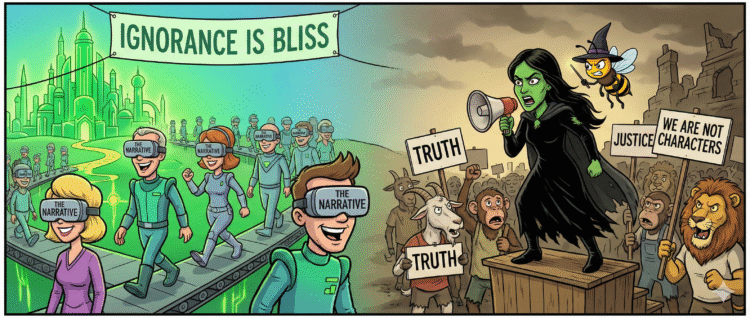
The lights went down in the theater, and for a brief moment, the collective anxiety of the world—the elections, the economy, the general sense that we are living in the final season of a poorly written reality show—suspended itself in the dark. I sat there with Matthew, my fiance and designated emotional anchor, and our friend Tasi, flanked by popcorn and the specific, vibrating anticipation that only comes when you are about to witness a cultural monolith attempt to justify its own existence. We went in expecting a spectacle. We went in hoping for a distraction. We walked out having witnessed a crime scene of raw emotion, political allegory, and vocal acrobatics that didn’t just defy gravity; it defied the cynicism I have spent forty years carefully curating.
We absolutely loved it. And I say that as someone who generally views “remakes” and “adaptations” with the same suspicion I reserve for gas station sushi.
There is a specific alchemy required to take a beloved Broadway musical—one that has been strip-mined for every ounce of merchandise and “Defying Gravity” riff for twenty years—and make it feel dangerous again. But Jon M. Chu, alongside a cast that seemingly sold their souls to some Ozian deity for lung capacity, managed to do it. This was not just a movie about a green girl and a popular blonde. It was a dissertation on power, propaganda, and the terrifying ease with which a society can decide who is a person and who is a monster.
The Pink and Green Power Hour
Let us talk about the elephant in the room, or rather, the bubble and the broomstick. When the casting was announced, the internet did what the internet does best: it vomited premature opinions. Ariana Grande as Glinda? Cynthia Erivo as Elphaba? The skeptics sharpened their knives. They wanted failure. They wanted a train wreck they could meme into oblivion.
Instead, they got a masterclass.
Ariana Grande did not just play Glinda; she dismantled her. It is easy to play the “dumb blonde” trope. It is incredibly difficult to play a woman who uses weaponized incompetence and performative bubbly-ness as a survival strategy in a patriarchal surveillance state. Grande found the tragedy inside the bubble. She played the ditz with the precision of a neurosurgeon, layering every hair toss and high note with a desperate need to be loved, a need so consuming it eventually corrodes her soul. She was funny, yes. She was operatic, obviously. But she was also terrifyingly human. She showed us that “goodness” in the public eye is often just a performance art, a series of calculated gestures designed to keep the crowd from turning on you.
And then there is Cynthia Erivo.
If Grande was the polished surface, Erivo was the tectonic plate shifting beneath it. I have seen Wicked on stage. I know the songs. I thought I knew the character. But Erivo brought a grounded, visceral rage to Elphaba that felt entirely new. This wasn’t just a misunderstood outcast; this was a woman being slowly radicalized by the realization that the systems governing her world were built to destroy her. Her Elphaba was raw, exposed, and painfully stoic. When she opens her mouth to sing, it isn’t just technique; it is an exorcism. She carries the weight of every person who has ever been told they are “too much,” “too loud,” “too dark,” or “too difficult.” She played the green skin not as a costume, but as a condition of existence—a permanent mark of otherness that no amount of talent or magic could scrub away.
The chemistry between them was not the polite friction of coworkers; it was the messy, complicated, devastating intimacy of a friendship that is doomed by history. You watch them and you know they are soulmates, and you know, with a sinking heart, that one of them is going to have to betray the other to survive.
A Tale of Two Cities (and Two Theaters)
Watching this unfold on the big screen, I couldn’t help but flash back to last October. I was in New York City with Shelby, my sister in all the ways that matter. We went to the Gershwin Theatre to see the stage production. It was one of those crisp, electric New York nights where the city feels less like a meat grinder and more like a promise.
That night on Broadway was life-changing for me. There is something about the immediacy of live theater—the spit flying in the spotlight, the collective gasp of two thousand people—that rewires your brain. Seeing it with Shelby, standing in the lobby afterward dissecting the lyrics, feeling the resonance of the story in my own bones, it solidified something I had always suspected but never fully articulated: Wicked is not a fairy tale. It is a tragedy wrapped in sequins.
The movie, however, does something the stage play cannot. The stage relies on distance. The movie relies on the close-up. On stage, Elphaba’s pain is projected to the back row. On screen, Erivo’s pain is projected directly into your nervous system. You see the micro-expressions. You see the hesitation before the anger. You see the moment the light leaves Dr. Dillamond’s eyes. The film took the emotional blueprint I experienced with Shelby in New York and built a skyscraper of heartbreak on top of it.
The Goat, The Ban, and The Fascism
We need to talk about the animals.
In the shiny, Technicolor world of Oz, it is easy to get distracted by the flying monkeys and the emerald skylines. But the beating heart of Wicked—and the part that feels nauseatingly relevant to 2025—is the subplot regarding the Animals. Note the capital “A.” In Oz, Animals have souls, voices, and tenure. They are professors, neighbors, and citizens.
Until they aren’t.
The arc of Dr. Dillamond, the goat professor, is the pivot point of the entire narrative. He is the canary in the coal mine. The regime doesn’t start by rounding up the citizens; it starts by silencing the “Other.” It starts with a ban on Animals teaching. Then a ban on Animals traveling. Then the cages. Then the silence.
When Dr. Dillamond loses his ability to speak—when he reverts from a sentient intellectual to a bleating beast because the trauma and the oppression have stripped him of his humanity—it is the most horrifying thing I have ever seen in a “family” movie. It is a direct, brutal link to race, identity, and the mechanics of genocide. It is the story of every marginalized group that has watched their rights stripped away layer by layer, laws passed in the name of “safety” or “unity” or “economic stability” that are actually designed to erase them from public life.
Elphaba is the only one who sees it for what it is. She is the only one who refuses to look away. And because she sees it, because she speaks it, she is branded a terrorist. This is the core of the story: the “Wicked Witch” is not wicked because she is evil. She is wicked because she is inconvenient. She is wicked because she refuses to be complicit in the silence. She is the embodiment of the “Other”—the queer kid, the person of color, the neurodivergent mind, the whistleblower—who realizes that the table was rigged before they even sat down to play.
The Book vs. The Broadway vs. The Reality
To truly understand the weight of this story, you have to look back at the source material. Gregory Maguire’s 1995 novel is not a happy book. It is a grim, dense, political satire teeming with adult themes, sexual politics, and a relentless cynicism about the nature of power. The musical softened the edges, scrubbed away the grime, and gave us a soaring anthem. But the movie seems to be finding a middle ground, pulling some of that darkness back into the frame.
Maguire wrote the book in the shadow of the Gulf War and the rising tide of political polarization. He wanted to look at the “villain” of childhood memory—the terrifying green witch—and ask: “What happened to her?”
This was a revolutionary act. Before Wicked, villains were one-dimensional obstacles. They were evil because the plot required them to be evil. They cackled. They plotted. They died. Wicked was the first major cultural touchstone to flip the script. It demanded that we look at the person behind the monster. It posited that no one is born wicked; wickedness is a label thrust upon you by the people who control the printing press.
There is always a story. Not always one that warrants the chaos, sure. Sometimes people are just broken. But there is always a motive. There is always a sequence of events, a series of little betrayals and systemic failures, that leads someone to pick up a broomstick and declare war on the sky. Even if the motive is just chaos and insanity, there is a path that led there. Elphaba’s motive is justice. Her motive is truth. And in a world run by a Wizard who relies on smoke and mirrors to maintain control, truth is the most dangerous weapon of all.
The Wizard, played with terrifying mediocrity by Jeff Goldblum, is the ultimate modern villain. He isn’t a demon. He isn’t a sorcerer. He’s just a con man. He’s a weak man who stumbled into power and realized that people are easier to control if you give them an enemy to fear. He creates the crisis so he can be the savior. He demonizes the Animals to unite the Ozians. He is every populist demagogue who has ever stood at a podium and told the crowd that they are the problem, and he is the solution.
The Problem with “Act 2” Critics
Now, we arrive at the discourse. The critics are already sharpening their knives for “Act 2,” or “Part 2,” or whatever the studio is calling the back half of this saga. They are complaining that the split feels like a cash grab. They are complaining about the pacing. They are looking at it as a sequel, and they are missing the point entirely.
It is not a sequel. It is the dark conclusion of Act 1.
The structure of Wicked demands this split. Act 1 is the setup. It is the school days, the friendship, the hope. It ends with “Defying Gravity,” a moment of triumph and rupture. But Act 2? Act 2 is the fallout. Act 2 is where the consequences come home to roost. Act 2 is where the fascism fully takes hold, where the resistance is crushed, where the love story turns tragic, and where the characters we love are forced to make impossible choices.
You cannot rush that. You cannot cram the dismantling of a regime and the death of a hero into a breathless forty-five minutes after the popcorn is stale. The critics want a tidy resolution. They want the dopamine hit of a happy ending. But Wicked doesn’t do happy endings. It does honest endings. It ends with the realization that sometimes, the bad guys win the PR war. Sometimes, the hero has to die (or disappear) so the legend can live. Sometimes, the only way to change the world is to let the world hate you.
I wish they would win an Oscar for this film. Not because I care about the gold statues—which are, let’s be honest, just another form of Wizard-approved propaganda—but because it would force the industry to acknowledge a story that is aggressively uncomfortable. It would force them to applaud a film that says, loudly and clearly: “Your heroes are frauds, your government is lying to you, and the monster you fear is just a woman trying to save a goat.”
The Mirror in the Emerald City
For Matthew and me, sitting in that theater, the resonance was personal. We know what it is like to be the “Other.” We know what it is like to navigate a world that wasn’t built for us. Matthew, with his TBI, navigates a world that demands a cognitive speed and conformity he cannot always provide. I, as a queer, biracial man who has survived systems designed to crush me—from conversion therapy to the prison industrial complex—see myself in Elphaba’s exhaustion.
I see the way she tries, at first, to play by the rules. She tries to be good. She tries to seek the Wizard’s approval. She thinks that if she is just talented enough, just smart enough, just magical enough, the system will protect her.
The most heartbreaking moment is not when she flies. It is when she realizes the Wizard doesn’t care about her magic; he only cares about how he can use it. That is the moment she becomes radicalized. That is the moment she realizes that assimilation is a trap. You cannot fix the system from the inside when the system is powered by the suffering of people like you.
This is why Wicked matters. It is not just about flying monkeys. It is about the moment you decide to stop asking for permission to exist. It is about the moment you decide that if the world is going to call you wicked for speaking the truth, then you might as well buy the hat and own the title.
The Final Note
As we walked out of the theater, Tasi, Matthew, and I were quiet for a moment. The usual post-movie chatter felt insufficient. We had just watched a ninety-minute allegory for the collapse of democracy set to a pop score, and we needed a minute.
The critics can say what they want about the runtime. They can complain about the CGI or the lighting. But they cannot deny the power of the narrative. Wicked forces us to look in the mirror. It asks us who we are in the story of Oz. Are we Elphaba, willing to burn it all down for what is right? Are we Glinda, willing to compromise our soul to maintain our comfort? Or are we the Ozians, happily wearing our green glasses, believing the lies because the lies make us feel safe?
The movie is a masterpiece not because it is perfect, but because it is necessary. It is a reminder that history is written by the winners, but the truth is usually hiding in the shadows, wearing black, and refusing to smile. It is a reminder that “goodness” is not a state of being; it is a choice, and usually a painful one.
So, bring on Act 2. Bring on the darkness. Bring on the tragedy. We are ready. We have seen the man behind the curtain, and we know he is just a man. The real magic is in the refusal to kneel.
The Part They Hope You Miss
The most subversive element of Wicked isn’t the flying or the magic; it’s the complete deconstruction of the concept of “legacy.” The show ends with the citizens of Oz celebrating the death of the Wicked Witch. They are dancing on her grave. They are relieved. The entire society is united in their hatred of the woman who actually tried to save them. It is a brutal, cynical, and deeply realistic depiction of how public opinion works. The hero doesn’t get the parade. The hero gets the pitchforks. The con man gets the statue. It is a lesson that every activist, every whistleblower, and every truth-teller learns eventually: you don’t do it for the applause. You do it because the alternative is silence, and silence is the only true wickedness.