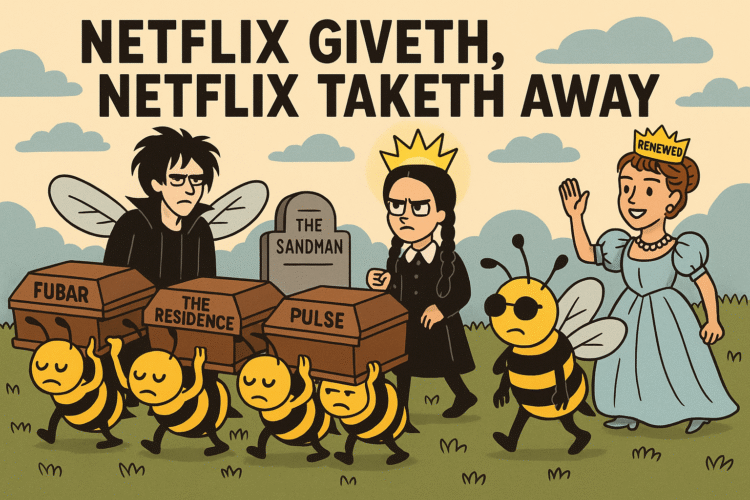
The streaming economy is nothing if not biblical: seven years of plenty, seven years of famine, seven executives screaming “cut costs!” while canceling your comfort show. And so, on August 17, Netflix opened the velvet curtain to reveal the latest mass grave of content.
FUBAR? Dead. The Residence? Evicted. Pulse? Flatline. The Recruit? Dishonorably discharged. The Sandman? Faded to dust once more.
But don’t despair! Virgin River lives, Bridgerton multiplies like Regency rabbits, and Queer Eye will bow out in Washington, DC with the kind of pomp reserved for a farewell state dinner. Netflix giveth, Netflix taketh away, and we—poor subscribers—remain shackled to the algorithm like Victorian orphans begging for gruel.
FUBAR (Canceled After 2 Seasons)
Arnold Schwarzenegger as a CIA dad trying to balance family life and international espionage was peak dad-core television. It was Mr. & Mrs. Smith if your uncle with the accent and the bad back got called back into the field because apparently there weren’t enough twenty-somethings willing to lie on their LinkedIn about “special skills.”
I loved FUBAR because it leaned into the absurdity of Arnold’s entire career: he is both the punchline and the hero, and he knows it. Watching him try to “blend in” at PTA meetings while also waterboarding arms dealers was exactly the kind of tonal whiplash I require on a Tuesday night.
Netflix canceling this one is proof they don’t understand their core demographic: exhausted queer viewers who find it cathartic to see a 75-year-old man still outpacing 30-year-old mercenaries. Representation matters, and I felt represented.
The Residence (Canceled After 1 Season)
A White House murder mystery where every staffer was a suspect? Yes, please. The Residence was like Clue if Clue came with subpoenas. The only problem: it barely had time to establish itself before Netflix yanked the rug.
I adored it because it treated politics the way politics should be treated: as a soap opera with dead interns, missing classified documents, and a First Dog who probably knows too much. It was fun, campy, and vaguely plausible in a way that made you uncomfortable about democracy.
But alas, Netflix decided we didn’t deserve another season of political whodunit. Instead, we’ll just have to settle for the actual news cycle, which is a murder mystery where the culprit is always “billionaires.”
Pulse (Canceled After 1 Season)
Pulse was supposed to be Netflix’s big sci-fi flex: techno-horror wrapped in neon paranoia. It asked the question: what if our digital lives took on a pulse of their own? Spoiler: it wasn’t good for anyone.
I loved it because it dared to be weird. Every frame looked like it was shot through a vape cloud at an underground Berlin club, and every character spoke like they were two steps away from uploading their consciousness to a USB drive. It wasn’t perfect—but it was different.
And Netflix, famously allergic to difference, put it down after one season. Now we’ll never know if the algorithm that haunted the characters was also the same one that canceled them.
The Recruit (Canceled After 2 Seasons)
This one hurts. A green lawyer accidentally entangled in CIA operations? A hot mess of espionage, bureaucracy, and nervous breakdowns? The Recruit was every unpaid intern’s fantasy: the idea that your incompetence could somehow get you promoted to “accidentally saving the world.”
I loved it because it leaned into the truth of adult life: none of us know what we’re doing, and yet somehow we’re still trusted with nuclear codes, mortgages, and raising children. The protagonist was not James Bond—he was James Blunders, and I related.
Netflix canceling it after two seasons is cruel. Two seasons is enough to get you attached, not enough to give closure. It’s the narrative equivalent of ghosting.
The Sandman (Canceled After 2 Seasons)
This is sacrilege. Neil Gaiman’s masterpiece, one of the most ambitious comics ever written, turned into a lush, dreamlike series that actually worked—and Netflix killed it after two seasons.
I loved The Sandman because it was unapologetically gothic, queer, and weird. It gave us a Death who was kind instead of cruel, a Dream who brooded like an emo bassist, and visuals that made you want to paint your bedroom black again. It was proof that fantasy could be literate and popular at the same time.
Canceling it isn’t just shortsighted. It’s symbolic. In a world where algorithms rule, dreamers are the first to go.
The “Huge Hit” Ending: Queer Eye (Final Season in DC)
We knew it had to end someday, but Queer Eye has been one of the few pure-hearted joys of the last decade. Watching the Fab Five transform broken kitchens, broken wardrobes, and occasionally broken men into something hopeful has been a spiritual ritual.
I love that they’re ending in Washington, DC. It feels intentional, like a benediction over the nation’s capital. Congress may not pass meaningful legislation anymore, but at least it will get a fresh coat of paint, a better haircut, and maybe learn to cook something besides resentment.
Queer Eye isn’t just about makeovers. It’s about survival, about building chosen families, about resilience—queer values that echo in every book I write and every story I tell.
The Renewals: Netflix’s Comfort Food
- One Piece S3: Renewed before S2 even dropped. Proof that anime piracy has finally been defeated, not by the law, but by capitalism.
- Wednesday S3: Because goth girls keep the economy afloat.
- Virgin River S8: Proof that straight people need their comfort sagas too, even if those sagas involve 200 episodes of people drinking wine and making terrible decisions.
- Bridgerton S5–S6: Regency gowns and strategic nudity will outlive us all.
- The Diplomat S4: Because international relations are sexier when Keri Russell is sighing in frustration.
- Love Is Blind S10: Nothing unites America like watching two strangers realize, in real time, that they made a mistake.
- Squid Game: The Challenge S3: Because Netflix will milk Korean dystopia until morale improves.
- Sweet Magnolias, Lincoln Lawyer, Walter Boys, Tires: The B-plots of our lives, renewed so we always have something to half-watch while scrolling.
No Good Deed: The “Indefinite Pause”
Ah, the soft cancel. The show isn’t dead, it’s just on “pause.” Which in Netflix terms means: it’s buried, but the grave is shallow enough they could resurrect it if they need filler. It’s the television equivalent of putting leftovers in the fridge knowing full well you’ll never eat them.
Why This All Matters
Streaming cancellations aren’t just about losing shows. They’re about losing the rituals we build around them. FUBAR was my weeknight absurdity. The Residence was my White House soap. Pulse was my late-night neon anxiety. The Recruit was my intern fantasy. The Sandman was my goth bedtime story. Each cancellation is a tiny theft, a reminder that nothing in this economy is built to last.
And yet, amid the carnage, we still get renewals. We still get one more season of the Fab Five saving America one casserole dish at a time. We still get Bridgerton’s corsets, Wednesday’s side-eye, and Love Is Blind’s endless parade of mistakes.
Netflix knows what it’s doing: killing our dreams while feeding us enough comfort to stay subscribed. It’s not art, it’s hostage negotiation. And every time we hit “Play Next Episode,” we agree to the terms.
Closing Chord
The cancellations hurt, but the song beneath the noise is the same one that plays through all my own writing: survival, queerness, resilience. Shows die, but the stories we carry remain. The absurdity, the camp, the heartbreak—they all hum beneath the cancellations like a refrain we can’t forget.
So goodbye, Sandman. Farewell, FUBAR. Goodnight, Recruit. You may be gone from the algorithm, but you live rent-free in my queer little heart.
And to Netflix, I say: cancel all you want. We’ll still be here, surviving you, mocking you, and waiting for the next renewal to give us just enough hope to keep scrolling.