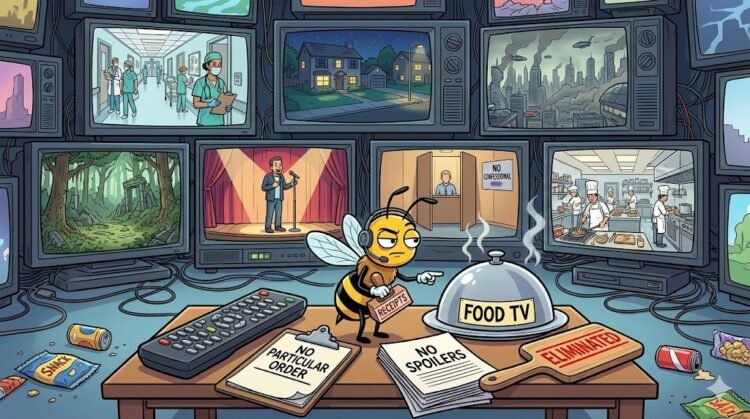
No particular order, because ranking art is how streaming apps turn joy into spreadsheets.
Every year, television looks at America’s collective attention span, flicks it on the forehead, and says, “Come here, I made you something complicated.” In 2025, it felt like the medium finally admitted what we all already know, most of us are not watching TV to “escape,” we’re watching to metabolize. Prestige shows gave us dread with better lighting. Reality shows gave us strategy with eyeliner. Competition shows gave us a controlled environment where the rules are clear and the villains wear name tags.
So here are my top picks for the year, in no particular order, plus the glorious chaos wing of reality competition and the steady, comforting combustion of food television. These are the shows that kept my brain busy, my feelings engaged, and my group chats spiritually employed.
The Pitt
This show does not begin, it activates. The world is fluorescent, urgent, and allergic to rest, and the performances make exhaustion feel like a language. Noah Wyle anchors the chaos with the kind of competence that looks heroic only because the system around him is perpetually five minutes from collapse. I love it because it treats medicine as both sacred work and constant triage, and it never lets the audience pretend the consequences are theoretical. Its impact this year was reminding everyone that the real horror genre is “understaffed.”
Pluribus
Vince Gilligan built a story where the threat is not just violence, it’s the seductive promise of enforced comfort. Rhea Seehorn carries the emotional weight with a kind of precision that makes every scene feel like a question you’re not sure you want answered. I love it because it uses tone like a scalpel, funny, tender, then suddenly unnerving, and it asks what people will trade away for a life that feels easy. Its impact was giving 2025 a new paranoia, the kind that whispers that the nicest solution might also be the cruelest.
All Her Fault
A thriller that understands the specific nightmare of watching your normal life get rewritten by strangers in real time. Sarah Snook plays a woman forced to keep moving through disbelief, suspicion, and public judgment, while Dakota Fanning adds a sharp, complicated counterforce that keeps the story from falling into lazy certainty. I love it because it captures how quickly society turns women into suspects and mothers into headlines. Its impact this year was fueling a national wave of “Who do you trust” debates that felt less like fandom and more like a warning.
The Beast in Me
Claire Danes as an author circling danger like it’s research, and Matthew Rhys bringing the kind of charisma that makes your instincts argue with your curiosity. I love this show because it’s a psychological duel in thriller clothing, and it understands the creeping terror of not knowing whether you’re safe, or just desperate to feel safe. Its impact was proving that suspense still works when the tension is internal, not just plot mechanics.
The Morning Show Season 4
Jennifer Aniston and Reese Witherspoon return to the world of broadcast power, where every sincere sentence has an angle and every apology has a legal team. Billy Crudup remains the embodiment of ambition in human form, and the ensemble keeps the universe thick with agendas. I love this season because it makes information feel like a weapon and a commodity at the same time. Its impact this year was reminding everyone that the media isn’t just covering culture, it’s negotiating with it.
Chief of War
Jason Momoa leads a historical epic with real weight, where identity and sovereignty are treated as lived truths rather than decorative themes. The scope is cinematic, the tone is serious without being stiff, and the sense of cultural specificity gives it an authority that prestige TV too often avoids. I love it because it demands attention and refuses simplification. Its impact was a course correction for historical storytelling, the kind that lingers because it refuses to shrink itself for comfort.
The Studio
Seth Rogen and an absolutely lethal cast turn Hollywood into a satire that feels less like exaggeration and more like an exposed wiring diagram. Catherine O’Hara and Kathryn Hahn are especially fun to watch because they can deliver a line that lands as comedy and then echoes as truth. I love it because it captures the industry’s nervous breakdown energy, the way it sells dreams while running on fear. Its impact was giving 2025 a mirror for the content machine, and watching us laugh while recognizing our own complicity.
Your Friends and Neighbors
Jon Hamm as a disgraced hedge fund manager who starts burglarizing wealthy neighbors is a premise that should not be as satisfying as it is, and yet. The show uses suburbia as a pressure cooker, with secrets tucked behind curated lawns. I love it because it treats money as a costume, not a solution, and it understands that power is often just theft with better branding. Its impact this year was giving “eat the rich” energy a sleek, character-driven vehicle without turning it into a lecture.
The Final Season of The Handmaid’s Tale
Elisabeth Moss brings June’s long war to its last stretch with controlled ferocity, and the ensemble keeps the moral terrain complicated rather than clean. I love the final season because it refuses easy catharsis while still insisting on consequence, and it understands that survival is not the same as healing. Its impact was closure that still left bruises, the kind of ending that forces reflection rather than applause.
The Last of Us Season 2
Pedro Pascal and Bella Ramsey return to a world where love always has a cost and nobody gets to pay in installments. The writing remains emotionally unflinching, and the show keeps its commitment to intimacy even in a story built on danger. I love it because it refuses to treat violence as spectacle, and it understands that the real conflict is what people do when they’re terrified of losing each other. Its impact this year was proving again that genre TV can be wildly popular while still being ethically uncomfortable.
The Bear Season 4
Jeremy Allen White, Ayo Edebiri, Ebon Moss-Bachrach, and the whole cast make stress feel like a dialect you can suddenly speak. I love this season because it treats growth as jagged, progress as fragile, and love as something that can look like conflict when everyone is trying not to drown. Its impact this year was keeping the conversation alive about work, ambition, and what it does to a person to chase excellence while carrying old wounds.
Hacks Season 4
Jean Smart and Hannah Einbinder continue to make their dynamic feel like comedy with teeth and tenderness. The writing remains one of the best examples of humor that respects pain and pain that still leaves room for laughter. I love it because it treats legacy as messy and mentorship as emotionally complicated, and it never pretends success solves anything. Its impact was reminding 2025 that the funniest shows are often the most honest.
Survivor (2025 season)
This show remains the purest social experiment on television because it never stops being about people trying to be liked while also trying to win. The casting in 2025 gave us a mix of strategy brains, chaos hearts, and players who understood that perception is currency. I love Survivor because it’s a lesson in human behavior disguised as an adventure show, and because the best episodes feel like watching a group therapy session hosted by hunger. Its impact this year was keeping the art of the blindside alive, not as cruelty, but as narrative.
The Traitors (2025 season)
The Traitors is what happens when you trap a group of dramatic people in a fancy house, add paranoia, and then hand them a moral dilemma disguised as entertainment. The 2025 season delivered exactly what it needed to, suspicion, alliances that melt, and people discovering that they are not as good at reading vibes as they thought. I love it because it’s campy without being empty, and it turns trust into a fragile object everyone keeps dropping. Its impact was giving us a new batch of icons and a new reason to side-eye anyone who says, “I’m just being honest.”
Big Brother (2025 season)
Big Brother remains the longest-running lesson in how quickly people will form micro-governments and pretend it’s personal. The 2025 season delivered the usual cocktail of strategy, delusion, social maneuvering, and the occasional houseguest who thinks loyalty is a personality trait. I love it because it’s a controlled ecosystem where power dynamics are visible, and because watching people campaign for safety while also plotting your eviction is a uniquely American form of theater. Its impact this year was keeping live-feed obsession alive and reminding everyone that the most dramatic part of human nature is boredom.
Food Competition TV, the edible comfort category
There is a specific joy in watching talented people cook under absurd pressure while you sit on your couch holding a snack that required zero knife skills. Food competition shows scratch a deep itch in the brain, rules are clear, the stakes are immediate, and the outcome is decided by performance rather than vibes. In 2025, food TV continued to be my comfort chaos, the place where tension is real but survivable.
MasterChef remains the classic, big-emotion, big-judgment format, where home cooks chase excellence while being stared at by professionals who can smell fear through the screen. I love it because it’s sincere, intense, and always about growth, even when the editing tries to make it about humiliation.
Hell’s Kitchen is still the cathedral of loud standards, a place where the chaos is the point and competence is the only path to peace. I love it because it’s theatrical and ridiculous, but also because it rewards people who can keep it together while the kitchen tries to break them.
Tournament of Champions is my favorite kind of competition because it feels like pure craft. It’s brackets, skills, and chefs who already know who they are, trying to prove it anyway. I love it because it treats cooking like sport without losing respect for the art.
House of Knives taps into the primal pleasure of watching people who are good at something compete in a format designed to make them sweat. I love it because knives are honest, the clock is cruel, and the food tells the truth.
24 in 24 is the endurance version of food television, a show that looks at sleep and says, “Not today.” I love it because it turns cooking into a test of stamina and will, and because watching people push past exhaustion feels weirdly inspiring when you’re folding laundry.
Beat Bobby Flay is still the perfect bite-sized competition, part ego, part skill, part “let’s see what happens when confidence meets reality.” I love it because it’s playful without being low-stakes, and because the format always delivers the satisfaction of watching someone swing big.
Next Level Chef is pure escalation, a competition designed like a metaphor for modern life, different resources, different conditions, same expectations. I love it because it forces adaptation and reveals who can stay creative when the floor literally drops out from under them.
If 2025 television had a theme for me, it was this: competence under pressure, whether it’s an ER doctor, a survivor on an island, a comedian rewriting her legacy, or a chef trying not to melt down on camera. I gravitate toward stories where people are tested and still find a way to be human, sometimes messy, sometimes brilliant, sometimes both in the same scene.
The Year in Screen Form
These shows mattered to me because they didn’t treat the audience like we’re fragile. They trusted us with tension. They let humor and pain sit at the same table. They gave us characters and contestants who were not clean archetypes, but complicated people trying to win, survive, heal, or just make it through another day without being eaten alive by the system around them. 2025 TV didn’t just entertain, it documented the emotional weather, and for once the forecast felt honest.