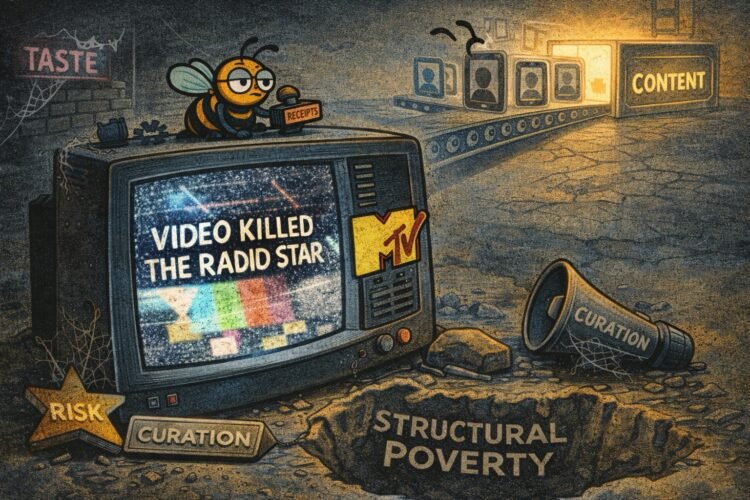
The channel that taught America how to watch sound signed off with a joke that stopped being funny decades ago.
MTV ended its last remaining 24 hour music video channels by playing “Video Killed the Radio Star,” the same song that launched the network in 1981. It was meant to feel clever, full circle, maybe even charming. Instead it landed like a headstone inscription chosen by an intern who only knew the story through vibes. The irony worked too well. The song wasn’t a wink. It was a confession.
Because MTV didn’t die from irrelevance. It died from success followed by fear.
At the beginning, MTV was a weird little cable experiment that looked like a pirate broadcast from the future. The videos were grainy. The VJs felt slightly unhinged. The production values swung wildly between art-school brilliance and mall-catalog nightmare. And none of that mattered, because the channel did something no one had quite managed before. It taught a generation how to see music.
Not hear it. See it.
Suddenly sound had fashion. Lyrics had posture. Genres had lighting. The way an artist moved, dressed, stared into the camera, or refused to stare into the camera at all became part of the song. MTV didn’t just play music videos. It created a grammar for youth culture. It told kids in bedrooms across the country that taste was a language you could learn, remix, and weaponize against boredom.
It broke artists. It made stars out of people who would never have survived radio alone. It taught audiences how to recognize irony, glamour, transgression, and camp before most of them knew the words. It globalized pop. It collapsed geography. A kid in a small town could see the same thing at the same time as a kid in London or Tokyo and feel, for a few minutes, like they were inside the same room.
That was the power. And it terrified everyone who touched it.
MTV became a monoculture engine almost by accident. When something worked, it worked everywhere. When a video hit, it didn’t just chart, it imprinted. It changed haircuts, slang, silhouettes, politics, and posture. It smuggled in queerness, racial complexity, gender play, and rebellion through a medium adults dismissed as noise. It made misfits legible and cool. It made excess aspirational and dangerous. It taught kids how to look back at the camera like they were in on the joke.
And then, slowly, the channel started backing away from the very thing that gave it power.
The erosion didn’t happen all at once. It never does. It happened the way institutions always rot, through reasonable decisions made under pressure. Music videos were expensive. Reality shows were cheaper. Ratings were volatile. Advertisers wanted predictability. Corporate parents wanted scale. Focus groups wanted familiarity. Executives started asking why they were funding art when they could fund conflict.
So the music got pushed later. Then earlier. Then off to the side. Then onto spin-offs. Then into themed blocks. Then into nostalgia hours. Then into archives. And finally into the kind of respectful silence usually reserved for ancestors you only mention on holidays.
Reality television filled the gap because it was efficient. It produced hours of content without requiring artists, unions, or risk. It created characters instead of stars. It manufactured drama that reset every season. It turned youth culture into a loop of confessionals and competitions, stripped of mystery and edited for maximum stickiness. It was brand-safe noise.
MTV told itself it was evolving.
What it was really doing was abandoning curation.
Curation is labor. Curation is taste. Curation requires people who can say no, who can spot something strange and decide it matters before the numbers agree. That’s expensive. Algorithms are cheaper. Reality formats are cheaper. Endless content is cheaper than culture. So the channel that once taught America how to see started chasing what America would not turn away from.
And the internet arrived right on time to finish the job.
Streaming didn’t kill music videos. It dissolved them. Music became atomized, sliced into playlists, moods, microgenres, and algorithmic guesses. Discovery stopped being communal and became private. Everyone got their own channel, tuned to their habits, stripped of surprise. The idea of a shared moment faded. There was no longer a reason to wait for a video to premiere when you could summon anything instantly.
MTV could have become a curator in that chaos. It could have doubled down on taste, context, history, risk. It could have been the place that told you why something mattered, not just that it existed. Instead it chased relevance by trying to out-algorithm the internet, a race it was never going to win.
So the channel hollowed itself out.
By the time the last 24 hour music video channels shut down, MTV had already been gone for years in everything but logo. The videos existed as ghosts, shuffled off to secondary platforms, treated like content instead of culture. The network that once broke artists no longer needed them. The artists no longer needed it. And the audience learned, slowly, that nothing precious was protected.
Which brings us back to that final song.
“Video Killed the Radio Star” was always about anxiety disguised as novelty. It was a song about fearing replacement, about technology rewriting power, about the feeling that something human was being pushed aside by something shinier. MTV turned that anxiety into a launchpad. It proved that new mediums don’t have to erase the old ones. They can remix them, amplify them, transform them into something alive.
But capitalism doesn’t reward stewardship. It rewards extraction.
MTV extracted everything it could from music. It strip-mined youth culture until it was predictable enough to package. It monetized rebellion until rebellion became a genre you could schedule. And when the music stopped being the most efficient engine of profit, it moved on without ceremony.
That’s the pattern. Innovation arrives wild and destabilizing. It changes how people see themselves. It threatens existing power. Then it gets bought, smoothed, optimized, and drained. By the time it’s finished being useful, it’s unrecognizable. The ending is always quieter than the beginning.
This is not just an MTV story. It’s an American media story.
We build institutions on risk and then punish them for taking it. We celebrate disruption and then demand stability. We let youth culture lead us into the future and then scold it for aging out of profitability. We turn art into content, history into IP, and memory into a playlist that disappears when the licensing deal expires.
MTV shutting down its last music video channels is not tragic because of nostalgia. Nostalgia is cheap. You can buy it in thirty second clips and anniversary specials. It’s tragic because it confirms that even our most powerful cultural machines are allowed to forget what they were built to do.
The channel that taught a generation how to see sound ended with a song about being replaced. Not by something better. By something flatter.
Music videos still exist. Artists still make them. But the shared ritual is gone. The sense that everyone is watching the same thing at the same time, learning the same visual language, absorbing the same references, has been replaced by feeds that never overlap. Culture didn’t die. It fractured.
And maybe that was inevitable. Maybe monoculture was always temporary. But there’s a difference between evolution and abandonment. There’s a difference between letting something change and letting it be stripped for parts.
When MTV chose reality over risk, algorithm over taste, safety over surprise, it didn’t just follow the market. It taught the market what to expect. It trained audiences to accept less. It modeled a future where innovation is tolerated only until it can be monetized into exhaustion.
So when the final broadcast rolled and “Video Killed the Radio Star” played one last time, it wasn’t history repeating itself. It was history being filed away.
The song wasn’t laughing at the past. It was mourning it.
Receipt Time: The Fade Out Problem
MTV didn’t fail because people stopped loving music. It failed because it stopped loving the thing that made it dangerous. When culture becomes content, risk becomes a liability and memory becomes optional. The quiet ending is the point. It’s how innovation is retired in America, not with a fight, but with a playlist and a shrug. “Video Killed the Radio Star” wasn’t a punchline. It was a warning we ignored until there was nothing left to watch.