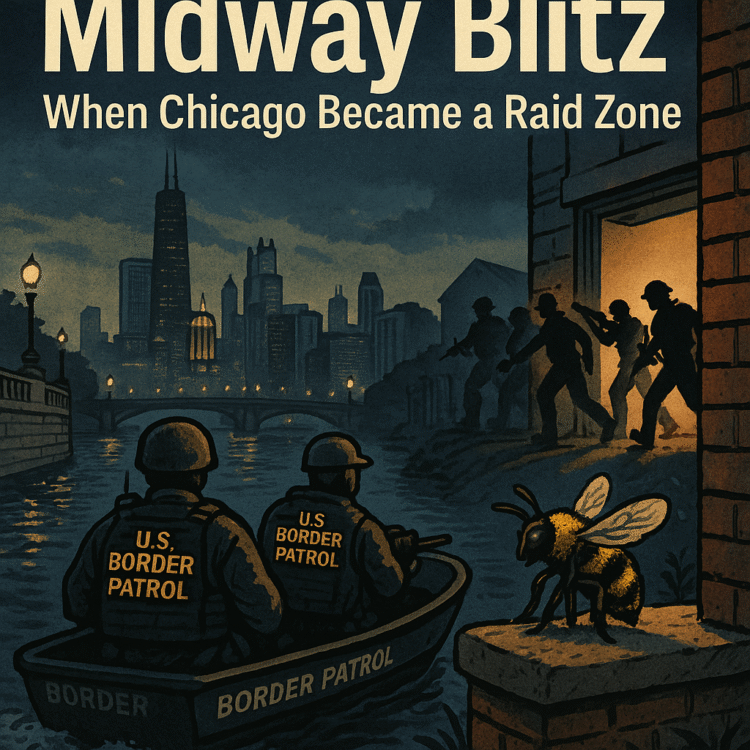
Chicago has always been a stage. The Loop, the Magnificent Mile, the riverwalk—backdrops for theater, protest, commerce. But in early October 2025, that stage changed. Operation Midway Blitz, a Department of Homeland Security crackdown, escalated from dramatic waterfront patrols to door-kicking raids in neighborhood after neighborhood. It was as if someone had decided that Chicago proper wasn’t enough spectacle—the suburbs, too, needed to stand in fear.
From late September, DHS forces had stalked Michigan Avenue and the river, lining up long guns and Border Patrol agents in tactical gear, as though tourism district and immigration enforcement were interchangeable. But come October 1–3, the operation moved inward—and the conflict moved loud.
Illinois Governor J. B. Pritzker and Chicago Mayor Brandon Johnson publicly condemned the escalated tactics. Pritzker called them “racial profiling by import,” Johnson accused the federal government of turning neighborhoods into war zones. In response, ICE and DHS officials claimed dozens of arrests, with cumulative totals ranging between 500 and 1,000 since late September, depending on the counting bucket.
Border Patrol Commander Gregory Bovino fanned controversy when he said agents factor “how they look” when deciding whom to stop. That is not tactical prudence. It is profiling, plain and simple.
Timeline & Theater of Raids
- September 25 onward: The operation’s first act took place on the river and waterfront. Patrol boats cruising the Chicago River, Border Patrol officers in gear along the Riverwalk and Michigan Avenue, stopping individuals—often men of color—questioning their status, demanding IDs. The optics: high-visibility theater meant to intimidate.
- October 1: The operation silently shifted. The beachfront patrols now had a purpose beyond displays. Reports of small sweeps in Edgewater and Bronzeville neighborhoods surfaced. Agents now had warrants; the show had become a campaign.
- October 2–3: Door-kicking raids in south and west side neighborhoods and suburbs. In South Shore, ICE agents burst into an apartment block early in the morning; residents reported minors being frightened, parents yelling for due process, agents pressing into rooms without prior notice. Outside the Broadview ICE facility, protests erupted. DHS forces used pepper balls and alleged tear gas. In one sweep, agents placed temporary airspace restrictions over parts of the city, suggesting helicopters were deployed overhead.
The DOJ, DHS, and local officials offered conflicting arrest counts: one source claimed “dozens” in the latest sweep; others placed the cumulative total since late September at between 500 and 1,000. Some arrests were of lawful residents or U.S. citizens detained by mistake, leading to several civil-rights complaints.
The Equipment & Force Posture
It wasn’t just foot raids. On the river, the DHS had deployed boats with long guns, scanning riverbanks like bank robbers scanning vaults. On land, agents in tactical gear prowled riverwalk promenades and luxury storefront districts. A drone or two was rumored overhead. Reports emerged of one apartment building’s airspace being temporarily restricted—a first in Chicago’s domestic enforcement history—suggesting that helicopters or drones hovered overhead for insertion or surveillance.
In South Shore, tear-gas whispers circulated. Parents said windows shattered, children screamed. Outside Border Patrol’s Broadview site, clashes erupted. Protesters said pepper balls rained, agents shoved. Multiple arrests followed dust-ups. The city’s civil-rights offices opened immediate investigations into the treatment of minors during raids.
Legal & Operational Landscape
The White House reportedly requested Illinois’ National Guard be placed on standby to assist or supplement federal operations. That raises the stakes: when federal enforcement leans on state forces, lines blur. Governors typically guard National Guard deployment authority; misuse is politically explosive.
Federal legal posture faces multiple friction points:
- Posse Comitatus: Active-duty federal troops (or operations clothed as enforcement) typically may not execute domestic arrests. If DHS agents operate with military backing or in paramilitary formations, that line frays.
- Equal protection / profiling: Using appearance or race as stop criteria invites constitutional challenge. If agents really “consider how they look,” that is prima facie discriminatory.
- Warrant procedures: Door-kicking requires warrants or exigent circumstances. If agents entered without proper process, wrongful detention lawsuits will follow.
- Due process & detentions: Detaining lawful residents or citizens by mistake is a slippery slope. Holding them without probable cause or denying access to counsel could spark damages claims and class actions.
Local attorneys and civil-rights groups are already organizing. Legal service organizations in Chicago have hotlines for people claiming detention without justification. The ACLU of Illinois is collecting complaints; city offices are demanding internal DHS memos on stop criteria and training.
Civic & Economic Stakes
Chicago counting on fourth-quarter tourism, holiday foot traffic, riverside dining, shopping on the Magnificent Mile. These raids don’t help. Images of Border Patrol in tactical gear strolling past Blackhawks merchandise, plume clouds around high-rise apartments, and riverboat patrols trolling for migrants—these aren’t just hits on reputation. They bleed foot traffic, scare away convention bookings, and depress restaurant reservations.
In neighborhoods, business owners near raid zones reported losing morning customers, families skipping weekend brunches, parents keeping children home from daycare when they fear knocks on doors. Apartments saw premature lease cancellations. Real estate apps flagged neighborhoods as “hot zones” overnight.
Civic trust erodes fastest in minority neighborhoods already wary of overpolicing. When federal agents start blanketing zip codes with raids, neighborhoods feel occupied, not patrolled.
How to “Verify” the Claims
DHS claims large numbers of arrests. To test them, independent watchers need:
- Stop criteria logs: Which demographic factors—appearance, age, location—trigger stops or not.
- Warrant records: Copies of judicial warrants used to enter homes or seize property.
- Booking tallies: Daily logs showing names, statuses (citizen, lawful resident, undocumented), charges, dispositions.
- Internal guidance memos: Documents that explain whether “how you look” is a de facto policy or training directive.
- Force-use reports: Pepper-ball usage, gas deployment logs, complaints records.
- Airspace coordination documents: FAA approvals, notices to airmen, drone authorization logs.
- Oversight audits: Independent reviews by state or federal watchdogs on civilian treatment, accounting.
If DHS refuses transparency on these, every public claim about “dozens” or “hundreds” remains suspect.
Closing Reflection
In early October 2025, Chicago’s skyline became a perimeter, neighborhoods became hunting grounds, and citizens became spectators in a crackdown masquerading as immigration enforcement. The shift from riverwalk pageantry to doorstep raids marks not escalation—it marks transformation. The operation has become part spectacle, part weapon.
When commanders say they consider “how they look” before stopping someone, we are no longer talking tactics. We are talking prejudice. When agents storm apartments in the early hours, we are not catching fugitives—we are resetting power. When mayors and governors cry foul and federal officials respond with “logic” and “priorities,” we see the outline of new federal-state conflict.
By November or December, we will ask: who remembers Q4 retail losses? Whose downtown foot traffic collapsed? Whose private business investments diverted? Whose citizens were detained erroneously? But tonight, we ask: what do we allow law enforcement to become?
If Midway Blitz continues, Chicago is no longer a city being policed—it is a theater being colonized. And whose rights are next seat rental?