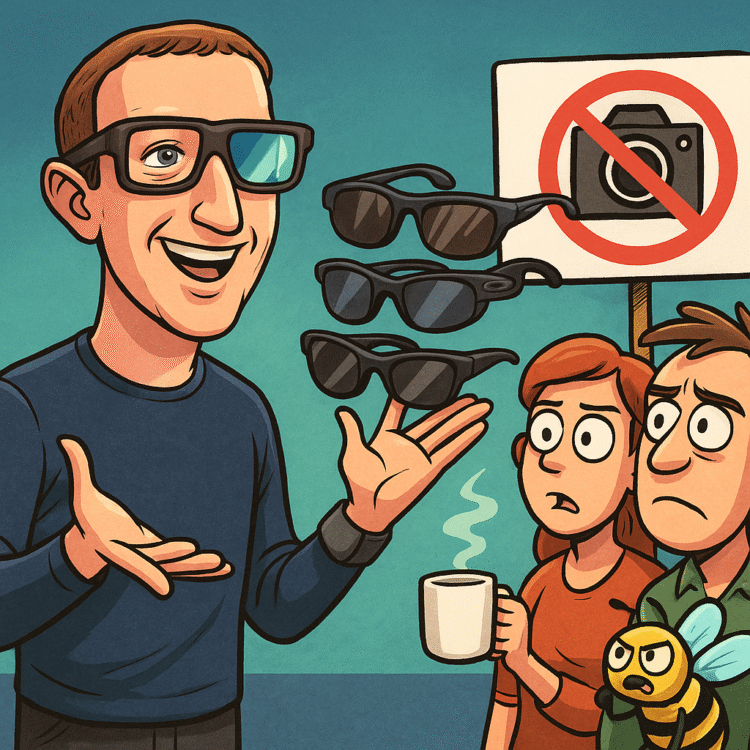
Welcome to the Eye Economy
Mark Zuckerberg took the stage at Meta Connect in Menlo Park and unveiled his latest plan to colonize the human face. Forget the metaverse graveyard; this year the pitch is three new AI glasses, because apparently the only thing keeping us from blissful techno-nirvana was strapping a HUD to our corneas.
The headliner is the Meta Ray-Ban Display—$799 Wayfarer-style shades with a full-color HUD projected in your right lens. They come bundled with something called the Meta Neural Band, a wristband that lets you control the display with tiny finger twitches. A subtle wave of your index finger can now translate into ordering lunch, sending a WhatsApp, or, more likely, accidentally live-streaming your trip to the bathroom. Shipping September 30. Just in time for fall fashion week and Halloween, when you can dress as “Tech Bro #437.”
For the athletes and influencers, there’s the Oakley Meta Vanguard—$499, shipping October 21. Think sport sunglasses with a center action camera, Garmin and Strava integrations, and a nine-hour battery. Perfect for documenting your morning run, your spin class, or your slow descent into dystopia.
And then there’s the Ray-Ban Meta Gen 2 line—longer battery, 3K Ultra HD video, available in multiple frames for people who insist on filming brunch.
Weight hovers around 69 grams—light enough to forget you’re wearing them until you’re asked why you’re recording everyone at Trader Joe’s.
Specs to Make You Feel Spied On
The HUD isn’t always on—it’s “display-on-demand.” You tap the Neural Band, the right lens lights up with maps, captions, or live translations. Great for tourists, terrible for poker games.
Live translation and captions are baked in. Ask your date about their childhood trauma in Spanish, and your glasses will give you the awkward silence in English. Integration with WhatsApp and Instagram means your DMs can literally float in front of your eye. Nothing says romance like eye-contacting someone while simultaneously checking if your ex liked your story.
Preorders are open through Ray-Ban, LensCrafters, Sunglass Hut, and Best Buy—because nothing screams high-tech future like buying AI glasses next to a mall kiosk selling Oakleys.
Who Benefits?
Meta’s partners: EssilorLuxottica (Ray-Ban, Oakley) gets another product to shove into retail pipelines. Fitness tech companies like Garmin and Strava get to ride shotgun. Meta gets to pretend it has moved on from the metaverse fiasco and pivoted to something even creepier: everyday wearable surveillance.
For consumers, the benefit is more abstract. Sure, the Neural Band’s finger-gesture control is futuristic—subtle thumb rubs to switch apps, pinch-to-snap to take a photo. But ask yourself: do you want a future where everyone is twitching their fingers like they’re trying to send Morse code from a POW camp?
Why This, Why Now?
Meta needs a win. Apple has the Vision Pro. Google is quietly re-rebooting AR. Snap Spectacles died like a Vine star. Zuckerberg is betting that if you make wearable AI subtle enough—shrink the cameras, hide the HUD—you can trick people into forgetting they’re living in a Black Mirror episode.
And the price points are strategic: $799 for the high-end Display model, $499 for the Oakley Vanguard, both undercutting Apple’s thousands-dollar Vision Pro but still expensive enough to scream aspirational luxury.
Ship dates are close: September 30 vs. October 21. Staggered enough to dominate two news cycles, close enough to keep competitors sweating.
The Roadmap: Celeste and Orion
As if three models weren’t enough, Meta teased “Celeste”—a smaller-display model designed for everyday wear—and “Orion,” the longer-term moonshot that’s supposed to fuse AR into your very soul. Orion has been Zuckerberg’s white whale for a decade: the perfect AR glasses that look normal, feel light, and replace your phone. Someday. For now, you’re stuck with Ray-Bans whispering WhatsApp notifications into your pupil.
Privacy, But Make It Fashion
Every launch like this raises the same question: is this cool or is this surveillance with extra steps?
Privacy advocates are already screaming. Cameras on faces are one thing at Coachella, another at the DMV. Consent becomes blurry. Did your neighbor agree to be in your HUD’s “test caption”? Did your Tinder date agree to be translated in real time? Does your barista know you just took a photo to mock their latte art on Instagram Stories?
The HUD may be “on demand,” but the cameras are always there. And if we learned anything from smartphones, it’s that “always there” quickly becomes “always used.”
Regulators Circle the Shark
Regulators in the U.S. and EU are sniffing. Cameras on glasses? Neural Bands capturing bio-signals? Instagram integration? It’s like Meta begged the FTC to send a subpoena.
European watchdogs already have concerns about biometric capture. Neural Band data isn’t just clicks; it’s a record of your muscle signals, potentially health data. Selling that to advertisers is just one business-unit brainstorm away.
The U.S. Congress, perpetually confused, will probably hold a hearing where an 80-year-old senator asks if the glasses can “print out the internet.” But the fact remains: these products tiptoe into medical-device territory while pretending to be fashion accessories.
Market Fallout
Apple is watching. Google is sweating. Snap is quietly Googling “how to stay relevant.”
If Meta can make glasses mainstream where everyone else failed, the market could flip. Instead of pulling out phones, people will pull on shades. Instead of tapping screens, they’ll twitch fingers. Instead of asking Siri, they’ll ask their Neural Band to translate a menu.
But Meta’s track record says otherwise. Horizon Worlds was a flop. Quest sales plateaued. The public doesn’t trust Facebook with their birthday; why would they trust it with their literal eyesight?
The Consumer Reality
Imagine walking into a bar. Half the people are wearing AI glasses, nodding while actually reading HUD captions. Someone’s Neural Band misfires and sends a sext to their boss. A jogger live-streams their run but trips on a curb, immortalized in 3K Ultra HD.
This is the promised future: awkward, invasive, and branded as inevitable.
The appeal is obvious if you squint. No more pulling out your phone. No more missing translations. No more fumbling with maps. But the cost is also obvious: cameras on faces, data in clouds, finger twitches logged forever.
The So-What
Why does this matter? Because Meta is betting our faces are the next platform. If phones owned our hands and laptops owned our desks, glasses will own our gaze. Whoever owns the gaze owns the ads, the data, the narrative.
Meta isn’t just selling sunglasses. It’s selling the right to mediate how you see the world. Literally.
The Irony
Meta spent billions on the metaverse—a cartoon world no one wanted. Now it’s pivoting to overlaying the real world with cartoon prompts and captions. We laughed at Zuck’s legless avatars. Now he’s back, insisting he can sell us lenses that caption our reality.
And maybe he can. Maybe convenience trumps dignity. Maybe people will pay $799 to have their friends’ sarcasm mistranslated in real time. Maybe we’ll normalize twitching our fingers in public like involuntary air-guitarists.
The question isn’t whether the tech works. It’s whether we want it to.
Reaction on the Ground
Early testers at Connect oohed and aahed at the HUD, the Neural Band, the integrations. But outside the bubble? Skepticism. People remember Google Glass—$1,500 face-cameras that branded you a “Glasshole.”
Meta swears it learned. The cameras are subtler. The designs are fashionable. The HUD isn’t always glowing. But memory lingers. Trust is scarce. And no Neural Band can twitch it back into existence.
Summary: The Face Is the New Phone
Meta’s AI glasses push a future where our eyeballs replace our iPhones. The Ray-Ban Display ($799, HUD + Neural Band, Sept. 30), Oakley Vanguard ($499, sports camera, Oct. 21), and Gen 2 Ray-Bans (longer battery, 3K Ultra HD) are strategic attempts to mainstream wearable AI. Specs include display-on-demand HUD, live translation, WhatsApp/Instagram integration, 69g weight, and sales through Ray-Ban/LensCrafters/Sunglass Hut/Best Buy. Meta teased “Celeste” and “Orion” as its roadmap, staking out competition with Apple and Google while regulators eye biometric capture and privacy advocates raise alarms. The appeal is frictionless convenience; the cost is constant surveillance. If being against fascism makes you a terrorist in Trump’s America, being against cameras-on-faces makes you a Luddite in Zuckerberg’s. The future, apparently, belongs to whoever owns your gaze.