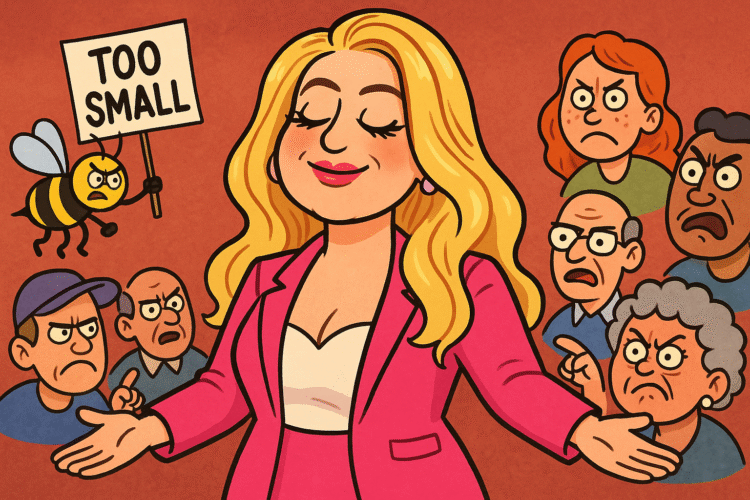
There are few things more American than policing a woman’s body. Apple pie, baseball, and the relentless demand that every female celebrity perform an impossible balancing act for a crowd of spectators who will boo no matter where she lands. In 2025, Meghan Trainor has become the latest sacrificial lamb to the treadmill that isn’t even plugged in.
After her second pregnancy, Trainor did what so many women do: she tried. A dietician, training sessions, and yes, a prescription for the GLP-1 drug Mounjaro—the same drug being heralded as a miracle by some and a moral failing by others. She lost weight, reshaped her image, and posted the celebratory TikTok that has become the digital version of saying, “I’m still alive.”
Cue the outrage.
The comments flooded in with surgical cruelty: “unrecognizable.” “Too small.” “She looks cracked out.” Others pivoted the opposite way: “She finally figured it out.” “About time.” A few managed the double play: “Pretty, but she lost the bass.”
And there it is—the ouroboros of body discourse. If you keep the weight on, you’re lazy. If you lose it, you’re fake. If you talk about it, you’re desperate. If you don’t talk about it, you’re ashamed. The treadmill spins, and the public claps, always hungry for a stumble.
Trainor, to her credit, didn’t take the bait quietly. She posted another TikTok, lip-syncing “pretty as f-k” with the kind of camp confidence that reads less like defense and more like declaration. It was a middle finger disguised as a filter. Glam squad, angles, defiance. The judgmental treadmill may keep humming, but she stepped off and said, “I’m fine over here, thanks.”
The backlash to the clapback was immediate, of course. Critics spun it as arrogance. As if a woman reclaiming the word “pretty” after months of being dissected like a side of beef is arrogance. As if men don’t call themselves legends for microwaving pizza rolls.
This is the hypocrisy of celebrity culture: we demand confessionals, then crucify the confession. When Trainor revealed earlier in the year that her wellness journey included Mounjaro, headlines called it both “refreshingly honest” and “problematic.” As though honesty itself now carries a weight warning label. Use a GLP-1, and you’re cheating. Don’t use one, and you’re not trying hard enough. Either way, you lose.
It’s the familiar calculus of damned if you do, damned if you don’t. But in Trainor’s case, it has a particular sting. Her entire career was built on celebrating body positivity in pop form. “All About That Bass” was a cheeky anthem about curves in an industry obsessed with angles. It was empowerment packaged in bubblegum beats, marketed as the antidote to Photoshop culture. Now, ten years later, critics gleefully label her “gone bass.” As though the body that once made her brand must remain forever static, frozen in amber, to appease their nostalgia.
Imagine applying that logic to any other profession. Imagine telling a carpenter, “You were celebrated for making chairs ten years ago, so you better never build a table.” The absurdity would be obvious. But when it comes to women’s bodies, absurdity is the rule.
The satire is baked in: Meghan Trainor becomes unrecognizable only when she dares to resemble someone else’s standard. The internet pretends it just wants “authenticity,” but authenticity is impossible when the crowd keeps moving the goalposts. Trainor’s authenticity ten years ago was “body positive bass.” Her authenticity now is “Mounjaro-assisted glam.” Both are true, both are hers, and both are mocked.
It isn’t about size. It never was. It’s about control. The public wants ownership of her body’s narrative. They want veto power over her reflection. And because she dared to reroute the storyline, they punish her with ridicule disguised as critique.
It’s worth noting the cruel humor in the phrase “unrecognizable.” As if we are owed recognition. As if celebrities exist only to remain familiar objects, unchanged props in the theater of our own nostalgia. The demand is grotesque: stay exactly as we met you. No wrinkles, no weight gain, no weight loss. Eternal present tense. You can tour, you can parent, you can even reinvent musically—but do not touch the packaging.
When Trainor posted her lip-sync, it wasn’t just defiance. It was survival. It was a reminder that recognition isn’t the same as validation, and that maybe being “unrecognizable” is liberation.
The larger joke here—the one no one laughs at—is how Mounjaro and drugs like it have warped the cultural conversation. What should be a discussion about health, accessibility, and medical ethics has become a purity test. Celebrities who admit to using it are derided as cheats. Celebrities who lie about using it are dragged when exposed. Ordinary people who use it are accused of vanity. Ordinary people who don’t are told they’re lazy. The cycle ensures no one escapes unscathed.
And it’s gendered, of course. Male celebrities drop fifty pounds for a superhero role with trainers, dieticians, and injections? Applause. Female celebrities reveal they did the same? Scandal. A man can call it discipline. A woman must call it confession.
What Trainor illustrates is that body positivity was never the shield it promised to be. The movement told us we could “love ourselves at any size,” but the culture never stopped assigning value to those sizes. The bass was celebrated, yes—but only when it was marketed as quirky empowerment. The moment she shifted the bassline, the applause soured.
And so we are left with the familiar hypocrisy: women’s bodies must be public property, constantly inspected, endlessly critiqued. And if they dare to step off the treadmill, dare to say “pretty as f-k” without asking permission, they will be punished for arrogance.
The satire writes itself. Imagine a world where a woman loses weight and the collective response is: “Congratulations, glad you feel healthy.” Instead, the world produces think pieces about whether she betrayed her brand. Imagine a world where she gains weight and the response is: “Bodies fluctuate, still talented.” Instead, the headlines scream relapse. Imagine a world where her body wasn’t the story at all. But then, what would the culture consume?
Because consumption is the real plotline here. Not her body, but ours. We consume her body like we consume her music, demanding endless remixes, but furious when the beat changes.
Trainor’s choice to answer critics with glamour, with lip-sync, with defiance, is the only sane response in a system designed to make her lose. If you’re going to be damned either way, you might as well be damned on your own terms.
And maybe that’s the deeper point. The treadmill isn’t neutral. It’s judgmental. It’s powered by our clicks, our comments, our insatiable need to police. But it doesn’t actually move forward. No matter how fast she runs—bass on, bass off, GLP-1 in, GLP-1 out—the treadmill stays in place. The only way to win is to step off.
There’s a scene that keeps replaying in this cultural theater: a celebrity posts a picture, commenters accuse them of changing, the celebrity claps back, critics call it arrogance, the media reports on the clapback, and the cycle continues. It’s less like a treadmill now and more like a hamster wheel—circular, exhausting, and absurd.
But maybe the absurdity has its own revelation. If every choice leads to critique, then the critique is meaningless. If every body is wrong, then maybe every body is right.
The haunting truth is that Meghan Trainor’s story is not exceptional. It is the script handed to every woman with a public face. Gain weight, lose weight, disclose it, hide it—it doesn’t matter. The treadmill stays in neutral. The crowd claps for the stumble.
So she said screw it. She lip-synced “pretty as f-k.” She owned the glam, the trainers, the Mounjaro, the whole thing. Not because she owes us an explanation, but because explanations are futile.
The most haunting truth is this: the judgment never ends, but the performance doesn’t have to. The treadmill is still running—but she doesn’t have to get back on.